Choosing a school curriculum involves understanding not only how students learn but also which subjects they study at different stages of their education.
For parents considering American curriculum schools in the UAE, knowing what children learn from Kindergarten to Grade 12 can help them plan their academic journey and identify areas where additional support may be useful.
The American curriculum generally follows a K–12 structure, covering Kindergarten through Grade 12.
Students develop foundational skills in the early years, expand their subject knowledge during middle school and explore more specialised courses in high school.
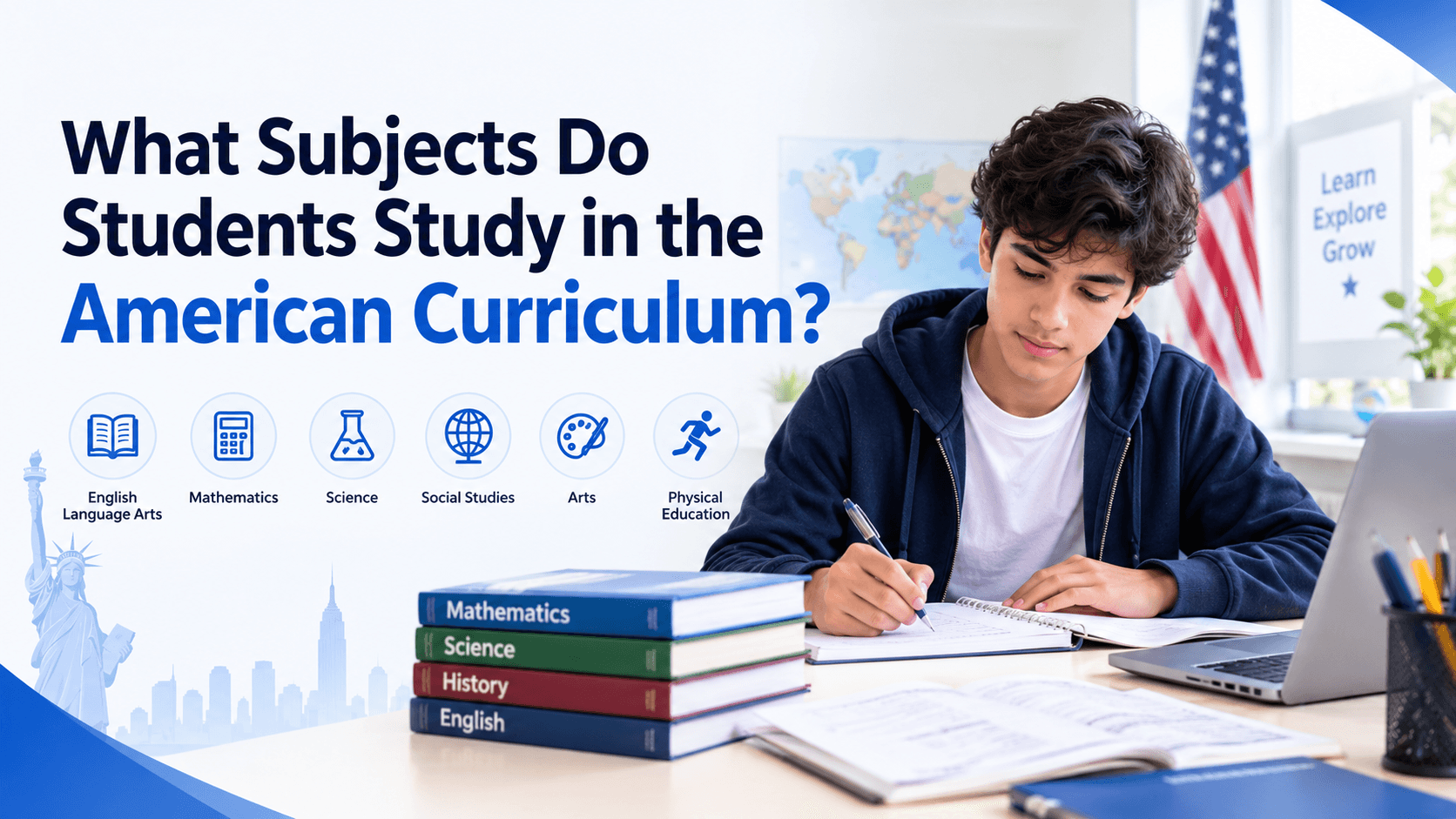
Common subjects include English Language Arts, Mathematics, Science and Social Studies.
Depending on their grade and school, students may also study Arabic, Islamic Education where applicable, additional languages, Art, Music, Physical Education, Technology and other electives.
One important point is that the American curriculum is not a single, identical syllabus used by every school.
In the United States, education standards and curriculum decisions are primarily handled at the state and local levels.
American curriculum schools in the UAE may therefore differ in their standards, subject sequence, learning resources and graduation requirements.
This guide explains the main subjects students typically study, how learning develops across school stages and what parents should consider when supporting their child's academic progress.
For families seeking support, American curriculum tutors in the UAE may be a useful option to explore.
What Is the American Curriculum?
The American curriculum is an educational approach based broadly on the United States' K–12 school structure.
It typically combines core academic subjects with practical learning, classroom activities, projects and opportunities to explore individual interests.
Students generally progress through three broad stages:
Elementary school: Kindergarten and the early primary grades, where students develop foundational academic skills.
Middle school: The intermediate grades, where subject knowledge becomes more detailed and students begin working more independently.
High school: The later grades, where students complete graduation requirements and may select electives or advanced courses based on their interests and future plans.
The exact grade ranges assigned to elementary, middle and high school vary between schools.
Unlike a curriculum with one centralised syllabus for every school, American curriculum programmes can draw on different state standards and educational frameworks.
Schools may also offer Advanced Placement (AP) courses or other advanced learning opportunities in high school.
For parents in Dubai, Abu Dhabi, Sharjah and other parts of the UAE, it is important to review the subject requirements of the specific school their child attends.
What Are the Main Subjects in the American Curriculum?
Although subject offerings vary, several academic areas are common across American curriculum schools.
1. English Language Arts
English Language Arts is one of the main subjects throughout a student's school journey.
It develops reading, writing, speaking, listening, vocabulary and language skills.
Students gradually progress from recognising words and constructing sentences to analysing complex texts and producing structured written arguments.
In elementary school, students may learn to:
Recognise letters, sounds and common words.
Develop reading fluency and comprehension.
Write sentences and short paragraphs.
Understand basic grammar and punctuation.
Communicate ideas through speaking and listening.
In middle school, students may focus on:
Reading longer and more challenging texts.
Identifying themes, arguments and supporting evidence.
Writing organised paragraphs and essays.
Improving vocabulary and sentence structure.
Comparing information from different sources.
In high school, learning may include:
Literary analysis and interpretation.
Persuasive and argumentative writing.
Research and evidence-based essays.
Analysing tone, purpose and rhetorical techniques.
Evaluating complex texts and developing independent arguments.
Strong English skills can support learning in other subjects because students must read instructions, interpret questions and explain their reasoning clearly.
Parents can encourage progress by providing regular reading opportunities and asking children to summarise what they have learned.
Students who struggle with writing may benefit from practising outlines, paragraph structure and proofreading.
2. Mathematics
Mathematics develops numerical understanding, logical reasoning and problem-solving skills.
The topics become more advanced as students move through school. Students typically begin with basic number concepts and progress towards more complex mathematical methods.
Elementary school Mathematics may include:
Counting and place value.
Addition, subtraction, multiplication and division.
Fractions and decimals.
Measurement and time.
Shapes and basic geometry.
Data interpretation and simple graphs.
Middle school Mathematics may introduce:
Ratios and proportions.
Percentages and rational numbers.
Expressions and equations.
Introductory algebra.
Geometry and measurement.
Statistics and probability.
High school Mathematics may include:
Algebra.
Geometry.
Algebra II or equivalent courses.
Functions and advanced mathematical relationships.
Trigonometry.
Statistics and probability.
Precalculus or calculus, depending on the school's offerings.
Not every student follows exactly the same sequence. High school Mathematics choices may depend on previous coursework, readiness, school policy and future academic goals.
For example, a student interested in engineering may need to plan for advanced Mathematics courses. A student pursuing a different pathway may have other course requirements.
The best approach is to understand the school's Mathematics sequence and address learning gaps before they affect more advanced topics.
3. Science
Science helps students understand the natural world through observation, investigation, evidence and reasoning.
Students usually begin with basic concepts about living things, materials, the environment and physical processes. As they progress, the subjects become more specialised.
In elementary school, Science may cover:
Plants and animals.
Human body systems at an introductory level.
Weather and seasons.
Earth and space.
Materials and their properties.
Basic forces, motion and energy.
Observation and simple investigations.
In middle school, students may explore:
Cells and living organisms.
Ecosystems and environmental systems.
Matter and chemical changes.
Forces, motion and energy.
Earth systems and natural processes.
Scientific investigation and data interpretation.
In high school, Science courses may include:
Biology.
Chemistry.
Physics.
Environmental Science.
Anatomy and Physiology.
Other specialised science electives.
Course availability varies between schools.
Successful Science learning involves more than memorising definitions. Students also need to understand processes, interpret diagrams, analyse data and explain how evidence supports a conclusion.
Parents can help by encouraging children to explain scientific concepts in their own words and practise applying them to different questions.
4. Social Studies
Social Studies helps students understand people, communities, history, geography, economics and government.
The content depends on the school's curriculum and the student's grade. Students generally progress from learning about their immediate surroundings to examining societies, historical events and broader global issues.
Elementary school topics may include:
Families and communities.
Maps and basic geography.
Local and national history.
Citizenship and responsibilities.
Cultural awareness.
Basic economic concepts.
Middle school topics may include:
World geography.
Ancient and modern civilisations.
Historical developments.
Government and civic systems.
Economics and trade.
Connections between people, places and resources.
High school courses may include:
World History.
United States History.
Government and Civics.
Economics.
Geography.
Psychology or other social science electives, depending on the school.
Students may be asked to interpret historical sources, compare viewpoints, evaluate evidence and explain how events influence society.
Reading carefully and supporting answers with relevant examples are important skills in Social Studies.
5. World Languages
Many American curriculum schools offer opportunities to learn an additional language.
Available languages vary by school. Students may study languages such as Arabic, French, Spanish or other options offered by the institution.
Language learning generally involves speaking, listening, reading and writing. Students develop vocabulary, grammar and the ability to communicate in different situations.
Some schools introduce additional languages in elementary or middle school, while others offer a wider range of courses in later grades.
In the UAE, families should also confirm which Arabic language requirements apply to their child and school, as these may depend on the relevant local regulations and the student's circumstances.
6. Art and Music
Art and Music provide opportunities for creative expression and practical skill development.
Students may learn drawing, painting, design, musical performance, composition or the analysis of creative work.
In younger grades, these subjects often introduce different materials, techniques and forms of expression.
Older students may have opportunities to select more specialised courses.
Creative subjects can also help students practise observation, planning, experimentation and communication.
The available courses and whether they are compulsory or elective depend on the school and grade level.
7. Physical Education and Health
Physical Education supports physical development, movement skills, fitness and participation in structured activities.
Students may learn about teamwork, coordination, exercise, sports and the importance of maintaining healthy habits.
Health education, where included, may cover age-appropriate topics related to personal wellbeing, safety, nutrition and other health-related concepts.
The structure of these subjects varies between schools, and parents should consult the school's curriculum information for specific requirements.
8. Technology and Computer Science
Technology-related learning helps students develop digital literacy and understand how technology can be used responsibly and effectively.
Depending on the school and grade, students may explore:
Computer basics and digital tools.
Online safety and responsible technology use.
Coding and programming.
Digital design.
Data and information.
Robotics or engineering activities.
Computer Science electives.
In high school, students may be able to select more advanced technology courses, depending on the school's programme.
These subjects can introduce useful problem-solving and technical skills, although the exact content and progression differ across schools.
How Do Subjects Change from Elementary to High School?
The American curriculum generally develops students' knowledge progressively. Students revisit important concepts while learning to apply them in more complex situations.
Elementary School: Building Foundations
During elementary school, the focus is on developing the core skills students need for future learning.
Reading, writing and Mathematics are particularly important because they support progress in other subjects.
Science and Social Studies introduce students to broader ideas, while creative activities, Physical Education and other subjects contribute to a wider educational experience.
At this stage, parents can support learning through reading routines, basic Mathematics practice and conversations about classroom topics.
If a child struggles with reading comprehension or number concepts, addressing these difficulties early can make later learning more manageable.
Middle School: Developing Independence
Middle school introduces greater subject depth and often requires students to manage work across several teachers and classes.
Students may be expected to write longer assignments, interpret more complex information, apply mathematical methods and complete independent or group projects.
Organisation becomes increasingly important because homework, assessments and deadlines may differ across subjects.
Students can benefit from using a planner, reviewing feedback regularly and breaking large assignments into smaller tasks.
High School: Preparing for Graduation and Future Study
High school generally offers more specialised coursework and opportunities to explore individual interests.
Students work towards the school's graduation requirements and may select electives or advanced courses based on academic strengths and future plans.
Depending on the school, options may include AP courses, advanced Mathematics, laboratory Sciences, additional languages, business-related subjects, arts or technology.
Students planning to attend university should research the entry requirements of their intended institutions and courses.
Requirements vary, so subject selection should be discussed with the school's academic counsellor.
What Are Electives in the American Curriculum?
Electives are courses students may choose in addition to, or alongside, their required subjects, depending on school rules.
They allow students to explore interests, develop new skills and potentially prepare for future study.
Examples of electives may include:
Visual Arts.
Music.
Computer Science.
Business.
Psychology.
Additional languages.
Journalism or media studies.
Engineering or design-related courses.
The available options depend on the school, grade level, timetable and academic requirements.
Students should not choose electives only because they appear easy or because their friends have selected them. Instead, they should consider their interests, current workload and longer-term goals.
What Are Advanced Placement (AP) Courses?
Advanced Placement courses are college-level courses offered by participating high schools.
They allow students to study selected subjects in greater depth and may provide an opportunity to take AP examinations.
Schools differ in the AP courses they offer, and students should check the availability and prerequisites for individual subjects.
AP options may include Mathematics, Sciences, English, History, Economics, Computer Science, Art and other subjects.
How Do AP Courses Fit into High School?
AP courses are generally taken during high school by students who are ready for more advanced subject work.
A student might choose AP Calculus if it fits their Mathematics preparation and future interests, or consider an AP Science course if it aligns with their academic plans.
The appropriate choice depends on the student's readiness, school guidance and intended university pathway.
Should Every Student Take AP Courses?
No. AP courses can provide valuable academic challenges, but they are not automatically necessary or suitable for every student.
Students should consider:
Their understanding of the subject's prerequisites.
Their current workload.
Their interests and motivation.
The availability of suitable courses at their school.
The admission policies of their intended universities.
Taking fewer advanced courses and performing consistently may be a more appropriate strategy for some students than taking on an excessive workload.
How Are Students Assessed in the American Curriculum?
Assessment methods vary across American curriculum schools. Students may be assessed through a combination of classwork, homework, quizzes, projects, presentations, practical activities, tests and examinations.
The weighting of these components depends on school policy and the subject.
Classwork and Homework
Classwork and homework allow teachers to check students' understanding of recently taught concepts.
These activities can help identify learning gaps before they affect more advanced topics.
Students should review corrections rather than simply checking whether an answer is right or wrong.
Understanding the reason for a mistake can prevent the same problem from recurring.
Quizzes, Tests and Examinations
Quizzes and tests help measure understanding of particular topics, while larger examinations may cover a wider range of material.
Preparation should include reviewing concepts, practising suitable questions and learning how to manage time during assessments.
Students should also understand the format and expectations of their school's assessments instead of assuming every school follows the same testing system.
Projects and Presentations
Some subjects include projects, presentations, research tasks or practical activities.
These tasks may assess a student's ability to investigate a topic, organise information, collaborate with others or explain ideas clearly.
Students should plan projects in stages, follow the instructions carefully and leave enough time for reviewing their work.
How Can Parents Help Children Succeed in the American Curriculum?
Parents can support academic progress by creating a positive learning environment and helping children develop consistent habits.
1. Understand the School's Subject Requirements
Ask the school for information about the subjects your child studies, the expected learning outcomes and any specific course requirements.
This is particularly useful when a child changes schools or transitions from one grade level to another.
2. Establish a Consistent Study Routine
A regular study schedule helps children balance homework, revision and other activities.
The routine should suit the child's age and workload. Younger students may benefit from shorter study sessions, while older students may need longer periods for assignments and exam preparation.
3. Identify Learning Gaps Early
If a child repeatedly struggles with a topic, identify the underlying difficulty before moving on to more advanced material.
For example, difficulties with fractions may affect later work on percentages, ratios and algebra.
Similarly, weak reading comprehension can make word problems and written examination questions harder to understand.
Targeted practice is often more useful than repeating an entire subject without identifying the specific problem.
4. Encourage Independent Learning
Help children learn how to organise their work, check instructions and review their own mistakes.
Parents can ask questions such as, "How did you reach that answer?" or "Which part of this topic is still unclear?"
These conversations encourage students to reflect on their learning rather than depend entirely on someone else to solve problems for them.
5. Consider Additional Academic Support When Needed
Some students benefit from individual explanations and guided practice outside regular classroom lessons.
Additional support can help reinforce concepts, prepare for assessments and develop more effective study habits.
For families seeking support, American curriculum tutors in the UAE may be a useful option to explore.
Any tutoring plan should be aligned with the student's actual school curriculum, grade level, learning needs and upcoming assessments.
Frequently Asked Questions
What are the main subjects in the American curriculum?
Common subjects include English Language Arts, Mathematics, Science and Social Studies. Depending on the school and grade, students may also study world languages, Art, Music, Physical Education, Technology and other electives.
Do all American curriculum schools teach the same subjects?
No. American curriculum schools may use different standards, educational frameworks and course sequences.
Subject availability, graduation requirements and assessment methods can also differ.
What subjects do American curriculum students study in elementary school?
Elementary students commonly study reading, writing, Mathematics, Science and Social Studies.
They may also take Art, Music, Physical Education, languages and other subjects depending on their school.
What subjects are offered in American curriculum high schools?
High school subjects commonly include English, Mathematics, Science and Social Studies, alongside electives and additional courses. Some schools offer AP courses or other advanced academic options.
Are AP courses compulsory in American curriculum schools?
No. AP courses are optional advanced courses at participating schools.
Students should check which courses are available and whether they fit their academic preparation and future plans.
Is Mathematics taught the same way in every American curriculum school?
Not necessarily. Schools may follow different standards, course sequences and instructional approaches.
Parents should review the school's Mathematics pathway to understand which topics students are expected to study at each grade.
Do American curriculum schools in the UAE teach Arabic?
Arabic offerings and requirements depend on the school and applicable UAE regulations.
Families should confirm the relevant requirements with their child's school.
How can parents support students who struggle with American curriculum subjects?
Parents can review teacher feedback, identify specific learning gaps, establish a regular study routine and encourage practice.
If difficulties persist, targeted academic support may help students strengthen their understanding.
Conclusion
The American curriculum provides a broad educational pathway that typically includes English Language Arts, Mathematics, Science and Social Studies, alongside other subjects and electives.
As students progress from elementary school to middle school and high school, they develop more advanced knowledge, greater independence and opportunities to explore specialised subjects. Some schools also offer AP courses for students seeking additional academic challenges.
However, American curriculum schools do not all follow an identical syllabus. Subject sequences, course options and graduation requirements depend on the school's educational framework and policies.
For parents, the best starting point is to understand the specific curriculum their child's school follows, monitor academic progress and address learning gaps early.
With appropriate resources, consistent study habits and support tailored to individual needs, students can develop stronger subject knowledge and greater confidence throughout their education.
Published by StudyHours Global Editorial Board