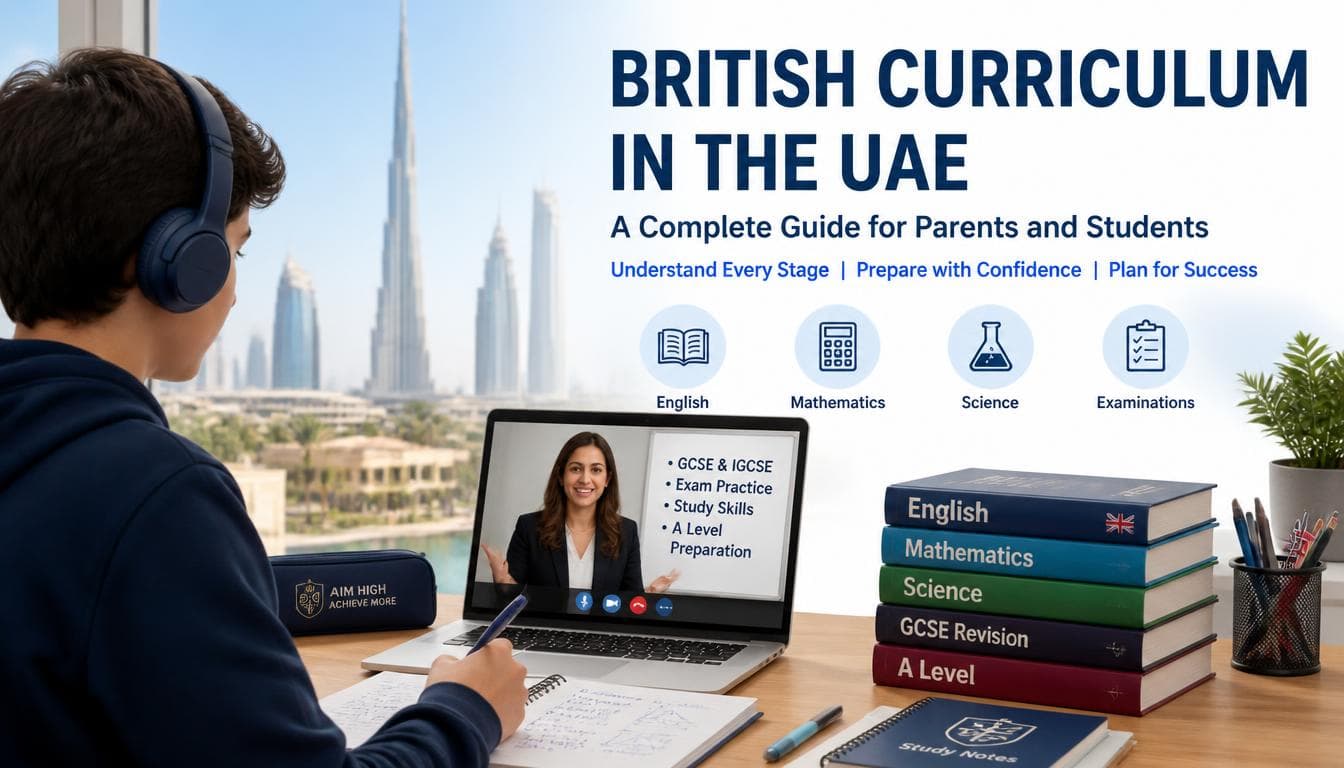
Choosing the right education pathway is an important decision for families living in the United Arab Emirates.
With British-curriculum schools available across Dubai, Abu Dhabi, Sharjah and other emirates, many parents want to understand how this education system works, what students learn at each stage, and how qualifications prepare them for university.
The British curriculum is widely recognised for its structured progression from primary education to secondary qualifications.
However, terms such as Key Stage 2, Key Stage 4, GCSE, IGCSE, AS Level and A Level can be confusing, particularly for families moving to the UAE from another country or transferring between international schools.
This guide explains the British curriculum in straightforward language, with a focus on UAE families.
It covers the learning stages, assessments, subject choices, examination preparation, school transfers and ways parents can help children succeed academically.
What Is the British Curriculum?
The British curriculum is an education framework based largely on the curriculum and qualifications used in England.
It organises learning into stages, with students gradually progressing from foundational knowledge to more advanced subject-specific study.
In the UAE, schools offering a British-style education may follow England's National Curriculum during the earlier years and prepare students for internationally offered qualifications such as GCSEs, IGCSEs and A Levels.
The exact curriculum, examination board and subjects available depend on the individual school.
Students typically develop skills in English, mathematics, science, humanities, languages, computing, creative subjects and physical education.
As they move into secondary school, they generally have more opportunities to specialise.
For parents, the key benefit of understanding the curriculum is being able to recognise what their child should be learning, which qualifications come next, and when additional academic support may be useful.
Families looking for structured learning assistance can explore online British curriculum tutoring in the UAE for support aligned with their child's school level and learning goals.
How Is the British Education System Structured?
The English curriculum is commonly organised into Key Stages. Many British-curriculum schools in the UAE use these stages or similar year-group structures, although school terminology and organisation can vary.
The main stages are:
Early Years Foundation Stage (EYFS): Usually covers nursery and reception-age learning, with an emphasis on communication, early literacy, numeracy, physical development and social skills.
Key Stage 1 (KS1): Years 1–2, when children build foundational reading, writing, mathematics and general knowledge.
Key Stage 2 (KS2): Years 3–6, when students develop stronger subject knowledge, independent learning and more complex problem-solving skills.
Key Stage 3 (KS3): Years 7–9, when students broaden their knowledge across secondary-school subjects.
Key Stage 4 (KS4): Years 10–11, when students commonly prepare for GCSE or IGCSE examinations.
Sixth Form: Years 12–13, when students often study A Levels or other post-16 qualifications.
These year groups are a useful guide rather than a guarantee that every UAE school follows an identical structure.
Parents should check their child's school's curriculum and assessment policies. Understanding the stage your child is in helps you identify the right type of support.
A primary-school pupil may need help building number confidence or reading comprehension, whereas a Year 11 student may need subject-specific revision and examination practice.
What Do Students Learn in Primary School?
Primary education builds the foundations students rely on throughout secondary school.
In the early years, children develop communication, number recognition, reading fluency, writing skills and confidence in the classroom.
As they progress through Years 1–6, learning becomes more detailed. English typically includes comprehension, spelling, grammar, vocabulary and extended writing.
Mathematics moves from basic arithmetic towards fractions, decimals, percentages, measurement, geometry and problem-solving.
Science introduces topics such as living things, materials, forces, electricity and the human body, depending on the year group and school scheme of work.
Geography, history, computing, art and other subjects help children develop broader knowledge and practical skills.
For families in the UAE, consistency is especially important when a child joins a new school or moves from another curriculum.
Even when the subjects have similar names, the order of topics and the expected level of independence may differ.
Parents can help by reading regularly with their children, reviewing school feedback, practising mathematics in everyday situations and asking teachers about specific learning gaps.
Short, consistent practice is often more productive than leaving revision until a major assessment is approaching.
What Happens During Secondary Education?
Secondary education introduces more demanding content and greater independence.
During Years 7–9, students generally study a broad range of subjects before making important qualification and subject decisions for Years 10–11.
At Key Stage 3, students may encounter more advanced algebra, scientific investigations, analytical reading, structured essays, historical interpretation and independent research.
They also learn to manage multiple subjects, deadlines and homework assignments.
The transition into Key Stage 4 is significant because learning becomes more closely connected to the requirements of chosen examination qualifications.
Students need to understand subject specifications, assessment objectives, command words and the types of questions used in examinations.
A student who understands a topic in class may still struggle to apply it independently under timed conditions. Regular practice, feedback and revision help bridge that gap.
Parents should pay attention to recurring difficulties rather than relying only on overall grades.
For example, a student may understand scientific concepts but lose marks when explaining processes, or know mathematical methods but struggle to interpret unfamiliar questions.
Identifying the specific problem early makes it easier to build a practical improvement plan before final examinations approach.
GCSE and IGCSE: What Is the Difference?
GCSE and IGCSE are qualifications commonly taken by students towards the end of secondary education.
GCSE generally refers to qualifications developed for the English education system, while IGCSE qualifications are designed for international settings and are offered by examination boards such as Cambridge International and Pearson Edexcel.
Both can provide a route to further education, but their subject specifications, assessment methods and availability vary.
Some subjects may use written examinations, practical assessments, coursework or a combination of assessment methods, depending on the qualification.
It is important not to assume that every GCSE and IGCSE subject follows the same assessment format. Students should consult the precise specification used by their school.
Preparation should include more than memorising notes. Students need to practise applying knowledge, interpreting questions, structuring answers and managing examination time.
They should also understand how marks are awarded and which parts of an answer need explanation or evidence.
For a student struggling with particular topics, targeted practice can be more effective than repeating an entire textbook.
Reviewing mistakes after each practice paper helps reveal whether the issue involves subject knowledge, exam technique or time management.
Parents can also explore online tutoring for the British curriculum in the UAE when their child needs structured help with school topics, examination preparation or a consistent revision routine.
Understanding AS Levels and A Levels
After completing Year 11, students often continue into Years 12 and 13, commonly known as Sixth Form.
Many choose A Levels, which allow them to study a smaller number of subjects in greater depth.
A Levels are particularly important for students planning university applications because their subject choices and grades may influence which degree programmes they can pursue.
AS Levels are qualifications or stages of study offered within certain subject and qualification structures.
Their role depends on the examination board and course. Parents should not assume that every A Level follows the same AS-to-A2 structure or that AS results automatically contribute to the final A Level grade.
Students may choose subjects such as mathematics, biology, chemistry, physics, economics, psychology, business, English literature or history, depending on the school's provision.
The best combination depends on the student's interests, strengths and future plans.
Someone considering engineering may need mathematics and physics, while medicine-related pathways often require chemistry and may require biology. Exact entry requirements vary by university and country.
Students should research university requirements before finalising their choices.
Changing subjects later may be possible at some schools, but it can create additional work if the new subject has content that was taught earlier in the course.
How Should UAE Students Choose Their Subjects?
Subject selection should balance ability, interest and future opportunities. Choosing a subject simply because friends are taking it, or because it is perceived as easy, may not be the best long-term decision.
Start by identifying possible university courses or career areas. Then check the subject prerequisites published by universities and compare them with the subjects offered by the school.
Students should also consider the type of work each subject involves. Some courses require substantial mathematical reasoning, while others place greater emphasis on extended writing, interpretation, practical work or evaluation.
A useful decision-making process includes:
Listing possible university degrees or career interests.
Checking the required and recommended school subjects for those pathways.
Reviewing personal strengths and recent assessment results.
Speaking with teachers or the school's careers adviser.
Comparing the examination structure and workload of each option.
For families in the UAE, it is also important to consider where the student may apply for university.
Requirements can differ between the UAE, the UK and other international destinations.
No single subject combination is ideal for every student. A balanced decision should keep realistic options open without creating an unnecessarily difficult workload.
How Are British-Curriculum Students Assessed?
Assessment takes different forms throughout a student's education. Younger children may be assessed through classwork, teacher observations, short tests, projects and school-based assessments.
Secondary students may complete topic tests, mock examinations, practical work and formal external examinations.
Assessment helps teachers understand what students know and where they need more practice.
It also helps students become familiar with the demands of their subjects before high-stakes examinations.
Parents should look beyond the final mark. Feedback may reveal problems such as weak comprehension, incomplete working in mathematics, insufficient evidence in written answers or difficulty applying knowledge to unfamiliar scenarios.
An effective response is to turn feedback into specific actions. For example, a student who loses marks in mathematics because of careless algebraic errors may benefit from a checking routine and targeted exercises.
A student who struggles with extended English answers may need practice planning arguments and using textual evidence.
Mock examinations are particularly useful when students review them properly. Completing a paper without analysing mistakes provides limited learning value.
The important step is to identify repeated errors, revisit the relevant content and attempt similar questions again.
Common Academic Challenges for British-Curriculum Students in the UAE
Students may experience difficulties for several reasons, and the cause is not always a lack of effort.
Moving between schools: Different schools may teach topics in a different order or use different resources. A transfer can leave gaps even when the student performs well overall.
Adjusting to a new curriculum: Children moving from another educational system may be familiar with the concepts but less familiar with British terminology, question styles or assessment expectations.
Managing multiple subjects: Homework, projects, tests and revision can become difficult to organise, particularly during examination years.
Understanding rather than memorising: Some questions require students to apply knowledge to unfamiliar examples, explain reasoning or evaluate evidence rather than repeat definitions.
Building confidence: Repeated difficulty with a topic can make students reluctant to ask questions or attempt challenging work.
The most helpful starting point is to identify the exact difficulty. Parents can review teacher feedback, compare performance across topics and ask the student which tasks feel hardest.
A targeted plan should address the underlying issue rather than simply increasing study hours.
Depending on the situation, that may mean revisiting foundational concepts, practising examination questions, improving organisation or seeking additional subject support.
How Online Tutoring Can Support British-Curriculum Learning
Online tutoring can complement classroom teaching by giving students opportunities to revisit challenging concepts, ask questions and practise skills at a pace suited to their needs.
For a primary-school pupil, sessions may focus on reading comprehension, spelling, number skills or problem-solving.
For a secondary-school student, support may involve algebra, chemistry calculations, essay structure, revision planning or examination technique. Older students may need focused guidance with advanced subject content and university-related academic goals.
The most useful sessions are built around clear objectives. Before lessons begin, parents and students can identify the subjects or topics causing difficulty, review recent school feedback and agree on what improvement should look like.
A tutor can then use explanations, worked examples, guided practice and feedback to help the student develop greater independence.
Progress should be reviewed regularly rather than judged by the number of sessions completed.
Families comparing options can visit StudyHours' online British curriculum tutoring page for the UAE to explore academic support suited to their child's stage and learning needs.
Online tutoring does not replace the school's teaching plan or guarantee particular examination results.
It works best when it complements classroom learning, encourages independent practice and addresses identifiable learning gaps.
What Should Parents Look for in an Online Tutor?
The right tutor should understand the student's qualification, subject specification and current learning objectives.
A tutor who is experienced in general mathematics, for example, may not automatically be the best match for every GCSE, IGCSE or A Level specification.
Before choosing a tutor, parents should consider:
Curriculum familiarity: Does the tutor understand the student's year group, examination board and subject requirements?
Diagnostic approach: Will the tutor identify strengths and weaknesses before setting a learning plan?
Clear explanations: Can the tutor explain difficult ideas in more than one way?
Practice and feedback: Will lessons include relevant questions and constructive feedback?
Progress monitoring: Can the student and parent review progress towards agreed goals?
Practical arrangements: Do the schedule, technology and lesson format suit the student's routine?
It is also worth asking how the tutor adapts lessons when a student makes faster progress than expected or continues to struggle with a concept.
The objective should be to help students become more capable and confident learners, not simply to complete homework during every session.
Studying the British Curriculum in Different UAE Emirates
Families across the UAE may encounter British-curriculum schools in Dubai, Abu Dhabi, Sharjah, Ajman, Ras Al Khaimah, Fujairah and Umm Al Quwain.
However, individual schools differ in their year-group structure, examination options, subject availability and internal assessment practices.
For example, a student moving from Dubai to Abu Dhabi should not assume that the new school will offer precisely the same subjects or follow an identical timetable.
Families should confirm placement, course availability and examination arrangements directly with the receiving school.
Online academic support can be convenient for families managing school runs, extracurricular activities and different daily schedules.
Students can work from home without travelling to a separate tutoring centre, provided they have a suitable study space and reliable internet access.
Parents should also check school-specific expectations for homework, examination preparation and communication with teachers.
Keeping notes on upcoming assessments and difficult topics can make extra learning sessions more focused.
The most important factor is not the emirate in which a student lives, but whether the support matches their school's curriculum and their individual academic needs.
British-Curriculum Qualifications and University Entry in the UAE
Students completing a British-style education may use GCSE or IGCSE and A Level qualifications when applying to universities.
However, the exact requirements depend on the institution, programme, qualification combination and intended country of study.
Families planning university entry in the UAE should distinguish between university admission requirements and the UAE's official school-certificate equivalency requirements.
These are related but are not necessarily identical processes.
The UAE Ministry of Education publishes guidance on equivalency of general education certificates.
Its requirements for British-curriculum qualifications include specified GCSE/IGCSE and AS/A Level or A Level combinations in relevant circumstances. The applicable rules and documentation should be checked against the latest official guidance before making decisions.
Parents should keep copies of transcripts, examination certificates and other academic documents, and confirm requirements with the relevant university or authority well before application deadlines.
Students planning to study abroad should separately review each university's subject prerequisites, grade expectations, English-language requirements and application procedures.
Early planning can help students choose suitable subjects and understand what qualifications they will need, rather than discovering missing requirements shortly before an application deadline.
Frequently Asked Questions About the British Curriculum in the UAE
Is the British curriculum the same in every UAE school?
No. Schools may follow different curriculum plans, examination boards and subject options.
The broad structure may be similar, but parents should consult the school's published curriculum and qualification information.
At what age do students usually take GCSE or IGCSE examinations?
Students commonly take these examinations in Years 10 and 11, often around ages 14–16. The precise timing depends on the school, subject and examination arrangement.
Are GCSE and IGCSE qualifications accepted by universities?
They are widely used as secondary qualifications, but university admission normally depends on the full qualification profile, including any required post-16 qualifications, subjects and grades. Students should check each university's entry criteria.
Do students have to take A Levels after IGCSE?
No. A Levels are one possible post-16 pathway. Schools may offer other academic or vocational qualifications.
The most suitable route depends on the student's goals and the courses available.
Can online tutoring help a child who is already doing well at school?
Yes. Tutoring can be used to strengthen subject knowledge, practise more challenging questions, build independent study habits or prepare for upcoming assessments.
The objectives should be appropriate to the student's needs.
How can parents tell whether extra academic support is needed?
Repeated difficulty with the same topics, declining confidence, incomplete understanding of feedback or trouble applying knowledge independently may indicate that additional support could help.
Discuss concerns with the school and identify specific learning goals before deciding on the next step.
Conclusion
Understanding the British curriculum helps UAE parents make better-informed decisions about their child's education, from early literacy and numeracy to GCSEs, IGCSEs, A Levels and university planning.
The most effective approach combines a clear understanding of the school's requirements with consistent study habits, early identification of learning gaps and realistic academic goals.
When students need extra help, targeted practice and well-planned online tutoring can complement classroom learning.
For families seeking structured support across British-curriculum subjects and year groups, explore online British curriculum tutoring in the UAE with StudyHours to find an approach aligned with your child's current needs and future ambitions.
Published by StudyHours Global Editorial Board