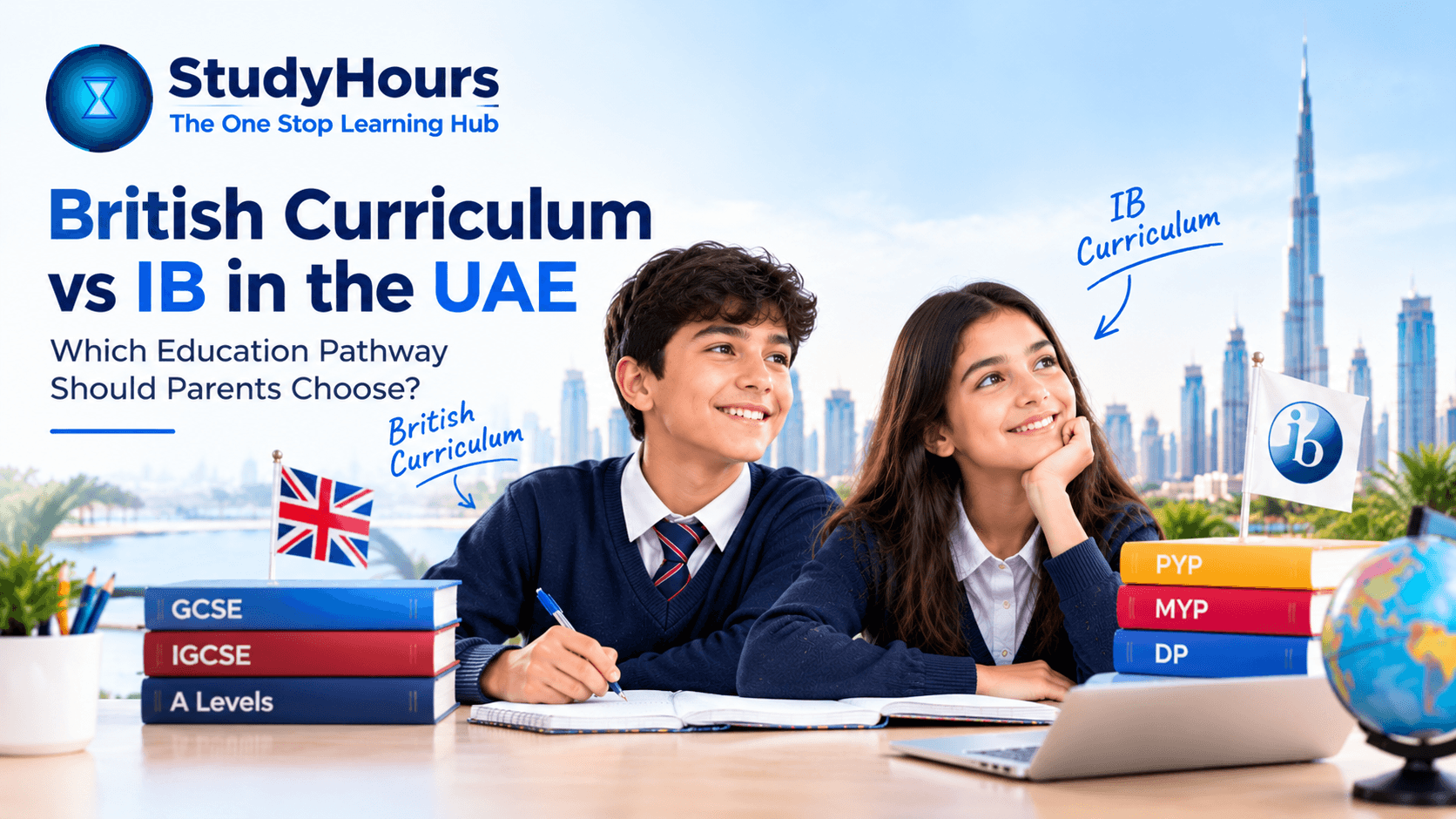
Parents in the United Arab Emirates have several international education pathways to consider when selecting a school for their children.
The British curriculum and the International Baccalaureate (IB) are two options available in private schools across Dubai, Abu Dhabi, Sharjah and other emirates.
Both pathways can prepare students for higher education, but they approach learning, subject selection and assessment differently.
The British curriculum commonly leads towards GCSE or IGCSE qualifications and, for many students, A-Levels.
The IB offers a sequence of programmes, including the Primary Years Programme (PYP), Middle Years Programme (MYP) and Diploma Programme (DP).
For parents, the decision involves more than comparing qualification names. A child's learning preferences, academic strengths, intended university destination and the quality of the individual school all deserve consideration.
This guide explains the differences between the British curriculum and IB education in the UAE, helping families identify the questions they should ask before choosing a school.
What Is the British Curriculum?
The British curriculum is based on educational frameworks associated with the United Kingdom. International schools may adapt aspects of the programme to meet local requirements and the needs of their students.
A common pathway in UAE British-curriculum schools includes:
Early Years education.
Primary education.
Secondary education.
GCSE or IGCSE qualifications.
A-Level qualifications for students continuing along that route.
Students generally study a broad selection of subjects in their earlier years. As they approach GCSE or IGCSE examinations, they choose subjects according to school requirements, interests and future academic plans.
Students who continue to A-Levels usually concentrate on a smaller number of subjects in greater depth.
This can help them develop specialist knowledge relevant to possible university courses.
The exact pathway depends on the school and the qualifications it offers. Some schools provide alternative post-16 programmes, so parents should confirm the available options rather than assuming every British-curriculum school follows an identical route.
What Is the International Baccalaureate?
The International Baccalaureate is an international education framework offering programmes for students across different age groups.
Its main programmes include:
Primary Years Programme (PYP): Focuses on inquiry, conceptual understanding and learning across subjects.
Middle Years Programme (MYP): Encourages students to make connections between academic subjects and real-world situations.
Diploma Programme (DP): A two-year pre-university programme generally intended for students aged 16–19.
Career-related Programme (CP): Combines selected IB courses with career-related learning.
Not every school offers every IB programme. Parents should check which programme the school is authorised to deliver and whether the desired pathway is available throughout the child's school years.
How does the IB Diploma Programme work?
The IB Diploma Programme includes six subject groups and three core components:
Theory of Knowledge (TOK).
Creativity, Activity, Service (CAS).
The Extended Essay (EE).
Students generally study six subjects, with three at Higher Level (HL) and the remaining subjects at Standard Level (SL). Some students take four HL subjects, subject to the programme's requirements.
The core components develop research, reflection, independent thinking and engagement beyond conventional subject lessons.
This structure means students must manage subject learning alongside longer-term projects and other programme requirements.
British Curriculum vs IB: What Are the Main Differences?
Subject specialisation
A common British pathway allows students to specialise through GCSE or IGCSE choices and then focus more closely on selected subjects at A-Level.
The IB Diploma Programme maintains a broader subject combination through its six subject groups. Students study languages, individuals and societies, sciences, Mathematics and other available subject options, alongside the programme core.
Students who want to concentrate on a few academic disciplines may prefer the A-Level structure.
Students who value breadth across multiple subject areas may find the IB Diploma Programme appealing.
However, the right choice also depends on which subjects the school offers and the requirements of the student's intended degree.
Learning approach
British-curriculum teaching varies by school and subject, but qualifications such as GCSEs, IGCSEs and A-Levels commonly involve clearly defined specifications and subject-specific learning objectives.
IB programmes place an explicit emphasis on inquiry, reflection and connections between subjects.
In the Diploma Programme, students also complete independent research through the Extended Essay and explore how knowledge is developed through Theory of Knowledge.
Neither approach removes the need for subject knowledge, consistent practice or effective revision.
Assessment
British qualifications often include externally assessed examinations, although coursework and practical assessments may apply to particular subjects.
IB assessment methods vary by programme and subject. Diploma Programme students may complete written examinations, internal assessments, investigations, presentations and extended research, depending on their courses.
Parents should ask each school how students are assessed and how the assessment structure changes as they move towards graduation.
Academic workload
Both pathways require sustained effort.
A-Level students need to study their chosen subjects in depth and prepare for the relevant assessments. IB Diploma students need to balance six subjects with the core requirements and deadlines for coursework or research.
The workload experienced by an individual student depends on subject choices, school expectations, organisation and academic strengths.
It is therefore more useful to compare the actual course requirements than to label one curriculum as universally easier or harder.
Which Curriculum Is Better for Different Students?
Students with clear subject interests
A student who enjoys Mathematics and Physics and is considering Engineering may appreciate the opportunity to concentrate on relevant subjects through an A-Level pathway.
The same student may also thrive in the IB, particularly if they enjoy a broader education and are comfortable balancing several subjects.
The important step is to check the entry requirements of possible university courses and compare the subject combinations available through each pathway.
Students who enjoy a broad academic programme
Students who like studying languages, Humanities, Sciences and Mathematics together may find the IB Diploma Programme attractive.
Its subject-group structure encourages breadth while allowing some subject specialisation through HL and SL choices.
However, students must be comfortable managing several subjects simultaneously and completing the programme's core requirements.
Students who prefer clearly defined examination goals
Some students find a subject-specific qualification structure helpful because it gives them a defined syllabus and clear assessment objectives.
A British-curriculum pathway may suit these learners, particularly when they are comfortable preparing for external examinations.
Nevertheless, the effectiveness of this approach depends on teaching quality, feedback and the student's ability to maintain regular study habits.
How Do University Opportunities Compare?
Both A-Levels and the IB Diploma are recognised university-entry qualifications, but admission depends on the individual university, degree, subject requirements and grades achieved.
University applications with A-Levels
Universities may assess A-Level students using their predicted or achieved grades, required subjects and other application criteria.
For example, some Engineering courses require Mathematics and Physics, while many Medicine courses require Chemistry and may also require Biology.
Students should check official university course pages before making subject choices.
University applications with the IB Diploma
Universities may assess IB applicants using their total Diploma points, individual subject grades, HL subjects and any additional admission criteria.
Certain degrees require particular subjects at Higher Level or specify minimum grades in relevant courses.
Students should not assume that a particular overall Diploma score guarantees admission. Competitive programmes may have additional requirements.
What about universities in the UAE?
Students planning to study in the UAE should check the admission policies of their intended institutions and any applicable certificate-equivalency requirements.
Those applying internationally should research each destination separately, as subject prerequisites and qualification policies differ.
Choosing a curriculum based only on general claims about university recognition can be misleading.
The better approach is to identify possible degree programmes and compare the exact qualifications they accept.
What Should Parents Check When Comparing UAE Schools?
The curriculum is important, but the individual school has a substantial influence on a child's educational experience.
Before enrolling, consider the following:
Subject availability: Confirm which GCSE, IGCSE, A-Level or IB subjects are offered, including any restrictions on combinations.
Teaching and academic support: Ask how teachers identify learning gaps, provide feedback and support students who need additional help.
School inspection information: Review available inspection reports and information about academic performance, wellbeing and inclusion.
University guidance: Find out how the school supports subject selection, course research and university applications.
Student wellbeing: Consider the balance between academic demands, extracurricular activities, personal interests and family life.
Transfer arrangements: If the family may relocate, ask how the school handles students entering from another educational system.
These details can help parents assess whether the school is suitable for their child, rather than relying on the curriculum name alone.
Can Students Receive Additional Academic Support?
Students following either pathway may need additional support at different stages of their education.
For British-curriculum students, support may focus on understanding subject concepts, strengthening prerequisite knowledge and practising questions aligned with their examination specifications.
Students approaching GCSE, IGCSE or A-Level assessments may benefit from structured revision and feedback on their written answers.
Families can explore online British curriculum tutoring in the UAE to learn about academic support relevant to the British pathway.
IB students may need help understanding difficult subject concepts, planning revision, managing deadlines or developing their approach to assessments. Any additional support should follow the school's academic integrity policies, particularly for assessed coursework and independent research.
Effective support helps students develop understanding and confidence rather than completing assignments on their behalf.
Frequently Asked Questions
Is the British curriculum better than the IB in the UAE?
Neither is automatically better. The British curriculum often offers a route through GCSE or IGCSE qualifications and A-Levels, while the IB Diploma combines six subject groups with three core components. The best option depends on the student and the school.
Is the IB harder than A-Levels?
The two pathways have different structures. A-Levels require deeper study of selected subjects, while the IB Diploma combines breadth, subject specialisation and core requirements.
Students should compare their strengths and the workload involved.
Can IB students attend UK universities?
Yes. UK universities accept IB Diploma applicants, subject to individual course requirements and admission criteria. Required subjects and grades vary.
Can British-curriculum students attend universities in the UAE?
Yes, provided they meet the university's current entry requirements and any applicable equivalency rules.
Can a student move from a British school to an IB school?
A transfer may be possible, but placement depends on the receiving school's admissions policy, available programme, subject options and the student's previous studies.
Do all UAE schools offer both curricula?
No. Schools differ in the programmes they are authorised to deliver. Some offer more than one pathway, while others focus on a single curriculum.
Conclusion
The British curriculum and IB offer different approaches to academic development. The British pathway can provide structured progression towards subject-specific qualifications, while the IB combines breadth, inquiry and independent research within its programmes.
For parents in the UAE, the best decision comes from comparing individual schools, examining subject options and researching university requirements.
Students who choose the British pathway may also need subject-specific academic support as they progress towards external qualifications. Families can learn more through StudyHours' online British curriculum tutoring in the UAE.
Published by StudyHours Global Editorial Board