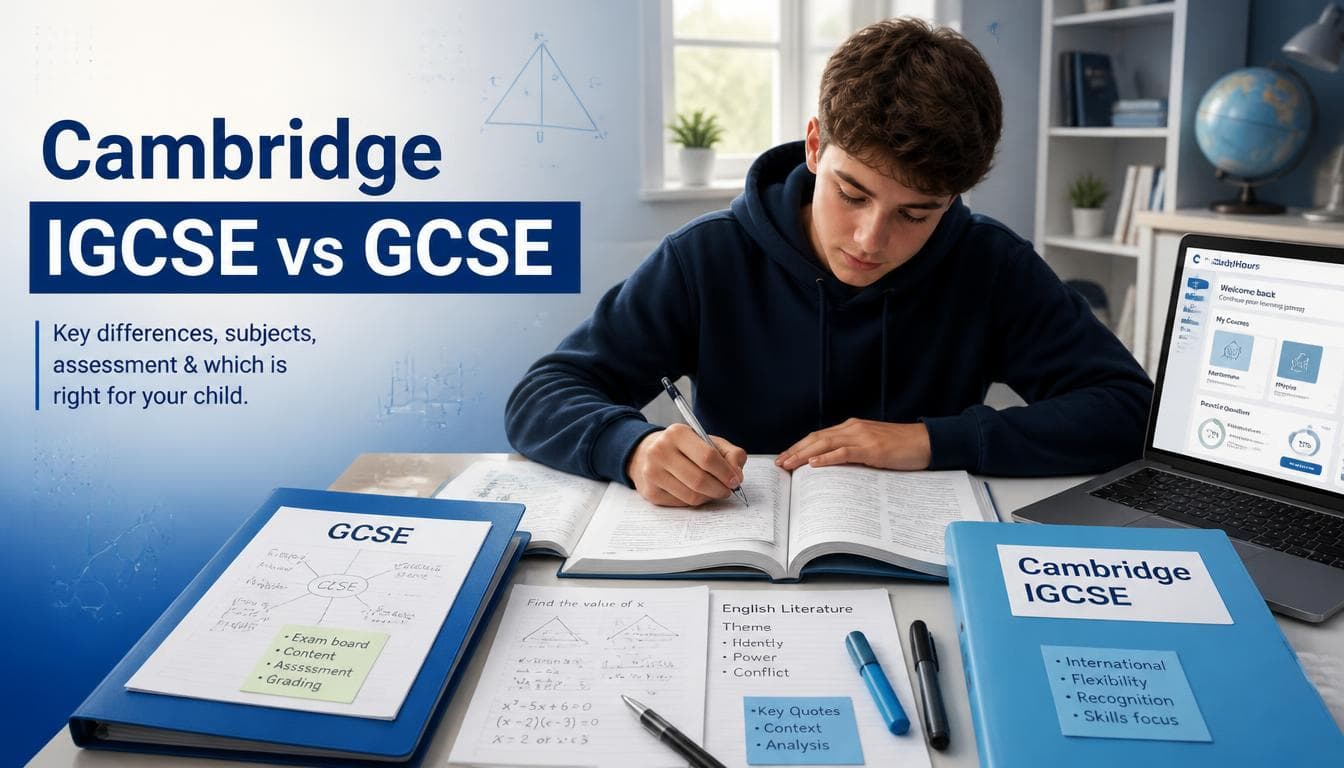
Choosing the right secondary-school qualification can be confusing for students and parents, especially when comparing GCSE and Cambridge IGCSE courses.
Both qualifications are widely used in secondary education, but they can differ in curriculum structure, assessment methods, subject specifications and grading arrangements.
For families in the UK, understanding these differences is useful when choosing a school, selecting subjects or preparing for examinations.
Students may also wonder whether Cambridge IGCSE is harder than GCSE, whether colleges accept both qualifications, and which revision resources they should use.
The answer depends on the exact qualification, subject and educational pathway. Neither qualification is automatically better for every student.
Understanding how each course works can help learners make informed decisions and prepare more effectively.
This guide compares Cambridge IGCSE and GCSE, explains their main differences, and provides practical advice for students and parents in the UK.
What Is GCSE?
GCSE stands for General Certificate of Secondary Education. It is a qualification commonly studied by secondary-school students in England, Wales and Northern Ireland, although educational arrangements and qualifications differ across the UK.
In England, students generally study GCSE subjects during Key Stage 4 and take their examinations in Year 11, usually at around 15 or 16 years old.
GCSE qualifications are offered by different awarding organisations, including AQA, Pearson Edexcel and OCR. Each organisation publishes its own subject specifications and assessment requirements.
Common GCSE subjects include:
Mathematics
English Language
English Literature
Biology, Chemistry and Physics
Combined Science
History and Geography
Computer Science
Modern foreign languages
Business and other optional subjects
The subjects available depend on the school and its curriculum.
Most reformed GCSE qualifications in England use numerical grades from 9 to 1, with grade 9 being the highest.
Assessment arrangements vary by subject, but many qualifications rely mainly on final examinations, while some include coursework or non-exam assessment.
Students preparing for these examinations can explore online GCSE tutoring in the UK to learn about additional subject support and examination preparation.
What Is Cambridge IGCSE?
Cambridge IGCSE stands for Cambridge International General Certificate of Secondary Education.
It is an international qualification developed by Cambridge International Education for learners typically aged 14–16.
Cambridge IGCSE is offered by international schools and other educational institutions around the world, including schools that follow international curricula in the UK.
The qualification provides a broad range of subject options, allowing schools to create programmes suited to their students and educational objectives.
Cambridge IGCSE subjects include Mathematics, English, Biology, Chemistry, Physics, Computer Science, Business Studies, Economics, Geography, History and languages. The exact selection depends on the school.
Assessment methods vary according to the subject and syllabus. Students may be assessed through written examinations, practical examinations, coursework or oral components where applicable.
Cambridge IGCSE commonly uses grades A*–G, although selected syllabuses offer a 9–1 grading option in certain administrative zones. Students should check the grading arrangements for their particular qualification.
Learners who need support with their course can explore Cambridge IGCSE tutors online in the UK for guidance aligned with their specific syllabus.
What Is the Main Difference Between Cambridge IGCSE and GCSE?
The main difference is that GCSE is a broad qualification category offered by several awarding organisations, while Cambridge IGCSE refers specifically to Cambridge International's international qualification.
The two qualifications are comparable in level, but their specifications, assessment structures and grading systems are not necessarily identical.
Feature | GCSE | Cambridge IGCSE |
Full form | General Certificate of Secondary Education | Cambridge International General Certificate of Secondary Education |
Qualification provider | Various awarding organisations | Cambridge International Education |
Typical age group | Usually 14–16 | Typically 14–16 |
Availability | Widely used in UK secondary schools | Offered internationally and by some UK schools |
Subject specifications | Depend on the awarding organisation | Depend on the Cambridge syllabus |
Assessment | Varies by subject and exam board | Varies by subject and syllabus |
Grading | Most reformed GCSEs in England use grades 9–1 | Commonly A*–G, with selected 9–1 options |
Subject availability | Depends on school and exam board | Depends on school and Cambridge subject options |
Further study | Can support progression to post-16 education | Can support progression to post-16 education |
This comparison provides a general overview. Students should check the exact specification because assessment and grading details can differ between individual qualifications.
Is Cambridge IGCSE Harder Than GCSE?
Cambridge IGCSE is not automatically harder than GCSE, and GCSE is not automatically easier than Cambridge IGCSE.
Difficulty depends on the subject, the syllabus, the student's strengths and the way examination questions assess knowledge and understanding.
For example, a student may find one Mathematics specification more challenging because of its topic coverage or question style, while another student may prefer that same specification. The experience can also differ between subjects.
It is therefore misleading to judge an entire qualification using a single claim about difficulty.What Makes One Course Feel More Difficult?
Several factors can affect how challenging a qualification feels:
Subject content: The topics and depth of study vary between specifications.
Question formats: Some students are more comfortable with structured questions, while others prefer questions that require extended explanations.
Assessment methods: Written examinations, practical assessments and coursework can place different demands on learners.
Previous knowledge: Students with gaps in foundational knowledge may find advanced topics more difficult.
Revision habits: Regular practice and familiarity with examination requirements can improve confidence.
Students should compare the specifications for the subjects they are considering instead of relying on general claims about which qualification is harder.
What Is the Difference Between GCSE and Cambridge IGCSE Mathematics?
Mathematics is a useful example because both qualifications develop numerical reasoning, algebraic understanding and problem-solving skills, but their specifications and assessments can differ.
GCSE Mathematics
GCSE Mathematics courses offered by awarding organisations such as AQA and Pearson Edexcel cover areas including number, algebra, ratio, proportion, geometry, statistics and probability.
In England, many GCSE Mathematics courses offer Foundation and Higher tiers. The available grades and examination structures depend on the specific qualification.
Students should check their examination board's specification to understand the exact topics, calculator requirements and paper arrangements.
Cambridge IGCSE Mathematics
Cambridge IGCSE Mathematics also develops mathematical reasoning and problem-solving.
Depending on the syllabus, students may have different assessment routes, such as Core and Extended.
Core and Extended routes are designed to accommodate different levels of ability and target grade ranges. Their availability and grading arrangements depend on the syllabus.
Students should check their syllabus code and the current course document before deciding which resources to use.
Which Mathematics Course Should You Choose?
Where a student can choose between qualifications, the decision should take into account the school's teaching programme, future study plans and the student's learning needs.
Parents should also check whether the school offers the necessary teaching support, subject options and examination preparation.
For students who find mathematical concepts difficult, targeted practice and regular feedback can be more useful than focusing solely on the name of the qualification.
How Do GCSE and Cambridge IGCSE English Qualifications Differ?
English qualifications can vary considerably depending on the subject and specification.
GCSE English Language generally focuses on reading, comprehension, analysis and writing.
GCSE English Literature involves studying literary texts and developing analytical responses.
Cambridge IGCSE offers several English qualifications, including English First Language, English as a Second Language and Literature in English.
The available options and assessment components depend on the syllabus.
Students should confirm the exact qualification they are taking before purchasing revision guides or preparing set-text notes.
What Should Students Focus on in English?
Effective English preparation usually involves:
Reading texts carefully and identifying key ideas.
Developing vocabulary and accurate written expression.
Supporting interpretations with appropriate evidence.
Understanding the assessment objectives.
Practising extended answers under timed conditions.
Reviewing feedback and correcting recurring mistakes.
For Literature, students should also confirm which texts and poetry selections are required by their course.
Are GCSE and Cambridge IGCSE Science Qualifications the Same?
Both qualification routes offer science subjects, but their content, assessment structure and practical requirements can differ.
GCSE science courses in England may include separate Biology, Chemistry and Physics qualifications or Combined Science.
Cambridge IGCSE also offers science subjects, with assessment arrangements determined by the relevant syllabus.
Students should check whether their course includes practical examinations, alternative-to-practical papers or other assessment components.
How Should Students Prepare for Science?
Science preparation should combine factual knowledge with the ability to apply concepts.
Students should practise:
Learning scientific terminology and definitions.
Completing calculations and using equations.
Interpreting graphs, tables and experimental results.
Explaining practical methods and identifying variables.
Applying scientific ideas to unfamiliar situations.
Answering structured questions using the correct level of detail.
The exact requirements depend on the subject and specification. Using the appropriate past papers and mark schemes helps students prepare for their own examination format.
Do GCSE and Cambridge IGCSE Use the Same Grading System?
No, not always. Most reformed GCSE qualifications in England use numerical grades from 9 to 1.
Cambridge IGCSE commonly uses the A*–G grading scale, although selected Cambridge syllabuses offer 9–1 grading in certain administrative zones.
Students should check the grading system for their exact qualification rather than assuming that all GCSE and IGCSE results use the same scale.
Can GCSE Grades Be Compared with Cambridge IGCSE Grades?
The qualifications are comparable in level, but there is no single conversion that should automatically be applied to every subject and situation.
Schools, colleges and other institutions may have their own admissions policies.
Students planning to progress to sixth form or further study should check the grades required for their chosen courses.
For example, a course may require a particular Mathematics or English grade, regardless of which awarding organisation provided the qualification. The institution can explain how it treats the specific result.
Are Cambridge IGCSE Qualifications Accepted by UK Colleges and Universities?
Cambridge IGCSE qualifications are used internationally and can support progression to further education. However, acceptance and grade requirements depend on the institution, course and student's wider qualifications.
Many students take Cambridge IGCSE before progressing to Cambridge International AS and A Levels or other post-16 programmes.
Students planning to apply to a sixth form, college or university should check the institution's entry requirements directly.
They should confirm the required subjects, grades and any additional qualifications.
It is particularly important to check requirements for subjects that build directly on earlier study, such as Mathematics and the Sciences.
Can You Use GCSE Revision Resources for Cambridge IGCSE?
Some GCSE resources can help Cambridge IGCSE students practise general skills, particularly when the topics overlap.
However, they should not replace resources that match the student's actual syllabus.
Different specifications may cover topics at different depths, use different question formats or require different practical skills.
For example, a GCSE Mathematics textbook may help a Cambridge IGCSE student practise algebra, but it may not cover every topic or assessment requirement in their course.
How to Choose the Right Revision Resources
Follow these steps:
Identify the exact examination board and syllabus code.
Download or review the current official specification.
Check that textbooks and revision guides match the course.
Use past papers and mark schemes for the correct qualification.
Practise unfamiliar questions and review mistakes.
Use additional resources only when they support relevant content.
This approach helps students focus their time on material that is directly useful for their examinations.
How Can Students Prepare for GCSE or Cambridge IGCSE Exams?
Although the qualifications differ, several revision principles apply to both.
1. Understand the Specification
Students should identify all the topics and assessment components they need to study.
A clear topic checklist makes it easier to plan revision and monitor progress.
2. Create a Realistic Study Timetable
Divide each subject into manageable sections. Give additional time to difficult topics while regularly reviewing previously learned material.
The best timetable is one that students can follow consistently, with time for breaks, practice questions and correction of mistakes.
3. Practise Past Papers
Past papers help students understand question formats, command words and time requirements.
After completing a paper, mark it carefully and identify the topics responsible for lost marks. Then review those topics before attempting similar questions.
4. Learn from Mark Schemes
Mark schemes explain how marks are awarded and can help students improve the accuracy and relevance of their answers.
Students should focus on understanding why an answer earns marks rather than simply memorising model responses.
5. Ask for Support When Needed
If a student repeatedly struggles with a topic, they should seek help from their teacher or a suitable subject specialist.
Students following Cambridge IGCSE courses can explore Cambridge IGCSE tutoring in the UK for support with subject knowledge, syllabus-specific practice and revision planning.
Those studying other GCSE specifications can also review online GCSE tutoring in the UK to explore broader subject support.
Should You Choose GCSE or Cambridge IGCSE?
The right qualification depends on the school, the available subjects, the curriculum and the student's future plans.
In many cases, students do not independently select the examination board because the school has already chosen the qualification it teaches.
If you are comparing schools or discussing course options, consider:
Which qualification and subjects are offered.
Whether the curriculum supports the student's future plans.
How the school teaches and assesses each subject.
Which learning resources and academic support are available.
The entry requirements for intended post-16 courses.
Neither qualification is universally better. A student's progress depends on effective teaching, consistent revision, suitable learning resources and familiarity with the course requirements.
Frequently Asked Questions About Cambridge IGCSE vs GCSE
Is Cambridge IGCSE equivalent to GCSE?
Cambridge IGCSE is comparable in level to GCSE qualifications, but the courses are not identical.
Their subject specifications, assessment methods and grading arrangements can differ.
Is Cambridge IGCSE recognised in the UK?
Cambridge IGCSE is an established international qualification used by schools in the UK and worldwide.
Students should confirm the entry requirements of their intended college, sixth form or university.
Is Cambridge IGCSE harder than GCSE?
Neither qualification is automatically harder. Difficulty depends on the subject, syllabus, assessment structure and student's preparation.
Do GCSE and Cambridge IGCSE have the same subjects?
There is considerable overlap in subjects such as Mathematics, English and the Sciences, but the available options and exact course content vary by awarding organisation and school.
Can I use GCSE past papers for Cambridge IGCSE?
They can provide additional practice where topics overlap, but students should prioritise papers and mark schemes that match their own Cambridge IGCSE syllabus.
Which qualification is better for A-levels?
Both qualifications can provide a foundation for further study. Students should check the subject and grade requirements for their chosen A-level courses and the institution they plan to attend.
How can I find a Cambridge IGCSE tutor?
Look for a tutor with relevant subject expertise and familiarity with the student's exact Cambridge IGCSE syllabus. Students can explore Cambridge IGCSE tutors online in the UK for syllabus-focused academic support.
Final Thoughts
GCSE and Cambridge IGCSE are comparable secondary-school qualifications, but they differ in their awarding organisations, specifications, assessment arrangements and grading systems.
Understanding these distinctions helps students choose the right revision resources and prepare effectively for examinations.
Rather than focusing only on which qualification is harder, students should identify their syllabus, understand the assessment requirements and practise using appropriate examination materials.
With a realistic revision timetable, regular practice and suitable academic guidance, learners can strengthen their understanding and prepare for their next stage of education.
Students following Cambridge IGCSE courses can explore Cambridge IGCSE tutors in the UK for additional support tailored to their subjects and learning goals.
Published by StudyHours Global Editorial Board