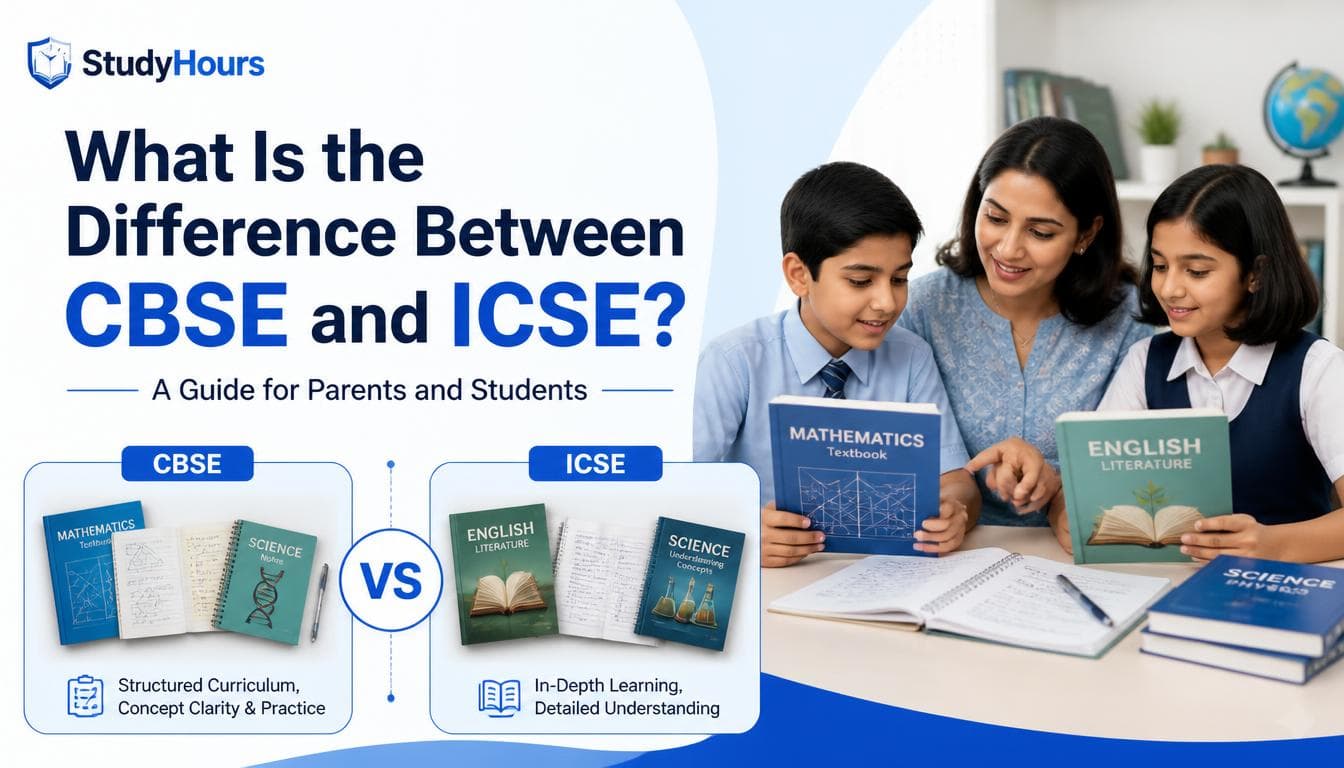
Choosing the right school curriculum is an important decision for parents and students.
In India and among Indian families living abroad, two commonly discussed options are CBSE and ICSE.
Both provide structured school education, but they differ in their educational frameworks, subject organisation, assessment approaches, and the way schools implement their curricula.
Understanding these differences can help families make informed decisions about schooling, academic expectations, and future educational plans.
CBSE stands for the Central Board of Secondary Education, while ICSE refers to the Indian Certificate of Secondary Education examination conducted by the Council for the Indian School Certificate Examinations (CISCE).
Although these terms are often used to describe the respective school systems, they refer to different boards and examination frameworks.
Neither curriculum is automatically better for every student. The right choice depends on the child's learning preferences, the quality of the school, available subjects, family circumstances, and future academic goals.
This guide explains the differences between CBSE and ICSE, their similarities, their potential advantages, and the factors parents should consider before choosing a school.
For families whose children follow CBSE, online CBSE tutoring in the UAE is one option to explore when additional subject guidance is needed. Students following other curricula should seek support aligned with their own syllabus and learning requirements.
What Is CBSE?
The Central Board of Secondary Education is an Indian national school education board that affiliates schools, establishes academic requirements, and conducts specified examinations.
CBSE-affiliated schools follow the board's prescribed curriculum and examination framework.
Students study a range of subjects, including languages, mathematics, science, and social science, with subject requirements depending on their grade.
The curriculum generally emphasises structured subject learning and the development of conceptual understanding.
Students in the secondary and senior secondary stages prepare for the relevant board examinations under the current CBSE requirements.
CBSE-affiliated schools operate across India and in other countries, including the UAE.
For families who may relocate between CBSE-affiliated schools, a shared curriculum framework can support educational continuity, although school calendars, teaching approaches, and individual student experiences may differ.
What Is ICSE?
ICSE stands for the Indian Certificate of Secondary Education. It is the examination associated with Class 10 under the Council for the Indian School Certificate Examinations, or CISCE.
Schools affiliated with CISCE follow its prescribed curriculum and assessment requirements.
The curriculum covers a range of academic subjects, including languages, mathematics, science, and humanities-related areas.
ICSE education is often associated with detailed subject coverage, English-language development, and a varied approach to academic assessment.
However, the experience students receive depends on the school's implementation, teaching quality, and available resources.
CISCE also conducts the Indian School Certificate (ISC) examination at the senior secondary level.
It is important to distinguish between the ICSE examination at the Class 10 level and the broader CISCE school framework, which includes other stages of education.
What Is the Main Difference Between CBSE and ICSE?
The main differences involve the boards responsible for the curriculum, subject organisation, assessment arrangements, and the educational experience provided by individual schools.
CBSE uses its own prescribed curriculum and examination framework. ICSE schools follow the CISCE curriculum and the requirements associated with the relevant examination.
Parents sometimes assume that one curriculum is always easier or more difficult than the other.
In practice, difficulty depends on the student's strengths, the subjects selected, the school's teaching approach, and how well the student understands the material.
A useful comparison should therefore consider several factors rather than relying on a single generalisation.
CBSE vs ICSE: Key Differences
1. Governing Board
CBSE and CISCE are separate educational bodies with their own school affiliation requirements, syllabuses, and examination arrangements.
CBSE conducts its Class 10 and Class 12 board examinations for eligible students.
Under the CISCE framework, ICSE refers to the Class 10 examination, while ISC is the senior secondary examination.
Parents should check the official requirements of the relevant board when comparing schools or planning a transfer.
2. Curriculum Structure
Both systems provide structured academic programmes, but their syllabuses and subject requirements are not identical.
CBSE schools follow the curriculum prescribed by CBSE for the relevant academic year.
CISCE-affiliated schools follow the curriculum and subject requirements set by CISCE.
The best way to compare the two is to review the current syllabus for the student's grade and the subjects offered by the specific schools under consideration.
3. English-Language Learning
English is an important subject in both systems, but the syllabus, assessment methods, and learning experience can differ.
ICSE is often associated with detailed English-language study, including literature and written expression.
CBSE also includes English-language learning and assesses skills appropriate to the relevant class.
Parents should look beyond general descriptions and review the actual language curriculum, reading expectations, writing tasks, and teaching methods used by each school.
4. Mathematics and Science
Both CBSE and ICSE include mathematics and science in their academic programmes.
The topics, sequence of learning, practical requirements, and assessment patterns can vary by grade and subject.
Students should compare the current syllabuses rather than assume that one board is universally more advanced.
For students who enjoy problem-solving, the quality of teaching and opportunities for practice may be just as important as the curriculum itself.
5. Humanities and Other Subjects
Both systems cover areas beyond mathematics and science, including languages and humanities-related subjects.
The available subject combinations and detailed requirements depend on the board, grade, and school.
Some schools may offer additional subjects or activities that help students explore different interests.
Parents should examine the specific options available rather than comparing only the names of the two boards.
6. Assessment and Examinations
Both boards use formal assessments, but the examination structure and subject-specific requirements differ.
Students may be assessed through written examinations and other forms of assessment, depending on the applicable rules and school arrangements.
The assessment pattern can change over time. Parents and students should refer to the latest official syllabus, examination regulations, and sample papers rather than relying on outdated descriptions.
7. Learning Resources
Students following either curriculum can use textbooks, teacher-provided materials, practice questions, and other authorised resources.
CBSE students commonly use NCERT textbooks where prescribed or recommended for their subjects and classes. ICSE students use resources aligned with the CISCE syllabus and their school's requirements.
The appropriate materials depend on the subject and academic year. Students should ensure that their practice questions match the syllabus they are studying.
Is CBSE Easier Than ICSE?
There is no universal answer. A student's experience depends on their academic strengths, study habits, the subjects they find challenging, and the way their school teaches the curriculum.
Some students may find the structure of one syllabus easier to manage, while others may prefer the learning and assessment approach of the other.
Instead of deciding based on claims that one board is easier, parents should consider:
The student's strengths in mathematics, languages, science, and other subjects.
The amount and type of written work expected.
The teaching methods used by the school.
The student's ability to study independently.
The support available when a topic becomes difficult.
The student's future academic plans.
A curriculum that suits one child may not be the best fit for another.
Which Curriculum Is Better for English?
Both CBSE and ICSE include English in their academic programmes. However, students' experiences depend on the syllabus, the school's approach to language teaching, and the level of practice provided.
Families who place particular importance on English reading, literature, grammar, and writing should review the detailed English syllabus and examples of assessment tasks for each board.
The school's teaching quality is also important. Regular reading, constructive feedback, and opportunities to develop written and spoken communication can support progress under either curriculum.
Which Curriculum Is Better for Mathematics and Science?
Both systems provide mathematics and science education, but the content and assessment requirements differ across grades.
Parents should compare the current syllabus, classroom approach, practical learning opportunities, and examination format for the relevant subjects.
Students who need additional support may benefit from a clear explanation of difficult concepts, regular problem-solving practice, and timely feedback.
These learning strategies can help students regardless of which board they follow.
The goal should be to find a curriculum and school environment that help the student develop sound subject knowledge and confidence.
Which Curriculum Is Better for Competitive Examinations?
Students planning to take competitive examinations should investigate the requirements of each examination and the subjects they will need to study.
CBSE students may find that some of their school resources align with topics covered in particular Indian entrance examinations.
However, competitive examinations have their own syllabuses and requirements, and students should not assume that following one board automatically prepares them for every test.
Students from either system may need additional study materials, practice examinations, or structured preparation depending on their goals.
The decision should be based on the student's intended examination pathway, school options, and preparation needs.
CBSE vs ICSE for Students Planning to Study Abroad
Both CBSE and CISCE qualifications may be considered by universities outside India.
However, recognition and admission requirements vary by institution, country, and course.
Students planning to study abroad should review the entry requirements of their intended universities, including accepted school qualifications, subject prerequisites, grade expectations, and English-language requirements where applicable.
A curriculum should not be selected solely on the assumption that it guarantees admission to a particular country or university.
Academic performance, subject choices, application requirements, and the student's overall profile can all influence admission decisions.
CBSE vs ICSE for Families Living in the UAE
Families in the UAE may encounter both CBSE and CISCE-affiliated school options, depending on their location and the schools available.
When comparing schools, parents should consider the curriculum alongside practical factors such as school fees, travel time, class size, facilities, teaching quality, extracurricular activities, and the support provided to students.
Families who may return to India or relocate to another country should also consider how the curriculum fits their likely plans.
What Should UAE Parents Check Before Choosing?
School availability: Confirm which boards are offered by schools in the family's preferred area.
Subject options: Review the subjects available at the relevant grade and whether they match the child's interests and future plans.
Teaching approach: Ask how teachers support students who struggle with difficult concepts or need additional academic challenge.
Assessment methods: Understand how the school monitors progress and prepares students for board examinations.
Future transitions: Consider whether the curriculum aligns with possible school transfers or university applications.
Student wellbeing: Look at workload, support services, extracurricular opportunities, and the child's overall experience.
The strongest choice is one that fits the student's educational needs and the family's circumstances.
Can Students Switch From CBSE to ICSE or From ICSE to CBSE?
A change between school systems may be possible, but it requires careful planning.
Students transferring between boards may encounter differences in syllabus coverage, subject sequence, textbooks, terminology, and assessment methods.
The extent of these differences depends on the student's current class and the subjects involved.
Before making a transfer, parents should speak with both schools about admission eligibility, required documents, subject equivalencies, and any additional academic support the student may need.
How Can Students Manage a Curriculum Change?
Students can make the transition more manageable by taking the following steps:
Review the new syllabus. Identify topics that are different from the previous curriculum.
Compare subject coverage. Find out which concepts have already been covered and which need to be learned.
Ask for school guidance. Teachers and administrators can explain transfer requirements and academic expectations.
Create a catch-up plan. Allocate time to unfamiliar topics without neglecting current schoolwork.
Monitor progress. Review assignments and assessments to identify areas requiring further attention.
Early preparation can help students adapt more confidently to a new academic framework.
How Can Parents Help Children Succeed in Either Curriculum?
Parents can support learning without needing to become experts in every subject.
A consistent routine, an appropriate study environment, and regular communication with teachers can make a meaningful difference.
Encourage Regular Revision
Students should revisit important topics throughout the school year rather than rely entirely on last-minute study.
Short, consistent revision sessions can help reinforce concepts and reveal misunderstandings before examinations.
Focus on Understanding
Encourage children to explain concepts in their own words, demonstrate how they solved a problem, and ask questions when something is unclear.
This approach helps parents identify whether the child understands the material or is relying mainly on memorisation.
Support Independent Learning
As students progress through school, they need to take greater responsibility for organising their work and preparing for assessments.
Parents can help students create realistic study plans, set priorities, and reflect on their progress.
Seek Help When Difficulties Persist
If a student repeatedly struggles with a subject, additional guidance may help identify the underlying problem.
Families can speak with teachers or consider appropriate academic support to reinforce concepts and build effective study habits.
For families whose children follow CBSE, online CBSE tutoring in the UAE is one option to explore when additional subject guidance is needed. Students following other curricula should seek support aligned with their own syllabus and learning requirements.
Frequently Asked Questions About CBSE and ICSE
1. What Is the Full Form of CBSE?
CBSE stands for Central Board of Secondary Education. It is an Indian school education board that affiliates schools and conducts specified examinations.
2. What Does ICSE Stand For?
ICSE stands for Indian Certificate of Secondary Education. It is the Class 10 examination associated with the Council for the Indian School Certificate Examinations.
3. Is CBSE the Same as ICSE?
No. CBSE and CISCE are separate educational boards with different curriculum and examination frameworks.
ICSE is the Class 10 examination under CISCE, while CBSE conducts its own Class 10 and Class 12 examinations.
4. Which Is Better: CBSE or ICSE?
Neither is universally better. The right choice depends on the student's learning preferences, the school's quality, available subjects, academic goals, and family circumstances.
5. Is ICSE More Difficult Than CBSE?
Difficulty varies by student, subject, and school. Parents should compare the current syllabuses and assessment requirements rather than assume that one curriculum is always more difficult.
6. Can CBSE and ICSE Students Apply to Universities Abroad?
Students from both systems may be eligible to apply to universities abroad, subject to each institution's entry requirements.
Applicants should verify qualification recognition, subject prerequisites, grades, and any additional requirements directly with their intended universities.
7. Can a Student Change From ICSE to CBSE?
A transfer may be possible, depending on the receiving school's admission policies, the student's class, and applicable board requirements.
Parents should contact the schools involved and check the current rules before making arrangements.
8. Do CBSE and ICSE Use the Same Textbooks?
Not necessarily. CBSE students commonly use NCERT textbooks where prescribed or recommended, while ICSE students use materials aligned with the CISCE syllabus and their school's requirements.
Students should follow the resources specified for their particular subjects and academic year.
Conclusion
CBSE and ICSE provide structured school education, but they differ in their governing boards, curriculum frameworks, subject requirements, and examination arrangements.
Choosing between them requires more than deciding which board is supposedly easier or more prestigious.
Parents should examine the actual school options, the student's strengths and interests, the subjects available, and the family's future educational plans.
For families in the UAE, practical considerations such as school availability, teaching quality, learning support, and possible international transitions are also important.
Once the curriculum and school environment are a good fit, students can benefit from regular revision, clear learning goals, and timely support when they encounter difficulties.
These habits can help them develop confidence and make steady academic progress under either system.
Published by StudyHours Global Editorial Board