Singapore's secondary school system has undergone one of its most significant changes in recent years.
Full Subject-Based Banding (Full SBB) has replaced the traditional stream-based approach, giving students greater flexibility in the subjects and academic levels they take.
The reform is particularly important for families navigating Singapore's changing education pathways. Students and parents who are familiar with the former O-Level pathway in Singapore, for example, now need to understand how secondary education is moving towards a subject-based system and the new Singapore-Cambridge Secondary Education Certificate (SEC).
Full SBB was announced in 2019, piloted in 2020, progressively implemented across schools, and fully implemented for the 2024 Secondary 1 cohort.
By 2026, Full SBB is no longer an upcoming reform. It is the current secondary school structure for students who entered Secondary 1 under the new system.
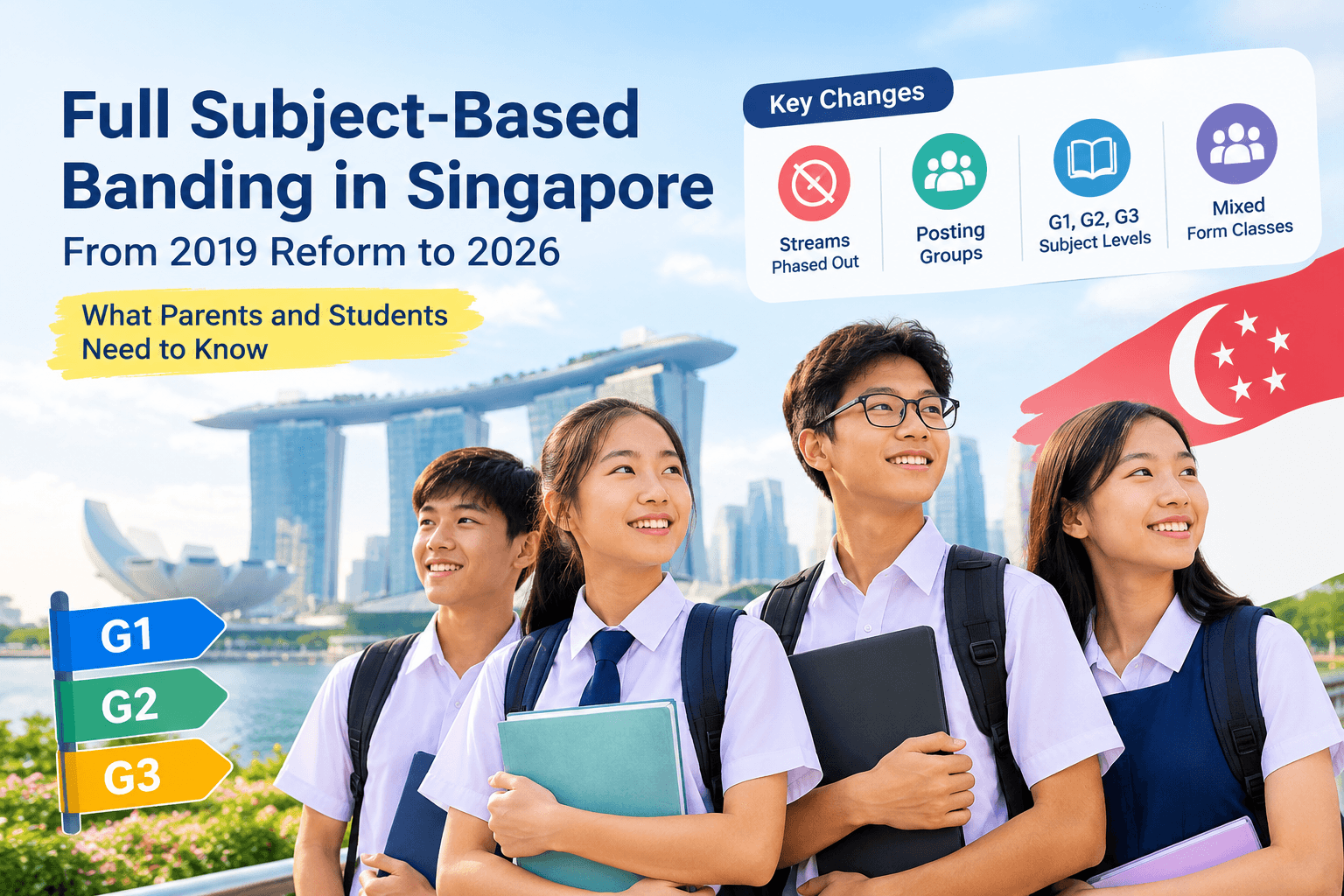
Instead of placing students into the traditional Express, Normal (Academic) or Normal (Technical) streams, students are posted through Posting Groups 1, 2 or 3 and can take individual subjects at G1, G2 or G3 levels.
The next major milestone will come in 2027, when the Singapore-Cambridge Secondary Education Certificate (SEC) replaces the separate N(T)-Level, N(A)-Level and O-Level examinations.
So, what exactly changed under Full SBB, why was the reform introduced, and what does the system mean for students and parents in 2026?
What Is Full Subject-Based Banding?
Full Subject-Based Banding is Singapore's approach to making secondary education more flexible and responsive to individual students' learning needs.
Under the previous system, students were placed into a broad academic stream after primary school. Their stream generally determined the academic level at which they studied most of their subjects.
Full SBB moves away from this model.
Instead of assigning a student to one overall stream, schools can offer subjects at different levels according to the student's strengths, learning needs and readiness.
The three subject levels are:
G1 – broadly aligned with the former Normal (Technical) level
G2 – broadly aligned with the former Normal (Academic) level
G3 – broadly aligned with the former Express level
The important point is that G1, G2 and G3 are subject levels, not student streams.
A student may therefore take one subject at G3 while taking another at G2, depending on the school's arrangements and the student's learning needs.
What Does "Subject-Based" Mean?
The term "subject-based" is central to understanding Full SBB.
Previously, a student's academic pathway was largely determined by the stream they entered. Under Full SBB, the focus shifts from a student's overall stream to the level at which they study individual subjects.
For example, a student could be stronger in Mathematics but require additional support in another subject.
Instead of having to study all subjects at the same broad academic level, the student may have the opportunity to take subjects at different levels.
This gives schools more flexibility to support students based on their individual academic profiles.
From Streaming to Full SBB: What Changed?
Full SBB represents a major structural change in Singapore's secondary education system.
1. Express, N(A) and N(T) Streams Were Phased Out
The traditional Express, Normal (Academic) and Normal (Technical) streams were progressively phased out.
Students entering Secondary 1 from 2024 are no longer posted into these three traditional streams.
Instead, they are posted through Posting Groups 1, 2 or 3.
This does not mean that the academic differences represented by the former streams disappeared completely. Rather, the system now expresses these differences through subject levels.
2. Posting Groups Were Introduced
Students entering secondary school are posted into one of three Posting Groups:
Posting Group 1
Posting Group 2
Posting Group 3
Posting Groups are used primarily for secondary school admission and placement. They should not be confused with the G1, G2 and G3 subject levels.
A student's Posting Group provides the starting point for their secondary school placement, while subject levels determine the academic level at which they study individual subjects.
3. G1, G2 and G3 Became the Subject Levels
Under Full SBB, students study subjects at G1, G2 or G3.
These levels broadly correspond to the academic demands associated with the former N(T), N(A) and Express pathways.
However, the key difference is that the levels are subject-specific.
The system therefore provides more flexibility than the previous stream structure.
4. Students Can Take Different Subjects at Different Levels
One of the most important features of Full SBB is the possibility of studying different subjects at different levels.
For example, a student may be taking:
Mathematics at G3
Science at G2
Another subject at G2 or G1
The exact combinations available depend on the student's school, academic profile and subject-level arrangements.
This allows learning to become more responsive to students' strengths rather than treating every student as belonging to one fixed academic category.
5. Students Learn in Mixed Form Classes
Full SBB also changes the social structure of secondary school.
Students from different Posting Groups can learn together in mixed form classes for common programmes and school activities.
This is intended to reduce the separation associated with the previous streaming system and provide more opportunities for students from different academic backgrounds to interact.
What Are Posting Groups in Singapore Secondary Schools?
Posting Groups 1, 2 and 3 are used when students are admitted to secondary school.
They replaced the former Express, Normal (Academic) and Normal (Technical) posting streams.
However, Posting Groups should not be interpreted as permanent academic labels.
Once students enter secondary school, they can study subjects at different levels depending on their learning needs and school arrangements.
This distinction is important because the Posting Group and subject level serve different purposes.
Posting Group vs G1, G2 and G3
It is easy to confuse these two parts of Full SBB.
Posting Groups are associated with secondary school posting.
G1, G2 and G3 refer to the levels at which individual subjects are studied.
A student does not simply become a "G1 student" or "G3 student" in the same way students were previously described as Express, N(A) or N(T).
Instead, the student's academic profile can involve different subject levels.
This is one of the defining differences between Full SBB and the previous streaming model.
What Do G1, G2 and G3 Mean?
The three levels represent different academic demands.
G1
G1 broadly corresponds to the level associated with the former Normal (Technical) pathway.
Subjects at this level are designed to provide an appropriate pace and level of academic demand for students who require greater support in particular areas.
G2
G2 broadly corresponds to the former Normal (Academic) level.
It provides a different level of academic demand and is designed for students who are ready to engage with the corresponding subject content.
G3
G3 broadly corresponds to the former Express level.
It represents a higher level of academic demand in the relevant subject.
Importantly, these broad comparisons with the former streams are useful for understanding the reform, but G1, G2 and G3 are not simply renamed versions of N(T), N(A) and Express. Full SBB changes the underlying structure by allowing subject-level flexibility.
Are Express, N(A) and N(T) Still Used?
For students entering Secondary 1 under Full SBB, the traditional Express, Normal (Academic) and Normal (Technical) streams have been phased out.
However, the terms remain relevant when discussing older cohorts who went through the previous system and the transition to the new SEC qualification.
The former N-Level pathways are particularly relevant to families researching Singapore's previous secondary education structure and examination routes.
Parents comparing the old and new systems can also explore this N-Level education pathway in Singapore for additional context.
The transition is important because 2026 is the final year for students taking the separate N(T)-Level, N(A)-Level and O-Level examinations before the SEC becomes the common secondary school qualification from 2027.
Can Students Take Different Subjects at Different Levels?
Yes. This is one of the central principles behind Full SBB.
Students can potentially take subjects at different levels according to their academic strengths, learning needs and readiness.
This means a student's academic pathway is no longer necessarily defined by one overall stream.
For parents, this is an important change in how secondary education should be understood.
Rather than asking which stream a child belongs to, it is increasingly useful to consider which subjects the student is taking and at what level.
Can Students Change Their Subject Levels?
Full SBB provides greater flexibility for students to move between subject levels where appropriate.
Subject-level changes are not automatic and depend on factors such as the student's performance, readiness, learning needs and the school's arrangements.
The broader principle is that students should have opportunities to take subjects at a level that is appropriate for their development rather than being permanently restricted by an initial academic placement.
What Are Mixed Form Classes Under Full SBB?
Another visible change is the introduction of mixed form classes.
Students from different Posting Groups can be brought together for common learning experiences, school programmes and activities.
The objective is to encourage greater interaction among students who may previously have been separated by academic stream.
This reflects one of the broader aims of Full SBB: reducing the emphasis on academic labels while still providing different levels of subject learning where necessary.
Why Did Singapore Introduce Full SBB?
Full SBB was introduced as part of Singapore's broader effort to make secondary education more flexible and inclusive.
The reform addresses several concerns associated with the previous streaming model.
Greater Flexibility
Students have different strengths across different subjects. A subject-based system allows schools to respond to those differences more effectively.
Less Emphasis on Academic Labels
The removal of the Express, N(A) and N(T) streams reduces the importance of broad academic labels assigned to students.
More Opportunities for Interaction
Mixed form classes allow students from different Posting Groups to interact and participate in common school experiences.
More Flexible Pathways
Full SBB also sits within a wider education system where students can eventually move towards different post-secondary pathways.
For families planning ahead, understanding how secondary education connects with later options is equally important. The Singapore JC Guide provides additional context for students considering the junior college pathway.
What Was Subject-Based Banding Before Full SBB?
Subject-Based Banding itself is not completely new.
Singapore had already introduced forms of subject-based banding before Full SBB.
The earlier approach allowed selected students to take certain subjects at a different academic level while remaining within the broader stream structure.
Full SBB takes this concept further.
Instead of subject-level flexibility being an exception within a stream-based system, subject-based learning becomes the foundation of the secondary school structure.
When Was Full Subject-Based Banding Announced?
Singapore announced Full Subject-Based Banding in 2019.
The reform was intended to move secondary education away from the traditional stream-based structure and provide students with greater flexibility in how they learn.
The implementation was not immediate. It was introduced progressively through pilots and subsequent expansion.
The 2020 Full SBB Pilot
In 2020, Singapore began piloting Full SBB in selected secondary schools.
The pilot involved 28 schools and allowed the Ministry of Education to test elements of the new approach before wider implementation.
The pilot was an important stage in moving from a traditional stream-based model towards a system based more strongly on individual subjects and learning needs.
When Was Full SBB Fully Implemented?
Full SBB was fully implemented for students entering Secondary 1 in 2024.
This marked the point at which the traditional Express, N(A) and N(T) posting streams were no longer used for the new Secondary 1 cohort.
By 2026, students who entered Secondary 1 under Full SBB are progressing through the new structure.
The reform therefore represents the current secondary education model rather than a future proposal.
What Does Full SBB Mean for Students in 2026?
For students currently in the Full SBB system, the key change is that their academic journey is increasingly defined by their individual subject levels rather than by a single stream.
Students and parents should therefore pay attention to:
The student's Posting Group
The level of each subject
Opportunities to change subject levels
The subjects required for future education pathways
The transition to the SEC from 2027
For students and families still familiar with the former O-Level structure, this can require a significant change in how academic progress is understood.
What Parents Should Not Assume About Full SBB
Several misconceptions can make the new system more confusing than it needs to be.
Full SBB Does Not Mean There Are No Academic Levels
G1, G2 and G3 continue to represent different levels of subject demand.
Full SBB Does Not Mean Every Student Takes Every Subject at G3
Students can study subjects at different levels depending on their individual learning needs and school arrangements.
Posting Groups Are Not the Same as Subject Levels
Posting Groups are used for secondary school posting, while G1, G2 and G3 describe subject levels.
Full SBB Does Not Eliminate Academic Pathways
Students continue to progress towards different post-secondary options. The reform provides greater flexibility in how they reach those pathways.
The Old N-Level and O-Level System Has Not Disappeared Overnight
The transition takes place across different cohorts. Students in the final cohorts of the old system continue to sit the relevant examinations, while students in the new system progress towards the SEC.
What Is the Connection Between Full SBB and the 2027 SEC?
Full SBB and the SEC are closely connected parts of Singapore's secondary education reform.
Full SBB changes how students learn and are grouped in secondary school.
The SEC changes the secondary school qualification and examination structure.
From 2027, the separate N(T)-Level, N(A)-Level and O-Level examinations will be replaced by the Singapore-Cambridge Secondary Education Certificate.
Students will take SEC subjects at G1, G2 or G3 levels, reflecting the subject-based structure introduced through Full SBB.
This means the changes introduced through Full SBB eventually extend into the examination system as well.
Full Subject-Based Banding Timeline: 2019 to 2026
2019 — Reform Announced
Singapore announced Full Subject-Based Banding as a move away from the traditional stream-based secondary school structure.
2020 — Pilot Begins
Full SBB was piloted in 28 secondary schools.
2021–2023 — Progressive Implementation
More schools progressively adopted elements of the new approach.
2024 — Full SBB Begins for Secondary 1
The traditional Express, N(A) and N(T) streams were replaced for the new Secondary 1 cohort by Posting Groups 1, 2 and 3.
2026 — Full SBB Becomes the Current System
Students who entered Secondary 1 under the new structure continue their secondary education through G1, G2 and G3 subject levels.
2027 — SEC Begins
The Singapore-Cambridge Secondary Education Certificate replaces the separate N(T)-Level, N(A)-Level and O-Level examinations.
Frequently Asked Questions About Full SBB
What is Full Subject-Based Banding in Singapore?
Full Subject-Based Banding is Singapore's secondary education model that replaces the traditional Express, Normal (Academic) and Normal (Technical) streams with Posting Groups and subject-level learning through G1, G2 and G3.
When did Full SBB start in Singapore?
Full SBB was announced in 2019, piloted in 2020 and fully implemented for the Secondary 1 cohort entering schools in 2024.
What are G1, G2 and G3?
G1, G2 and G3 are the three subject levels under Full SBB. They broadly correspond to the academic demands previously associated with N(T), N(A) and Express respectively.
Are Express, N(A) and N(T) still used?
The traditional streams are no longer used for students entering Secondary 1 under Full SBB. However, the terms remain relevant when discussing earlier cohorts and the transition to the new system.
What is the difference between Posting Groups and G1, G2 and G3?
Posting Groups are used for secondary school posting, while G1, G2 and G3 describe the level at which individual subjects are studied.
Can a student take different subjects at different levels?
Yes. One of the key features of Full SBB is that students can take different subjects at different levels according to their learning needs and school arrangements.
When will the SEC replace O-Level and N-Level examinations?
The SEC will be introduced from 2027, replacing the separate N(T)-Level, N(A)-Level and O-Level examinations.
Does Full SBB affect post-secondary pathways?
Full SBB changes the structure of secondary education, but students will continue to have different post-secondary pathways based on their qualifications, subjects, results and eligibility requirements.
What Full SBB Means for Students in 2026
Full Subject-Based Banding represents a fundamental shift in how Singapore approaches secondary education.
The system moves away from placing students into a single academic stream and instead allows greater flexibility at the subject level.
For students, this means their strengths and learning needs can play a greater role in determining the level at which they study individual subjects.
For parents, it means that understanding a child's education pathway now requires looking beyond traditional labels such as Express, N(A) and N(T).
And for the wider education system, Full SBB provides the foundation for the next major change: the introduction of the Singapore-Cambridge Secondary Education Certificate in 2027.
As Singapore moves further into the Full SBB era, understanding the difference between Posting Groups, G1/G2/G3 subject levels and the new SEC qualification will be essential for families making informed secondary education decisions.
Published by StudyHours Global Editorial Board