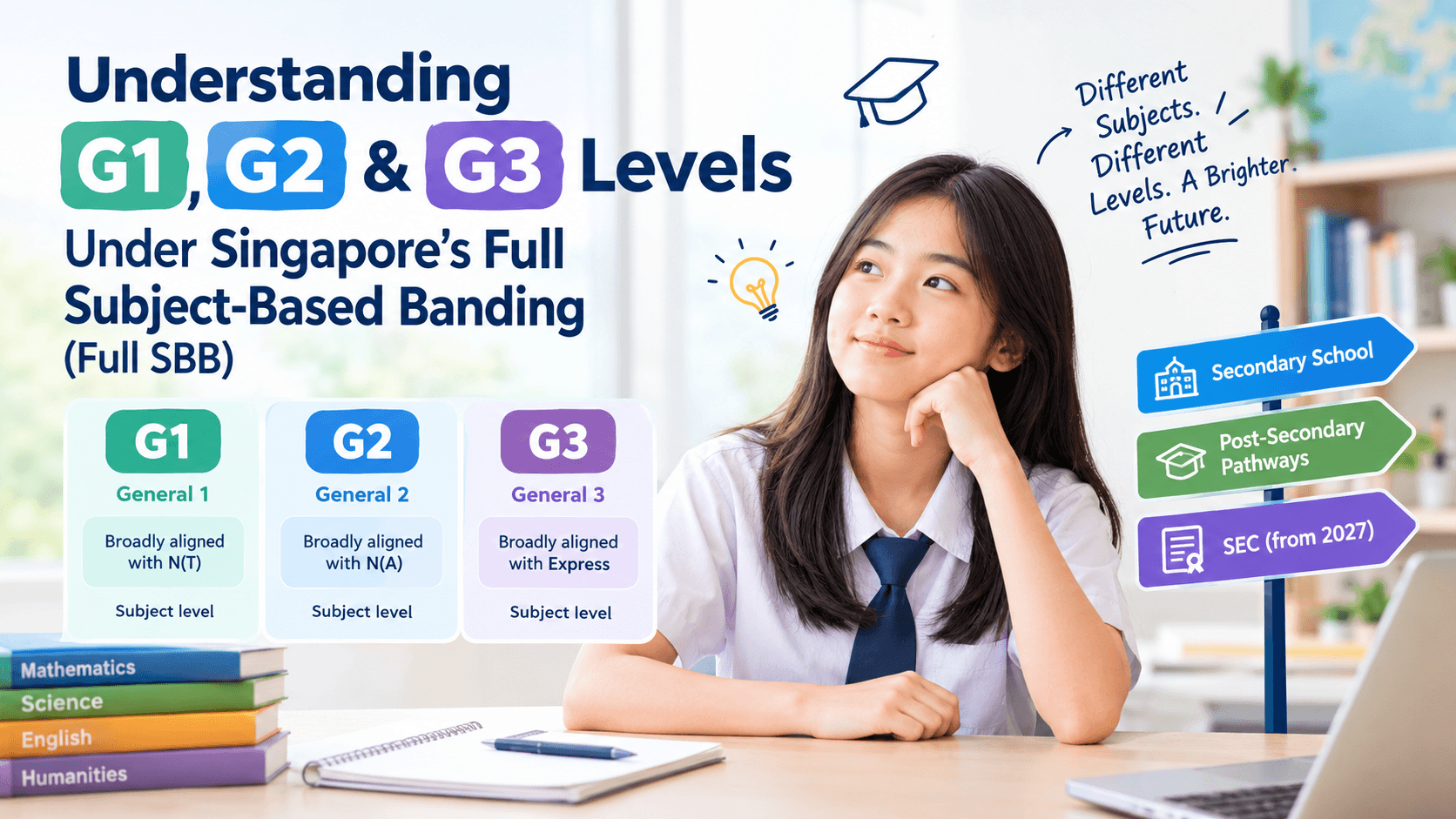
Singapore's secondary school system has moved away from the traditional Express, Normal (Academic) and Normal (Technical) streams.
With Full Subject-Based Banding (Full SBB) fully implemented for the 2024 Secondary 1 cohort, students can now take individual subjects at G1, G2 or G3 levels based on their strengths, interests, learning needs and educational plans.
This change can be confusing for parents who are familiar with the former N(T), N(A) and Express structure.
What does G1, G2 and G3 actually mean? Are they new streams? Can students take different subjects at different levels? And how will these levels connect to the new SEC from 2027?
This guide explains the G1, G2 and G3 levels in Singapore's secondary schools, what they mean in 2026 and what parents should know when discussing subject choices with their children and schools.
What Are G1, G2 and G3 Levels?
G1, G2 and G3 are subject levels under Singapore's Full Subject-Based Banding system.
The "G" stands for General.
Unlike the former stream-based system, where students were broadly placed into Express, N(A) or N(T), Full SBB allows students to study individual subjects at an appropriate level.
The three levels broadly correspond to the academic standards of the former streams:
G1 — broadly aligned with the former Normal (Technical), or N(T), standard
G2 — broadly aligned with the former Normal (Academic), or N(A), standard
G3 — broadly aligned with the former Express standard
However, G1, G2 and G3 are not simply new names for the old streams.
They are subject levels. A student's academic profile can therefore include different levels across different subjects.
Understanding the “G” Levels
The easiest way to understand the G levels is to think about them as different levels of learning within individual subjects.
G1
G1 broadly corresponds to the former N(T) standard.
It provides an appropriate subject-level pathway for students who may benefit from learning the subject at this level.
G2
G2 broadly corresponds to the former N(A) standard.
It sits between G1 and G3 and provides another level of subject learning within the Full SBB framework.
G3
G3 broadly corresponds to the former Express standard.
It represents the most demanding of the three G levels.
Are G1, G2 and G3 rankings of students?
No.
The purpose of the G levels is not to rank students from "best" to "worst".
A student may be stronger in one subject than another, which is why Full SBB allows subject levels to differ.
The appropriate level depends on the individual subject and the student's learning needs.
Why Did Singapore Introduce G1, G2 and G3?
The move to G1, G2 and G3 is part of Singapore's wider shift towards greater flexibility in secondary education.
Under the former system, a student's overall stream influenced the level at which they generally studied their subjects.
Full SBB changes this approach by allowing students to have more flexibility at the subject level.
Recognising different strengths
Students do not necessarily have the same academic strengths across every subject.
A student might find Mathematics easier than a language subject, while another student might have stronger abilities in English or the humanities.
Subject-based levels allow these differences to be recognised.
Reducing the emphasis on academic streams
Full SBB also reduces the importance of broad academic labels.
Instead of asking which stream a student belongs to, the system focuses more on the subjects the student takes and the level appropriate for each one.
Can Students Take Different Subjects at Different G Levels?
Yes.
This is one of the key features of Full Subject-Based Banding.
A student may take some subjects at G3 and others at G2 or G1, depending on their strengths, learning needs and the subject arrangements offered by their school.
For example, a student could potentially have:
Mathematics at G3
Science at G2
English Language at G2
Another subject at G1
Another student may take most subjects at G3 but study one subject at G2.
These are only examples. Actual subject combinations depend on the school's offerings and the student's individual circumstances.
The important point is that students are no longer required to have the same level for every subject simply because they entered secondary school through one academic stream.
Can Students Change Their Subject Levels?
Full SBB also provides opportunities for students to adjust subject levels at appropriate points during their secondary education.
This allows schools to consider a student's academic progress and readiness over time.
A subject-level decision should therefore not automatically be viewed as a permanent decision made at the start of Secondary 1.
G1, G2 and G3 vs the Former N(T), N(A) and Express Streams
Parents who are familiar with Singapore's previous secondary school system may find the transition easier to understand through the broad mapping:
N(T) → G1
N(A) → G2
Express → G3
However, the important difference is how these levels are used.
Previously, Express, N(A) and N(T) were broad academic streams.
Under Full SBB, G1, G2 and G3 are attached to individual subjects.
This means a student is not simply classified as a "G2 student" in the same way that a student was previously described as being in the N(A) stream.
Are G1, G2 and G3 the Same as Posting Groups?
No.
This is an important distinction for parents of Secondary 1 students.
Posting Groups 1, 2 and 3 are used for secondary school admission and posting.
G1, G2 and G3 refer to subject levels.
A student's Posting Group therefore should not be treated as the level of every subject that the student will study.
In simple terms
Posting Group = secondary school posting
G1/G2/G3 = subject level
This distinction is central to understanding how Full SBB works.
How Do Mixed Form Classes Work?
Full SBB also changes how students are grouped within secondary schools.
Students from different Posting Groups can be placed in the same form class.
They can learn together for common programmes and activities while attending different classes for subjects according to the levels they take.
This creates a more integrated secondary school environment without removing the flexibility to provide different levels of subject learning.
What Do G1, G2 and G3 Mean for Students in 2026?
For students and parents in 2026, G1, G2 and G3 are part of the established Full SBB structure.
The key change is that students are no longer defined by one overall Express, N(A) or N(T) stream.
Instead, their secondary school experience can include different subject levels.
Parents should therefore look at a student's individual subject profile, rather than assuming that one Posting Group or one G level describes the student's entire academic ability.
How Do G1, G2 and G3 Connect to the SEC?
The G levels will also become closely connected to Singapore's national examination structure from 2027.
From 2027, the separate GCE N(T)-Level, N(A)-Level and O-Level examinations will be replaced by the Singapore-Cambridge Secondary Education Certificate (SEC).
Students will sit their subjects at the relevant G1, G2 or G3 level.
The SEC will reflect the subjects and subject levels taken by each student.
Is the SEC the same as Full SBB?
No.
The two are related but different.
Full SBB is the secondary education structure that allows students to study subjects at different levels.
The SEC is the qualification and examination framework that will align with those G1, G2 and G3 subject levels from 2027.
Parents therefore do not need to think of the SEC as another set of G levels. The G levels describe the subject level; the SEC will assess students at those respective levels.
How Can G1, G2 and G3 Results Affect Future Pathways?
Students' subject choices and results can play a role in their progression to post-secondary education.
Depending on the subjects taken, grades achieved and the admission requirements that apply, students can progress towards different post-secondary routes.
These can include pathways involving:
Junior colleges and Millennia Institute
Polytechnics
Polytechnic Foundation Programme
ITE
Other recognised post-secondary education options
The important point is that there is no single G level that is automatically the best choice for every student.
A student and family should consider the subject level in relation to the student's abilities, interests and intended future pathway.
Why should future plans be considered?
Some post-secondary courses have specific subject and grade requirements.
Therefore, students who already have an idea of what they may want to study after secondary school can discuss relevant subject choices and requirements with their school.
At the same time, students do not need to have their entire education or career mapped out from Secondary 1.
How Should Parents Think About Subject Levels?
Choosing or discussing a G level should be about fit, not simply about choosing the highest available level.
Parents can consider:
A student's strengths
Which subjects does the student understand well and feel confident learning?
Learning needs
Would the student benefit from a different level of academic demand or additional support?
Interests
Does the student enjoy the subject enough to remain motivated as the academic demands increase?
Future plans
Could the subject and level be relevant to a future post-secondary course or area of study?
Progress over time
Has the student's performance changed enough to justify discussing a different subject level?
The aim is to find an appropriate level of challenge rather than treating G3 as universally better than G2 or G1.
Frequently Asked Questions About G1, G2 and G3
What does G1 mean in Singapore?
G1 is one of the three subject levels under Full SBB and is broadly aligned with the former N(T) standard.
What does G2 mean in Singapore?
G2 is a Full SBB subject level broadly aligned with the former N(A) standard.
What does G3 mean in Singapore?
G3 is a Full SBB subject level broadly aligned with the former Express standard.
Is G3 better than G2?
Not necessarily.
The appropriate level depends on the student's strengths, learning needs, interests and future plans. G3 should not be treated as a universally better option.
Can a student take G3 for one subject and G2 for another?
Yes. Full SBB allows students to take different subjects at different levels, subject to the school's arrangements.
Is G1 the same as N(T)?
G1 is broadly mapped to the former N(T) standard, but G1 is a subject level, whereas N(T) was a broader academic stream.
Is G2 the same as N(A)?
G2 is broadly mapped to the former N(A) standard, but it is now used as a subject level rather than an overall stream.
Is G3 the same as Express?
G3 is broadly mapped to the former Express standard, but G3 applies to individual subjects under Full SBB.
Does Posting Group 3 mean a student takes all subjects at G3?
No.
Posting Groups and G1/G2/G3 subject levels serve different purposes. Students can take different subjects at different levels under Full SBB.
Will G1, G2 and G3 continue when the SEC starts?
Yes. From 2027, students will sit SEC subjects at their respective G1, G2 or G3 levels.
G1, G2 and G3 at a Glance
Feature | G1 | G2 | G3 |
Meaning | General 1 | General 2 | General 3 |
Broad former standard | N(T) | N(A) | Express |
Used as | Subject level | Subject level | Subject level |
Part of Full SBB | Yes | Yes | Yes |
Can be combined with other G levels? | Yes | Yes | Yes |
SEC from 2027 | G1 subject level | G2 subject level | G3 subject level |
Should it be viewed as "better"? | No | No | No |
Final Takeaway: Understanding G1, G2 and G3 in Singapore
The biggest change under Full Subject-Based Banding is not simply the introduction of three new labels.
It is the move from an overall stream-based system to a more subject-based approach.
G1 broadly corresponds to the former N(T) standard, G2 to N(A), and G3 to Express. But unlike the former streams, these levels can apply to individual subjects, allowing students to have a combination that better reflects their strengths and learning needs.
For parents, the most useful question is therefore not "Which G level is the highest?"
It is:
"Which level is appropriate for my child in this particular subject, and how does it support their learning and future pathway?"
As Singapore moves towards the SEC in 2027, understanding this distinction will become increasingly important for families navigating the country's new secondary school system.
Published by StudyHours Global Editorial Board