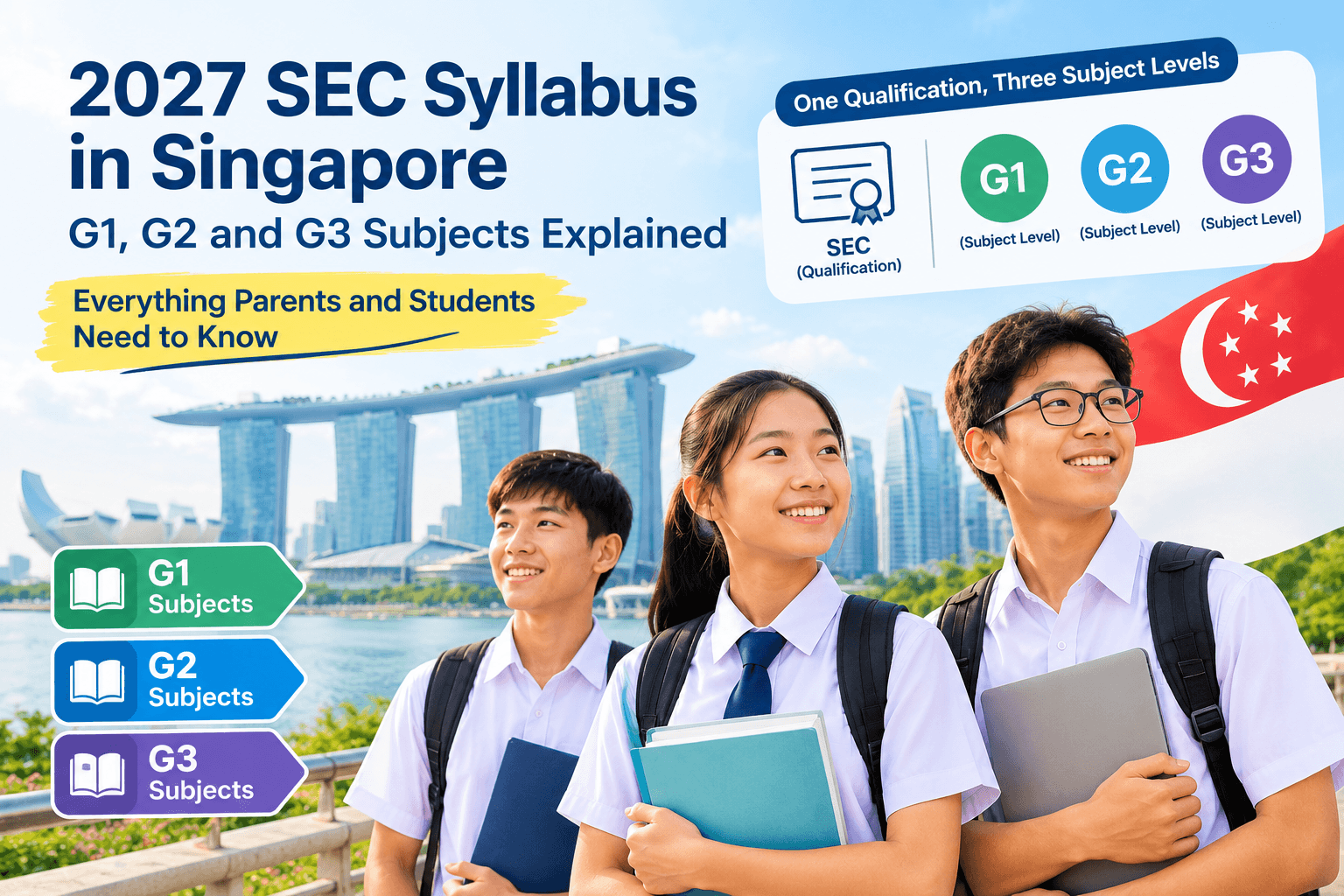
Singapore’s secondary school assessment system is entering a major transition in 2027.
Students sitting the Singapore-Cambridge Secondary Education Certificate (SEC) examination will no longer be taking the former N(T)-Level, N(A)-Level or GCE O-Level qualifications as separate national certificates.
Instead, the SEC brings the examination system together under one qualification, while students continue to take individual subjects at G1, G2 or G3 levels.
For students and parents, this means that understanding the 2027 SEC syllabus is not simply about finding a list of subjects.
It is also about understanding how subject levels work, how the syllabus connects with Full Subject-Based Banding (Full SBB), and where to find the correct syllabus and examination information.
This guide explains how the 2027 SEC syllabus is organised and what students should know before preparing for the examination.
What Is the 2027 SEC Syllabus?
The Secondary Education Certificate (SEC) is the new national secondary school qualification introduced from 2027.
Under the new system, students can take different subjects at G1, G2 or G3 levels. The level of a subject reflects the curriculum and assessment level at which that subject is taken.
This is an important distinction:
G1, G2 and G3 are subject levels. SEC is the qualification.
A student may therefore take subjects at different levels and receive a single SEC examination certificate showing the subjects taken at those different levels.
The Singapore Examinations and Assessment Board (SEAB) publishes separate 2027 syllabus lists for G1, G2 and G3 school candidates.
Why Are There G1, G2 and G3 Levels?
The three levels are part of Singapore's move towards a more flexible secondary education system under Full Subject-Based Banding.
Instead of placing a student into one fixed academic stream for all subjects, Full SBB allows students to take different subjects at levels that are more appropriate to their learning needs and strengths.
In simple terms:
G1 is one level of subject curriculum and assessment.
G2 is a different level.
G3 is a higher level.
The important point is that the levels are attached to individual subjects, rather than automatically defining a student's entire secondary education pathway.
For example, a student may take one subject at G3, another at G2 and another at G1, depending on the subjects and arrangements available to the student.
This is why parents should avoid thinking of G1, G2 and G3 simply as three replacement "streams". The SEC system is designed around subject-level flexibility.
How the 2027 SEC Syllabus Is Organised
The 2027 syllabus information published by SEAB is divided into separate sections for G1, G2 and G3.
Within these pages, subjects can be grouped into categories such as:
Cambridge Subjects
Local Subjects
Applied Subjects, where offered
The subjects available are not identical across all three levels.
SEAB's official 2027 pages should therefore be treated as the primary reference when checking whether a particular subject is offered at a particular level.
G1 SEC Syllabus
The 2027 G1 syllabus includes Cambridge and Local subjects, as well as selected MOE-ITE Applied Subjects for approved schools.
Examples of G1 Cambridge subjects include:
English Language — K100
Mathematics — K110
Computing — K127
Local subjects include:
Chinese Language — K120
Malay Language — K121
Tamil Language — K122
Science — K123
Music — K128
The G1 list also includes applied subjects such as Mobile Robotics, Smart Electrical Technology and Retail Operations. These applied subjects are available only to candidates from schools approved to offer them.
The important takeaway is that students should not assume that every subject offered at G2 or G3 is automatically available at G1. The official syllabus list for the examination year determines what is offered.
G2 SEC Syllabus
The 2027 G2 syllabus includes a wider range of academic subjects.
Examples include:
English Language — K200
Literature in English — K228
History — K227
Geography — K226
Mathematics — K210
Additional Mathematics — K232
Computing — K237
Science (Physics, Chemistry) — K223
Science (Physics, Biology) — K224
Science (Chemistry, Biology) — K225
Nutrition and Food Science — K235
Design and Technology — K234
Principles of Accounts — K233
G2 also includes Local Subjects such as Chinese, Malay and Tamil Language.
One notable point in the 2027 list is Computing (K237), which SEAB identifies as a new subject. The official syllabus page also identifies certain subjects as refined or revised and provides specimen papers where applicable.
G3 SEC Syllabus
The 2027 G3 syllabus provides a broad range of academic, language, creative and applied subjects.
Examples of G3 Cambridge subjects include:
English Language — K300
Literature in English — K331
History — K330
Geography — K329
Economics — K343
Mathematics — K310
Additional Mathematics — K341
Physics — K323
Chemistry — K324
Biology — K325
Computing — K349
Business — K344
Principles of Accounts — K342
Design & Technology — K345
Art — K347
Music — K350
The G3 syllabus also includes a range of languages and other subjects.
Examples include Arabic and Bahasa Indonesia as third languages, as well as French, German, Japanese, Hindi, Urdu, Bengali, Gujarati, Panjabi, Burmese and Thai.
G3 Local Subjects include subjects such as:
Higher Chinese
Chinese
Chinese Special Programme
Literature in Chinese
Higher Malay
Malay
Literature in Malay
Higher Tamil
Tamil
Literature in Tamil
Humanities combinations involving Social Studies and literature
Exercise and Sports Science
SEAB also lists Biotechnology and Design Studies as G3 Applied Subjects for approved schools.
The full G3 list is extensive, so students should use the official SEAB syllabus page rather than relying on third-party subject lists.
G1, G2 and G3: What Actually Changes?
One of the easiest ways to understand the new system is to separate subject level from qualification.
Subject level
A subject is taken at G1, G2 or G3.
The syllabus, assessment requirements and grading scale depend on the level at which that subject is taken.
Qualification
The student receives the Singapore-Cambridge Secondary Education Certificate (SEC).
The certificate can include subjects taken at different levels.
This means a student's academic profile is not represented by one single level across every subject.
That distinction is central to understanding the 2027 system.
How Does the SEC Syllabus Relate to Full SBB?
The 2027 SEC syllabus is closely connected to the implementation of Full Subject-Based Banding.
Under Full SBB, students can have greater flexibility in taking subjects at different levels according to their learning needs and strengths.
The SEC provides the examination framework for these different subject levels.
Therefore, the transition is better understood as:
Full SBB → flexible subject-level choices → G1/G2/G3 subjects → one SEC qualification
Rather than:
Old stream → new stream
This is why students moving through the Full SBB system should pay attention to the level of each individual subject.
How Is the 2027 SEC Different From N(T), N(A) and O-Level?
The biggest structural change is that the previous examination qualifications are being brought together under the SEC.
Under the earlier system, students were generally familiar with:
GCE N(T)-Level
GCE N(A)-Level
GCE O-Level
From 2027, the secondary school qualification becomes the SEC, while subjects continue to be offered at G1, G2 and G3 levels.
This does not mean that every individual G1, G2 or G3 subject should automatically be described as identical to a particular former N(T)-Level, N(A)-Level or O-Level subject.
The safest approach is to use the official 2027 syllabus document for the actual subject and level.
This is especially important when comparing older revision materials with the new SEC syllabus.
What Do the 2027 SEC Subject Codes Mean?
Students may notice that the 2027 SEC syllabus uses subject codes beginning with the letter K.
For example:
Subject | 2027 SEC Code |
G1 English Language | K100 |
G1 Mathematics | K110 |
G2 English Language | K200 |
G2 Mathematics | K210 |
G3 English Language | K300 |
G3 Mathematics | K310 |
G3 Physics | K323 |
G3 Chemistry | K324 |
G3 Biology | K325 |
G3 Computing | K349 |
SEAB also provides the older subject code for reference on its syllabus pages.
These codes are useful because they help students, parents and schools identify the exact syllabus being referred to.
A familiar subject name alone may not always be enough, particularly when checking older examination resources.
New, Revised and Refined Syllabuses
Not every 2027 syllabus is simply a renamed version of an older syllabus.
SEAB identifies changes using labels such as New, Revised and Refined.
For example, the 2027 G2 syllabus identifies Computing as New, while Principles of Accounts is marked Refined.
SEAB explains that for a refined syllabus marked with an asterisk, the changes relate to syllabus content and do not involve a change to the scheme of assessment.
This distinction matters when students use older notes, textbooks or practice papers.
A resource created for an earlier examination year may not fully reflect the 2027 syllabus.
What Are SEC Specimen Papers?
For subjects with revised syllabuses, SEAB provides specimen papers to help candidates understand the updated assessment.
These can be particularly useful when a syllabus has changed.
However, students should remember that a specimen paper is not a replacement for the syllabus document.
The syllabus explains what the examination covers, while the specimen paper provides an example of how the assessment may be structured.
SEAB states that specimen papers for revised syllabuses are generally available online for three years, including the year in which they are posted. Some material may be unavailable online because of copyright restrictions.
How Should Students Read the 2027 SEC Syllabus?
Students do not need to memorise an entire syllabus document.
Instead, use it as a planning and checking document.
1. Start with the correct level
First identify whether the subject is being taken at:
G1, G2 or G3.
Do not use a syllabus from another level simply because the subject has the same name.
2. Check the subject code
Confirm the 2027 code shown by SEAB.
This is particularly useful when searching for past resources or specimen papers.
3. Check the assessment structure
Look at the papers and assessment components required for the subject.
Some subjects may include written, oral, practical, listening or other components.
4. Look for revision notices
Check whether the syllabus is marked New, Revised or Refined.
If it has changed, make sure study materials correspond to the 2027 requirements.
5. Use specimen papers where available
Specimen papers can help students become familiar with the style and structure of the assessment.
But they should be used alongside the official syllabus, not instead of it.
Can Students Still Use Old N-Level or O-Level Resources?
Older examination resources can sometimes be useful for practice, but they should be used carefully.
The fact that an old resource covers the same subject name does not automatically mean that every topic, question type or assessment requirement applies to the 2027 SEC syllabus.
Before using older material, students should ask:
Is the subject being taken at the same level?
Does the resource match the 2027 syllabus?
Has the syllabus been revised?
Does the assessment structure still apply?
Is the resource based on the current examination requirements?
If the answer is unclear, the official 2027 SEAB syllabus should take priority.
What About Subject-Level Grade Mapping?
The SEC also includes arrangements for mapping grades between levels when required for progression purposes.
For example, SEAB provides a mapping from G3 grades to G2 grades and from G2 grades to G1 grades.
For G3:
A1–B3 maps to G2 grade 1
B4–C6 maps to G2 grade 2
D7 maps to G2 grade 3
E8 maps to G2 grade 4
9 maps to G2 grade 5
For G2:
Grades 1–3 map to G1 grade A
Grade 4 maps to G1 grade B
Grade 5 maps to G1 grade C
Grade 6 maps to G1 grade D
These mappings may be used for specific progression or score-computation purposes.
They do not mean that G1, G2 and G3 are simply three versions of the same examination.
Will Students Receive Separate G1, G2 and G3 Certificates?
No.
A key feature of the SEC is that students receive a single examination certificate reflecting subjects taken at the different levels.
According to SEAB, a certificate is awarded when a candidate obtains:
E8 or better for a G3 subject
Grade 5 or better for a G2 subject
Grade D or better for a G1 subject
The SEC results are scheduled for release in January of the following year, following the examination year.
Where Can You Find the Official 2027 SEC Syllabus?
The Singapore Examinations and Assessment Board (SEAB) is the most important source for the official syllabus.
The school-candidate syllabus section is divided into:
2027 G1 syllabuses
2027 G2 syllabuses
2027 G3 syllabuses
Each page provides the relevant subject title, language medium, 2027 subject code and, where applicable, the previous code and specimen-paper information.
Students should use these pages when checking the syllabus rather than relying entirely on tuition websites, social media posts or older revision guides.
School Candidates and Private Candidates
Another important point is that the syllabus information can differ depending on whether the candidate is a school candidate or private candidate.
SEAB publishes separate syllabus pages for private candidates at G1, G2 and G3.
Therefore, private candidates should check the appropriate SEAB private-candidate page instead of assuming that the school-candidate subject list applies to them.
School candidates, meanwhile, register for the SEC examination through their schools.
How Often Should Students Check for Syllabus Updates?
Students preparing for the 2027 SEC should not rely on a syllabus document downloaded many months earlier without checking the official source again.
SEAB can update examination information, syllabus documents and supporting resources.
A practical approach is to check the official syllabus:
when starting examination preparation;
when purchasing new study materials;
before beginning intensive revision;
when a school announces a syllabus change;
and again closer to the examination period.
This is especially important for subjects identified as new, revised or refined.
2027 SEC Syllabus: What Students Really Need to Remember
The 2027 SEC syllabus may initially seem complicated because it introduces new terminology and a different way of organising secondary school subjects.
But the basic structure is straightforward:
The SEC is the qualification. G1, G2 and G3 are subject levels.
Students should therefore focus on the syllabus for the exact subject and level they are taking, rather than trying to treat the entire SEC as one single syllabus.
The 2027 system also reflects the flexibility introduced through Full Subject-Based Banding.
Students may take subjects at different levels, while their results are reported together through the SEC.
The most reliable preparation strategy is to use the official SEAB syllabus, confirm the 2027 subject code, check the assessment requirements and use current specimen papers where available.
For any uncertainty about the 2027 SEC syllabus, the latest information published by SEAB should take priority over older examination resources or unofficial summaries.
Final Takeaway
The introduction of the 2027 Singapore-Cambridge Secondary Education Certificate marks an important change in Singapore's secondary education system.
Rather than thinking of G1, G2 and G3 as separate qualifications, students and parents should understand them as different levels at which individual subjects can be taken under one SEC qualification.
The best way to prepare is therefore not to memorise the entire SEC framework.
Instead:
Choose the correct subject level → check the 2027 syllabus → confirm the subject code → understand the assessment → use relevant specimen papers → keep checking official SEAB updates.
That approach will help students prepare for the 2027 SEC examination using information that is current, relevant and specific to their actual subject level.
Yes. Since this article is targeting 2026 readers preparing for the first 2027 SEC, I would add a focused FAQ section near the end.
These are the questions most likely to matter to parents and students because they address the practical changes: old qualifications, subject levels, grading, timetable, certificates, and Full SBB.
SEAB confirms that 2026 is the final year for the N(T), N(A) and O-Level qualifications, with the SEC beginning in 2027.
Frequently Asked Questions About the 2027 SEC
1. Will N-Level and O-Level examinations still exist in 2027?
No. 2026 is the final year for the GCE N(T)-Level, GCE N(A)-Level and GCE O-Level qualifications. From 2027, these qualifications will be replaced by the Singapore-Cambridge Secondary Education Certificate (SEC).
Students will take their subjects at G1, G2 or G3 levels under the new SEC system.
2. Is G3 the same as O-Level?
G3 is broadly aligned with the existing O-Level standard, including its grading structure and examination standards. However, G3 is not a separate O-Level qualification.
From 2027, G3 is a subject level within the SEC. A student can therefore take G3 for some subjects while taking other subjects at G2 or G1, where applicable.
3. Can students take different subjects at different SEC levels?
Yes. This is one of the key features of the new system.
Under Full Subject-Based Banding, students can take individual subjects at different levels according to their learning needs, strengths and school arrangements.
For example, a student could take Mathematics at G3 and another subject at G2.
The important point is that G1, G2 and G3 refer to subject levels, not separate examination streams.
4. Will students receive separate G1, G2 and G3 certificates?
No. Students will receive one SEC certificate.
The certificate will reflect the subjects taken and the corresponding levels. This means a student's SEC results can contain a combination of G1, G2 and G3 subjects rather than requiring a separate certificate for each level.
5. Will the 2027 SEC examination be harder than the current N-Level or O-Level examinations?
There is no announced overall increase in examination standards.
The SEC continues the existing standards at the respective G1, G2 and G3 levels. The major change is the organisation of subjects and qualifications under the new SEC framework, rather than simply making the examinations more difficult.
Students should therefore focus on the syllabus and assessment requirements for their actual subject level instead of assuming that the introduction of the SEC automatically means a harder examination.
6. Can students still use old N-Level and O-Level study materials for the 2027 SEC?
They can be useful for additional practice, but students should not assume that older resources completely match the 2027 SEC syllabus.
Before using an older textbook, revision guide or past paper, check:
the subject level;
the 2027 syllabus content;
the assessment structure;
whether the syllabus has been revised or refined; and
whether the resource was designed for the relevant examination level.
The latest official SEAB syllabus should remain the main reference for 2027 preparation.
7. When will the first SEC results be released?
The first SEC examinations will take place in 2027, with the first results expected in January 2028.
This is important for students planning their post-secondary education because the first SEC cohort will move through the new qualification and admissions arrangements following the 2027 examination.
8. Where can students find the official 2027 SEC syllabus?
Students should use the Singapore Examinations and Assessment Board (SEAB) as their primary source.
SEAB provides separate syllabus information for:
G1 SEC subjects
G2 SEC subjects
G3 SEC subjects
The official pages provide information such as subject titles, language medium, 2027 subject codes and specimen-paper information where applicable.
Students should always check the syllabus for their specific subject and level, especially when a syllabus is marked as new, revised or refined.
Quick Reminder for 2027 SEC Students
The easiest way to understand the new system is:
SEC = qualification
G1, G2 and G3 = subject levels
Full SBB = greater flexibility in choosing subject levels
For 2027 preparation, students should focus on the exact subject + level + syllabus + assessment requirements that apply to them rather than relying entirely on comparisons with the old N-Level or O-Level system.
Published by StudyHours Global Editorial Board