Understanding GCSE grades can be confusing for students and parents, particularly when comparing the current numerical grading system with the older letter grades from A* to G.
Questions often arise about what a Grade 4 means, whether Grade 5 is a good result, how Grade 9 is awarded, and what happens if a student does not achieve the grade they expected.
GCSE grades are important because they can influence entry to sixth form, college courses, apprenticeships and other training pathways.
However, their significance depends on the subject, the course a student wants to take and the entry requirements set by the education provider.
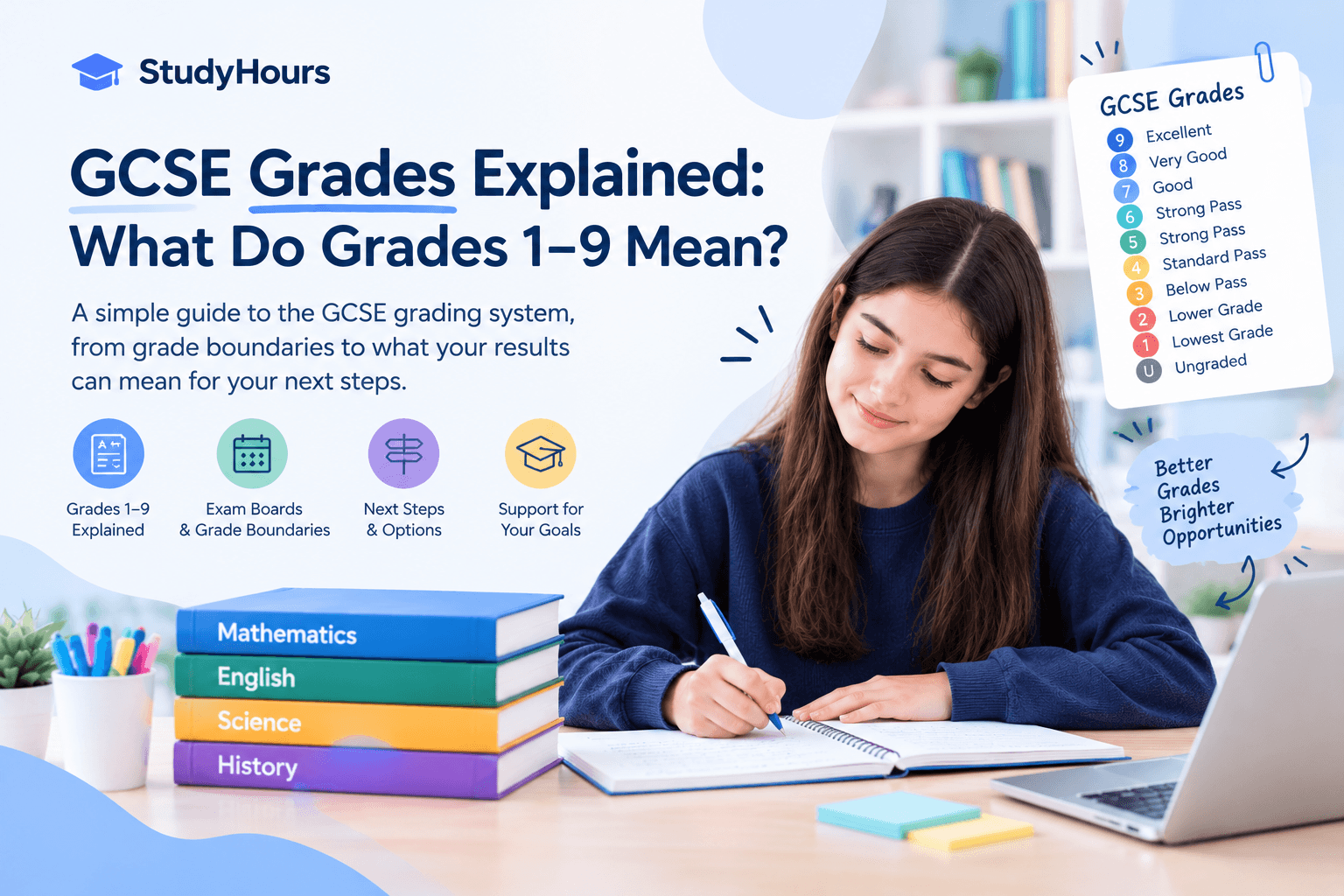
In England, most reformed GCSEs use a numerical grading scale from 9 to 1, with 9 being the highest grade.
A U grade indicates that the result is ungraded. Wales and Northern Ireland have their own qualification arrangements, and the grading system may differ depending on the qualification and awarding organisation.
This guide explains the GCSE grading system, the difference between a standard pass and a strong pass, how grade boundaries work, how examination boards award grades, and what students can do if their results are lower than expected.
For families considering personalised support, StudyHours GCSE online tutoring is a relevant place to explore subject-specific help.
What Is the GCSE Grading System?
GCSEs in England use a numerical grading scale from 9 to 1 for most reformed GCSE qualifications.
Grade 9 is the highest available grade, while Grade 1 is the lowest numbered grade. A U result means the qualification has been ungraded.
The numerical system replaced the former A*–G grading scale as reformed GCSEs were introduced from 2017 onwards.
The change was designed to distinguish achievement at the top of the grading scale more clearly and support more demanding GCSE qualifications.
The grades are not a simple one-to-one conversion of the old letters. Although broad comparisons can help explain the system, students should avoid assuming that every numerical grade corresponds exactly to a previous letter grade.
GCSE grades at a glance
Grade 9: The highest grade available in the numerical GCSE system.
Grade 8: A very high level of achievement, below Grade 9.
Grade 7: A high grade, broadly comparable to the lower end of the former A grade.
Grade 6: A strong result, above the standard-pass threshold.
Grade 5: Commonly described as a strong pass in England.
Grade 4: Commonly described as a standard pass in England.
Grade 3: Below the standard-pass threshold.
Grade 2: A lower numbered grade.
Grade 1: The lowest numbered grade.
U: Ungraded.
The exact knowledge and performance represented by each grade depend on the subject, examination specification and assessment series.
What Is a Grade 9 at GCSE?
Grade 9 is the highest grade available in the numerical GCSE grading system used in England.
It represents exceptional performance against the requirements of the qualification.
Grade 9 is not simply the new name for the old A*. The reformed grading structure was designed to distinguish the strongest performances more clearly, meaning that a Grade 9 reflects achievement at the very top of the grading scale.
Students aiming for Grade 9 need strong subject knowledge and the ability to apply that knowledge accurately and independently.
For example, a student aiming for Grade 9 in Maths may need to solve unfamiliar problems, explain mathematical reasoning, use appropriate methods and avoid errors across different topics.
In English, a high grade may require perceptive analysis, well-supported interpretations and clear, controlled writing.
How can students work towards Grade 9?
Students should begin by understanding the specification for their subject and the skills expected by the examination board.
Useful strategies include:
Learning the full specification rather than concentrating only on familiar topics.
Practising challenging questions as well as routine exercises.
Reviewing mark schemes to understand how answers are assessed.
Identifying recurring mistakes and practising the relevant skills.
Improving the clarity, accuracy and depth of written responses.
Completing timed papers to develop examination technique.
Aiming for Grade 9 should not mean sacrificing all balance in a student's life.
Consistent learning, feedback, rest and realistic planning are important throughout the course.
What Is a Grade 8 at GCSE?
Grade 8 is a very high GCSE grade. It sits below Grade 9 and above Grade 7.
Students achieving Grade 8 generally demonstrate strong understanding and the ability to apply subject knowledge effectively. The specific requirements depend on the subject and examination board.
For example, in Science, strong performance may involve applying scientific principles to unfamiliar situations, interpreting data and explaining processes accurately.
In History, it may involve constructing a well-supported argument and analysing evidence effectively.
Grade 8 can be an excellent outcome for students applying to competitive sixth forms or planning to study demanding subjects after Year 11. However, entry requirements vary, so students should check the requirements of their intended courses rather than assuming a particular grade guarantees admission.
What Is a Grade 7 at GCSE?
Grade 7 is a high GCSE grade and is broadly comparable to the lower end of the former A grade.
Students who achieve Grade 7 usually demonstrate strong subject knowledge and the ability to apply it to a range of questions.
A Grade 7 may be relevant when applying for A-level subjects with specific GCSE entry requirements.
For example, a sixth form may ask for a particular grade in a subject before allowing a student to study it at A-level.
However, there is no universal Grade 7 requirement for every A-level course or sixth form. Each provider sets its own criteria.
Students should review the actual entry requirements of the institutions they are interested in and ask admissions staff if anything is unclear.
For families considering personalised support, StudyHours GCSE online tutoring is a relevant place to explore subject-specific help.
What Is a Grade 6 at GCSE?
Grade 6 is above the standard-pass threshold in England and represents a solid level of achievement.
A Grade 6 can support applications to many post-16 courses, depending on the subject and the provider's requirements.
Students should remember that GCSE grades are interpreted in context.
A Grade 6 in a subject with a demanding entry requirement may not meet the criteria for a particular course, while the same grade may be more than sufficient for another pathway.
The best approach is to check course-specific requirements and consider the complete set of results rather than judging a student's future from one grade alone.
What Is a Grade 5 at GCSE?
Grade 5 is commonly described as a strong pass in England.
It sits above Grade 4, which is commonly described as a standard pass. The distinction matters because some schools, sixth forms, colleges and training providers set their entry requirements at Grade 5 rather than Grade 4.
For example, a provider may require Grade 5 in English and Maths for a particular course, while another may accept Grade 4. Requirements vary by institution and qualification.
Is Grade 5 a good GCSE result?
A Grade 5 can be a strong result, but whether it meets a student's needs depends on their goals.
Students planning to study A-levels should check the entry criteria for each subject.
Some providers ask for higher grades in subjects closely related to the course, while others use different requirements.
Students should not assume that every course requires Grade 5, nor should they assume that Grade 5 automatically meets every entry requirement.
What Is a Grade 4 at GCSE?
Grade 4 is commonly described as a standard pass in England.
It is an important threshold for many students because English and Maths results can affect further education and training options.
Some sixth forms and colleges accept Grade 4 in particular subjects, while others require Grade 5 or higher.
More demanding courses may also require a specific grade in a subject directly related to the course.
Is Grade 4 a pass?
For most reformed GCSEs in England, Grade 4 is the commonly recognised standard-pass benchmark.
However, students should distinguish between achieving a pass grade and meeting the entry requirements for a specific course.
A student can achieve a Grade 4 and still need a higher grade for their chosen sixth-form programme.
Students should check their institution's official admissions information instead of relying on general rules.
What Do Grades 1, 2 and 3 Mean?
Grades 1, 2 and 3 are below the standard-pass threshold of Grade 4 in England.
These grades still provide information about a student's performance. They can help teachers identify which areas need further development and guide decisions about additional learning support.
A lower grade does not mean a student cannot improve. Examination performance can be affected by subject knowledge, revision methods, confidence, attendance, health, time management and other circumstances.
Students who receive a Grade 3 or lower should discuss their next steps with their school or college.
Depending on their goals, they may be able to resit the examination, continue studying the subject or follow another suitable pathway.
What Does a U Grade Mean?
A U grade means that a GCSE result is ungraded. It does not represent a numbered grade on the 9–1 scale.
An ungraded result can be disappointing, but it should be treated as a starting point for understanding what happened and deciding what to do next.
Students should speak to their teacher or examination centre to understand their options.
They may need guidance about resits, alternative qualifications, study support or the entry requirements for a future course.
Where a student believes that an administrative or marking issue may have affected the result, they should ask their school or examination centre about the appropriate review process and deadlines.
How Do the New GCSE Grades Compare with the Old A*–G Grades?
The numerical grading system replaced the older A*–G scale as reformed GCSEs were introduced in England.
Broad comparisons can help parents understand the change, but the two systems are not identical.
The following comparisons are commonly used as a general guide:
Numerical grade in England | Broad comparison with the former scale |
Grade 9 | Above the former A* benchmark |
Grade 8 | Within the former A* range |
Grade 7 | Broadly comparable to the lower end of A |
Grades 6–5 | Across parts of the former B and C range |
Grade 4 | Broadly comparable to the former C benchmark |
Grades 3–1 | Across the lower former grade range |
U | Ungraded |
These are broad comparisons rather than exact conversions. Grade distributions, qualification specifications and assessment standards mean that a numerical grade should not automatically be translated into a single former letter grade.
Parents comparing results from different years should also consider whether the student took a reformed qualification and which grading arrangements applied at the time.
What Is the Difference Between a Standard Pass and a Strong Pass?
In England, Grade 4 is commonly described as a standard pass, while Grade 5 is commonly described as a strong pass.
These labels are useful when explaining GCSE results, particularly for English and Maths.
However, they are not universal admission rules for every school, college or course.
A provider may require Grade 4 in one subject and Grade 6 or higher in another. Some courses specify a minimum overall profile, while others consider additional criteria.
Students should therefore use the terms as general descriptions, not as a replacement for checking the entry requirements of their intended course.
How Do GCSE Grade Boundaries Work?
A grade boundary is the minimum mark required to achieve a particular grade for a specific examination or qualification in a given assessment series.
Grade boundaries are not necessarily the same every year. They can vary according to the paper, specification and assessment series.
This does not mean that examination boards randomly change grades.
Awarding procedures are designed to maintain standards over time while accounting for the difficulty of the assessments.
Why do grade boundaries change?
Examination papers can vary in difficulty. If a paper is more demanding than the equivalent assessment in another year, the boundary needed for a particular grade may differ.
Awarding organisations use established procedures and statistical evidence, alongside expert judgement, to maintain comparable standards.
Students should not plan revision around guesses about future grade boundaries.
The most reliable preparation is to learn the specification, practise examination questions and improve the quality of their answers.
Are grade boundaries the same for every subject?
No. A boundary for GCSE Maths cannot be directly compared with a boundary for GCSE English or Biology.
Subjects differ in content, paper structure, assessment methods and the number of available marks. Boundaries also vary between qualifications and assessment series.
Students should consult the relevant examination board's official grade-boundary information when reviewing a completed examination.
How Are GCSE Grades Decided?
GCSE grades are awarded according to the qualification's assessment arrangements and the relevant awarding organisation's procedures.
Depending on the subject, assessment may involve written examinations, practical components, coursework or a combination of methods.
Examination boards assess students against the requirements of the specification and use awarding procedures to determine grade boundaries and final grades.
Students should know which examination board they are studying with for each subject.
Common awarding organisations include AQA, Pearson Edexcel and OCR, although the available qualifications vary.
Does every examination board use the same paper?
No. Examination boards can use different specifications, question structures and assessment approaches.
For example, two students studying GCSE Geography may cover broadly similar themes but follow different topic arrangements or assessment requirements.
This is why students should use revision resources designed for their own examination board and specification.
Can students predict their final grade from a mock exam?
Mock exams can provide useful information, but they do not guarantee a final grade.
A mock result reflects performance on a particular paper at a particular time.
It may be affected by the topics covered, examination conditions and how much revision the student has completed.
Students should use mock feedback to identify what needs to improve, rather than treating a mock grade as a fixed prediction.
Do GCSE Grades Differ Across England, Wales, Northern Ireland and Scotland?
Yes. Qualification systems and grading arrangements are not identical across the UK.
England
Most reformed GCSEs in England use numerical grades from 9 to 1, with U indicating an ungraded result.
Wales
Wales has its own qualification arrangements. Students and parents should check the relevant qualification and awarding organisation for the grading system that applies.
Northern Ireland
Northern Ireland offers GCSEs through relevant awarding organisations. Available specifications and grading arrangements may differ depending on the qualification and board.
Scotland
Scotland generally follows a different qualification system, including National 5s, Highers and Advanced Highers. GCSE grades are not the standard school qualification pathway in Scotland.
Families comparing results across the UK should not assume that a grade or qualification has an exact equivalent in every nation.
They should check the official guidance and the requirements of the institution they are applying to.
How Do GCSE Grades Affect Sixth Form and College Applications?
GCSE results can play an important role in post-16 education decisions. Sixth forms and colleges often publish minimum grades for admission to their programmes and individual subjects.
For example, a course may require a minimum grade in English or Maths, while a subject such as A-level Maths may require a higher GCSE Maths grade.
However, requirements vary considerably between providers. Students should check the admissions information for each institution rather than assuming there is one national threshold for every course.
What if a student meets some requirements but not others?
A student who does not meet every entry requirement should contact the provider to ask about available options.
Depending on the institution, possible routes may include a different course, an alternative qualification, additional support or a resit. The options depend on the course and the student's circumstances.
Students should seek advice early, particularly if they have a specific sixth form or college in mind.
What Should Students Do If They Are Disappointed with Their GCSE Grades?
Receiving a lower grade than expected can be upsetting, particularly after months of revision.
Students should give themselves time to process the results before deciding what to do next.
The first step is to understand the options available.
Speak to the school or college
Teachers and advisers can explain whether the student has met the requirements for their intended course and what alternatives may be available.
They can also help students understand the next steps if a resit or review is being considered.
Check course requirements
A disappointing result does not automatically close every educational pathway. Different sixth forms, colleges and training providers may have different entry requirements.
Students should contact providers directly and ask what routes remain open.
Review the examination performance
Students can reflect on which topics they found difficult, how they prepared and whether they struggled with timing, question interpretation or exam anxiety.
This review should focus on useful lessons rather than blame. Understanding the cause of a difficulty makes it easier to prepare for future assessments.
Ask about reviews of results
If a student or school has a genuine concern about a result, they should ask the examination centre about the available review procedures.
There are formal processes for certain post-results queries, but eligibility, procedures and deadlines vary.
A review can lead to a grade staying the same, increasing or decreasing, depending on the circumstances and rules.
Students should obtain guidance from their school or examination centre before making a request.
Can You Resit a GCSE If You Do Not Get the Required Grade?
Yes, GCSE resits are possible in relevant circumstances, but the arrangements depend on the subject, the student's age and the examination series.
English Language and Maths are particularly important in England because students who have not achieved the required standard may be expected to continue studying these subjects after Year 11.
Students should ask their school or college which resit opportunities are available and whether they need to enrol in a course before taking the examination.
How should students prepare for a resit?
Students should avoid simply repeating the same revision routine if it did not produce the desired outcome.
Instead, they should identify the areas where marks were lost and build a focused plan.
Useful steps include:
Reviewing the relevant specification.
Identifying recurring errors from previous papers.
Practising the question types that caused difficulty.
Improving time management and exam technique.
Seeking teacher feedback on written responses.
Completing timed practice under realistic conditions.
Students should also confirm the examination board and specification for the resit so that their preparation matches the qualification they will take.
How Can Students Improve Their GCSE Grades?
Improving GCSE grades usually requires a combination of subject understanding, consistent practice and effective feedback.
Simply spending more hours studying does not always lead to better results if the methods are not effective.
Build a realistic revision timetable
Students should allocate time across their subjects according to their needs. Subjects with difficult topics or upcoming assessments may need more attention, but all subjects should receive regular review.
A timetable should be achievable. A realistic plan that is followed consistently is generally more useful than an ambitious plan that quickly becomes overwhelming.
Use active recall
Active recall means testing yourself without looking at the answer first.
Students can use flashcards, short quizzes, blank-page summaries or verbal explanations to check what they remember.
This approach helps reveal gaps that may remain hidden when students only reread notes.
Practise past-paper questions
Past papers help students become familiar with the style of GCSE questions, the time available and the way marks are awarded.
After completing a question, students should compare their answer with the mark scheme and identify exactly what was missing.
Keep an error log
An error log records mistakes and the correct approach. It might include a misunderstanding of a concept, a calculation error, weak evidence in an essay or an incomplete explanation.
Reviewing this log regularly allows students to target the issues that are most likely to affect their performance.
Seek help with difficult topics
If a student repeatedly struggles with a subject, extra explanation or targeted practice may help.
Students can speak to their teachers, attend school support sessions or explore additional academic guidance.
For families considering personalised support, StudyHours GCSE online tutoring is a relevant place to explore subject-specific help.
Frequently Asked Questions About GCSE Grades
What is the highest GCSE grade?
For most reformed GCSEs in England, Grade 9 is the highest grade.
What is a pass at GCSE?
In England, Grade 4 is commonly described as a standard pass and Grade 5 as a strong pass. Course providers may set different entry requirements.
Is Grade 4 a fail?
No. Grade 4 is commonly recognised as the standard-pass benchmark in England for reformed GCSEs. However, a specific course may require a higher grade.
Is Grade 5 better than Grade 4?
Yes. Grade 5 is one grade higher and is commonly described as a strong pass, while Grade 4 is described as a standard pass.
What does a U mean on GCSE results?
U means ungraded. It is not a numbered grade on the 9–1 scale.
Are GCSE grade boundaries the same every year?
No. Grade boundaries can vary by qualification and assessment series. Awarding procedures aim to maintain standards across years.
Does Grade 7 equal an A?
Grade 7 is broadly comparable to the lower end of the former A grade, but the numerical and letter systems are not exact equivalents.
Can GCSE grades affect university applications?
GCSE results can be considered by universities, but requirements vary by course and institution.
Some courses specify minimum grades in particular subjects, while others place greater emphasis on later qualifications.
Can a GCSE grade change after results day?
In certain circumstances, a grade may change following a formal review or correction.
Students should contact their school or examination centre for advice about the applicable process and deadlines.
What should I do if I do not get Grade 4 in English or Maths?
Speak to your school or college about resits, continued study and alternative pathways.
The appropriate next step depends on your circumstances and intended course.
Conclusion
The GCSE grading system helps students, parents and education providers understand performance at the end of Key Stage 4.
In England, most reformed GCSEs use grades from 9 to 1, with Grade 9 at the top, Grade 4 commonly recognised as a standard pass and Grade 5 as a strong pass.
However, a grade should always be considered in context. The requirements for sixth form, college, apprenticeships and further study vary, and qualification arrangements differ across the UK.
Students can make informed decisions by understanding their results, checking official entry requirements and seeking advice when they need it.
If a grade is lower than expected, there may still be options to improve it or follow an alternative route.
For students who want to strengthen their understanding and prepare more effectively for GCSE examinations, StudyHours GCSE online tutoring provides a starting point for exploring personalised academic support.
Published by StudyHours Global Editorial Board