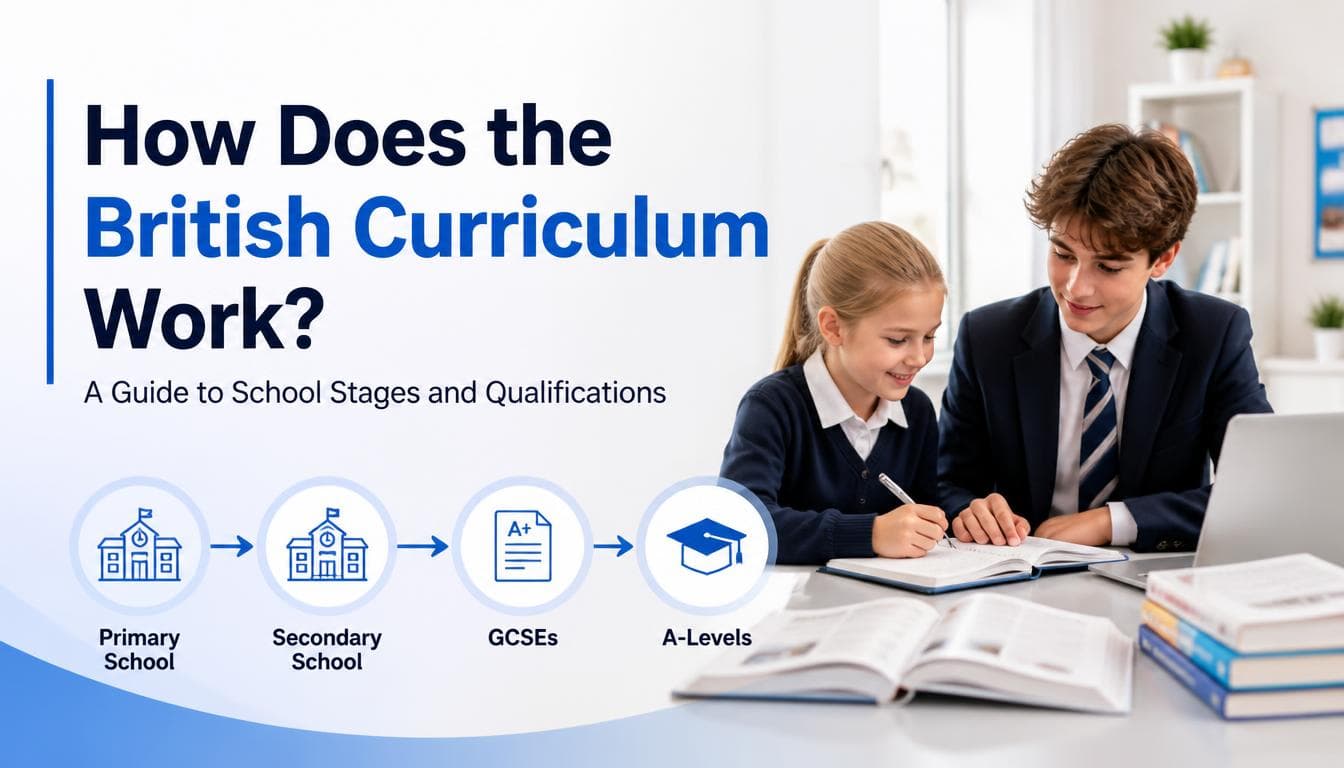
Understanding the British curriculum can help parents make informed decisions about their children's education.
However, families who are new to this system may have questions about school years, learning stages, subject choices, examinations, and qualifications.
The British curriculum is structured to help students develop their knowledge and skills as they progress through school.
In England, education is organised into different stages, beginning with early years education and continuing through primary and secondary school. Many students later take qualifications such as GCSEs and A-Levels.
International schools in the UAE often follow a British-style curriculum, although their school structures, subject offerings, and examination arrangements may differ.
Knowing how the system works can help parents understand what children typically study at each stage, when they begin choosing subjects, and how school qualifications can support future education.
What Is the Structure of the British Curriculum?
The British curriculum generally refers to an educational approach based on the UK school system, particularly England. It combines structured learning stages with subject-specific programmes and qualifications.
In England, the National Curriculum sets learning requirements for many state-funded schools.
British international schools may adapt elements of this framework or follow other recognised programmes designed for international education.
The system is commonly divided into the following stages:
Early Years Foundation Stage (EYFS)
Key Stage 1
Key Stage 2
Key Stage 3
Key Stage 4
Key Stage 5
Each stage supports a different part of a student's educational development.
Younger students build foundational skills, while older students study subjects in greater depth and may work towards formal qualifications.
The exact structure depends on the school and the programme it offers.
How Do the Different School Stages Work?
Early Years Foundation Stage (EYFS)
The Early Years Foundation Stage covers early childhood education in England, generally up to age five.
During this period, children develop communication, language, physical coordination, early mathematical understanding, literacy, and social skills.
Learning often combines play, exploration, guided activities, and structured teaching.
The goal is to help children develop the foundational abilities they need for primary school.
International schools may use different early years frameworks, so parents should check the arrangements at their chosen school.
Key Stage 1: Years 1 and 2
Key Stage 1 generally covers Years 1 and 2, when children are approximately five to seven years old.
Students develop core skills in English and mathematics while learning about science and other subjects.
In English, they practise reading, spelling, writing, and communication. In mathematics, they develop number knowledge, basic calculations, measurement, and problem-solving skills.
Teachers also help students become more confident in following instructions, completing activities, and working independently.
At this stage, regular reading, practical learning activities, and consistent routines can help children build confidence.
Key Stage 2: Years 3 to 6
Key Stage 2 generally covers Years 3 to 6, when students are approximately seven to eleven years old.
Students build on their earlier learning and begin tackling more complex concepts.
English lessons may involve longer written responses, comprehension, grammar, and vocabulary development. Mathematics introduces more advanced calculations, fractions, decimals, geometry, and other topics.
Students may also study science, history, geography, computing, art, design and technology, physical education, and languages.
As children progress through primary school, they are expected to explain their reasoning, apply knowledge to different situations, and complete tasks with greater independence.
A strong foundation during these years can make the transition to secondary school easier.
Key Stage 3: Years 7 to 9
Key Stage 3 generally covers Years 7 to 9, when students are approximately eleven to fourteen years old.
This stage marks an important transition from primary to secondary education.
Students commonly study a broader secondary curriculum that may include English, mathematics, science, history, geography, languages, computing, art, design and technology, and physical education.
The level of challenge increases as students learn to manage different subjects, organise assignments, and apply their knowledge to more demanding questions.
Key Stage 3 also helps students prepare for the next stage of secondary education.
Students who develop effective study habits during these years may find it easier to manage the workload associated with GCSE or IGCSE courses.
Key Stage 4: Years 10 and 11
Key Stage 4 generally covers Years 10 and 11, when students are approximately fourteen to sixteen years old.
Many schools use these years to prepare students for GCSE or IGCSE qualifications.
Students study selected subjects according to the school's programme, available options, and qualification requirements.
English, mathematics, and science are commonly important parts of the curriculum, although exact subject requirements differ.
At this stage, students need to understand their syllabuses and assessment methods.
They also benefit from regular revision, practice questions, and feedback on their work.
Some qualifications are assessed mainly through examinations, while others may include coursework or practical components. Requirements depend on the subject and awarding organisation.
Key Stage 5: Years 12 and 13
Key Stage 5 generally covers Years 12 and 13, when students are approximately sixteen to eighteen years old.
Many students choose A-Levels or other senior secondary qualifications at this stage.
Unlike earlier school years, students usually concentrate on a smaller selection of subjects and study them in greater depth.
Subject choices may depend on academic interests, strengths, future career plans, and university entry requirements.
For example, students considering a science-related degree should investigate the subjects required by their intended universities before selecting their A-Level combination.
This stage encourages greater independence, more detailed academic analysis, and preparation for further education.
How Do Subjects Change as Students Progress?
One important feature of the British curriculum is the progression from broad learning to greater subject specialisation.
Primary School: Building Foundational Knowledge
In primary school, students typically study a wide range of subjects.
The main focus is on developing essential literacy, numeracy, communication, and problem-solving skills.
Students also begin exploring science, humanities, creative subjects, and physical education.
These experiences help children develop a broad understanding of different areas of learning before moving into secondary school.
Lower Secondary School: Exploring Different Subjects
During Key Stage 3, students continue studying a broad range of subjects while encountering more advanced content.
They learn to manage separate subject requirements and develop more independent approaches to learning.
This stage can also help students identify the subjects they enjoy and the areas in which they perform well.
However, students should not feel that their future career must already be decided. Exploring different subjects can help them make more informed choices later.
Upper Secondary School: Choosing Qualifications
During Years 10 and 11, students generally prepare for GCSE or IGCSE qualifications, depending on their school.
They may have opportunities to select subjects alongside those that are required by their school or programme.
After completing these qualifications, many students move on to A-Levels or alternative pathways.
Subject selection becomes increasingly important because some further education programmes and university courses have specific entry requirements.
Parents and students should review these requirements before making decisions.
What Are GCSEs and How Do They Fit into the Curriculum?
GCSE stands for General Certificate of Secondary Education.
In England, students commonly study GCSE subjects during Years 10 and 11 and take their examinations at around age sixteen.
Each qualification focuses on a particular subject, such as mathematics, English, biology, chemistry, physics, history, or geography.
The subjects available depend on the school and its curriculum.
How Are GCSE Students Assessed?
Assessment methods vary by subject and awarding organisation.
Many GCSEs include written examinations, while some subjects may have additional practical or non-exam assessment components.
Students should understand the assessment structure for each subject rather than assume that every GCSE follows the same format.
Successful preparation usually involves understanding the syllabus, reviewing class notes, practising suitable questions, and learning from mistakes.
Why Do GCSE Results Matter?
GCSE results may influence a student's next educational step.
Schools may use grades to determine whether students meet the entry requirements for particular A-Level subjects or other programmes.
Some subjects at A-Level require students to have achieved specific grades in related GCSE subjects.
Requirements vary by school and subject, so students should confirm them before selecting their next course.
What Is the Role of IGCSEs in British Curriculum Schools?
IGCSE stands for International General Certificate of Secondary Education.
It is an international qualification offered by various awarding organisations and used by many international schools.
IGCSE programmes can provide a pathway for students studying outside the UK, including students attending British curriculum schools in the UAE.
How Are IGCSEs Different from GCSEs?
GCSE and IGCSE qualifications are related, but they are not identical in every respect.
Differences may include syllabus content, assessment structure, examination format, and subject availability.
These differences depend on the awarding organisation and the specific qualification.
Parents should check which IGCSE specifications their child's school offers and understand how the qualifications relate to the student's intended next step.
How Should Students Prepare for IGCSE Examinations?
Students should begin by understanding the requirements of each subject.
A practical preparation plan may include:
Reviewing the official syllabus or specification.
Identifying topics that need additional practice.
Revising concepts regularly instead of leaving everything until the final weeks.
Practising relevant past-paper questions.
Checking answers against official mark schemes where available.
Reviewing mistakes and improving explanations.
Asking teachers for help with difficult concepts.
Regular preparation helps students identify weaknesses early and use their revision time more effectively.
How Do A-Levels Work?
A-Levels are advanced qualifications commonly studied during Years 12 and 13.
Students typically choose a smaller number of subjects than they studied at GCSE or IGCSE level.
The aim is to develop a deeper understanding of each subject and prepare students for higher education or other future pathways.
How Do Students Choose A-Level Subjects?
Students should consider several factors when choosing A-Level subjects.
Academic strengths: Subjects in which students perform well may be appropriate options, although future requirements should also be considered.
Personal interests: Interest in a subject can help students remain engaged with challenging material.
University requirements: Some degree programmes specify subjects or grades that applicants must achieve.
Future pathways: Students who have a career direction in mind can research which qualifications are commonly required for relevant courses.
School availability: The final choices depend on the subjects and combinations offered by the school.
It is sensible to research potential university requirements early rather than choose subjects based only on popularity or perceived difficulty.
Why Are A-Levels Important for University Applications?
Many universities consider A-Level subjects and grades when evaluating applicants.
Some courses require particular subjects, while others accept a wider range of combinations.
Students planning to apply internationally should check the admission requirements of their intended institutions because requirements differ by country, university, and degree programme.
A-Level qualifications can support applications, but admission decisions may also involve other criteria.
How Does Assessment Work Throughout the British Curriculum?
Assessment changes as students progress through school.
In primary education, teachers may use classroom activities, written work, tests, observations, and other methods to understand students' progress.
In secondary education, students may complete regular school assessments alongside preparation for formal qualifications.
For GCSEs, IGCSEs, and A-Levels, assessment methods depend on the subject and awarding organisation.
Why Is Feedback Important?
Feedback helps students understand what they have done well and what they need to improve.
For example, a student may know the correct scientific concept but struggle to explain it clearly in an examination response.
Feedback can help identify whether the problem involves subject knowledge, question interpretation, organisation, or the use of technical terminology.
Students can then focus their practice on the areas that need attention.
How Can Students Use Assessment Results Effectively?
Rather than focusing only on grades, students should review the reasons behind their results.
They can identify repeated errors, revisit misunderstood topics, and practise similar questions.
A simple record of mistakes can help students track progress and avoid repeating the same problems.
This approach is particularly useful when preparing for formal examinations.
How Does the British Curriculum Work in the UAE?
British curriculum schools are available across the UAE, including Dubai, Abu Dhabi, Sharjah, and other Emirates.
Although many schools follow a British-style educational pathway, their programmes are not necessarily identical.
Some schools offer GCSE and A-Level qualifications, while others may provide IGCSEs or alternative senior secondary programmes.
School year arrangements, subject combinations, examination boards, and teaching approaches can also differ.
What Should Parents Check?
Before choosing a school, parents should review:
The school's curriculum and year-group structure.
Which qualifications are offered.
Available subjects and subject combinations.
The examination boards used by the school.
Entry requirements for GCSE, IGCSE, and A-Level courses.
Academic support and examination preparation.
University guidance and progression pathways.
Families should also consider whether the learning environment meets the child's academic, social, and personal needs.
The curriculum is an important factor, but the quality of teaching and the support available to students are equally important considerations.
How Can Parents Help Children Progress Through the British Curriculum?
Parents can support learning by encouraging consistent routines and helping children become more independent.
Encourage Regular Study Habits
Short, consistent study sessions can help students reinforce classroom learning.
The amount of study time should be appropriate for the child's age, school workload, and individual needs.
A realistic timetable can make it easier to balance homework, revision, hobbies, and rest.
Monitor Progress Without Creating Unnecessary Pressure
Parents can discuss schoolwork, review feedback, and ask children which topics they find difficult.
The goal is to identify areas where support may be useful, not to make every assessment a source of pressure.
Encouraging children to ask questions and learn from mistakes can help them become more confident learners.
Prepare for Important Transitions
Transitions between primary and secondary school, and from GCSE or IGCSE study to A-Levels, can involve changes in workload and expectations.
Students may need to develop stronger organisation, independent study, and time-management skills.
Discussing these changes in advance can help families prepare for the next stage.
Seek Additional Support When Needed
Some students need extra help with particular subjects or examination skills.
Online tutoring can provide additional opportunities to review concepts, practise questions, and receive individual feedback.
For families exploring this option, online British curriculum tutoring in the UAE may complement classroom teaching through personalised subject support.
When choosing a tutor, parents should check their subject expertise and familiarity with the student's specific syllabus and examination board.
Frequently Asked Questions
1. How Many Stages Are There in the British Curriculum?
In England, the school system includes the Early Years Foundation Stage and Key Stages 1 to 5.
International schools may adapt the structure or use different arrangements.
2. What Is the Difference Between Key Stage 3 and Key Stage 4?
Key Stage 3 generally covers Years 7 to 9 and provides a broad secondary education.
Key Stage 4 generally covers Years 10 and 11, when many students prepare for GCSE or IGCSE qualifications.
3. When Do Students Choose Their GCSE Subjects?
Students commonly make GCSE or IGCSE subject choices before beginning Year 10, although the timing and available options vary by school.
4. Do All British Curriculum Schools Offer A-Levels?
No. Many schools offer A-Levels, but others provide different senior secondary qualifications or pathways. Parents should check the programme offered by each school.
5. Can Students Move from IGCSEs to A-Levels?
Yes, many students progress from IGCSEs to A-Levels. Entry depends on the student's results, the chosen subjects, and the requirements of the school offering the A-Level programme.
6. Is the British Curriculum the Same in Every UAE School?
No. Schools may differ in their year-group arrangements, examination boards, subject options, and qualifications. Families should review each school's specific programme.
7. How Can Students Prepare for the Transition to Secondary School?
Students can prepare by practising organisation, developing independent study habits, asking questions when they need help, and becoming familiar with the expectations of different subjects.
8. How Can Students Improve Their British Curriculum Results?
Students can improve by reviewing lessons regularly, understanding their syllabuses, practising relevant questions, analysing mistakes, and seeking help with difficult concepts.
Conclusion
The British curriculum provides a structured educational pathway that supports students as they progress from early learning to secondary education and advanced qualifications.
Each stage has a different purpose.
Primary school builds foundational knowledge, lower secondary develops subject understanding, and upper secondary allows students to work towards qualifications such as GCSEs, IGCSEs, and A-Levels.
For parents in the UAE, understanding these stages can make it easier to evaluate schools, support subject choices, and prepare children for important academic transitions.
The most effective approach is to understand the requirements of the student's specific school and qualification programme.
With consistent study habits, suitable guidance, and timely support, students can develop the knowledge and confidence needed for their next educational step.
Published by StudyHours Global Editorial Board