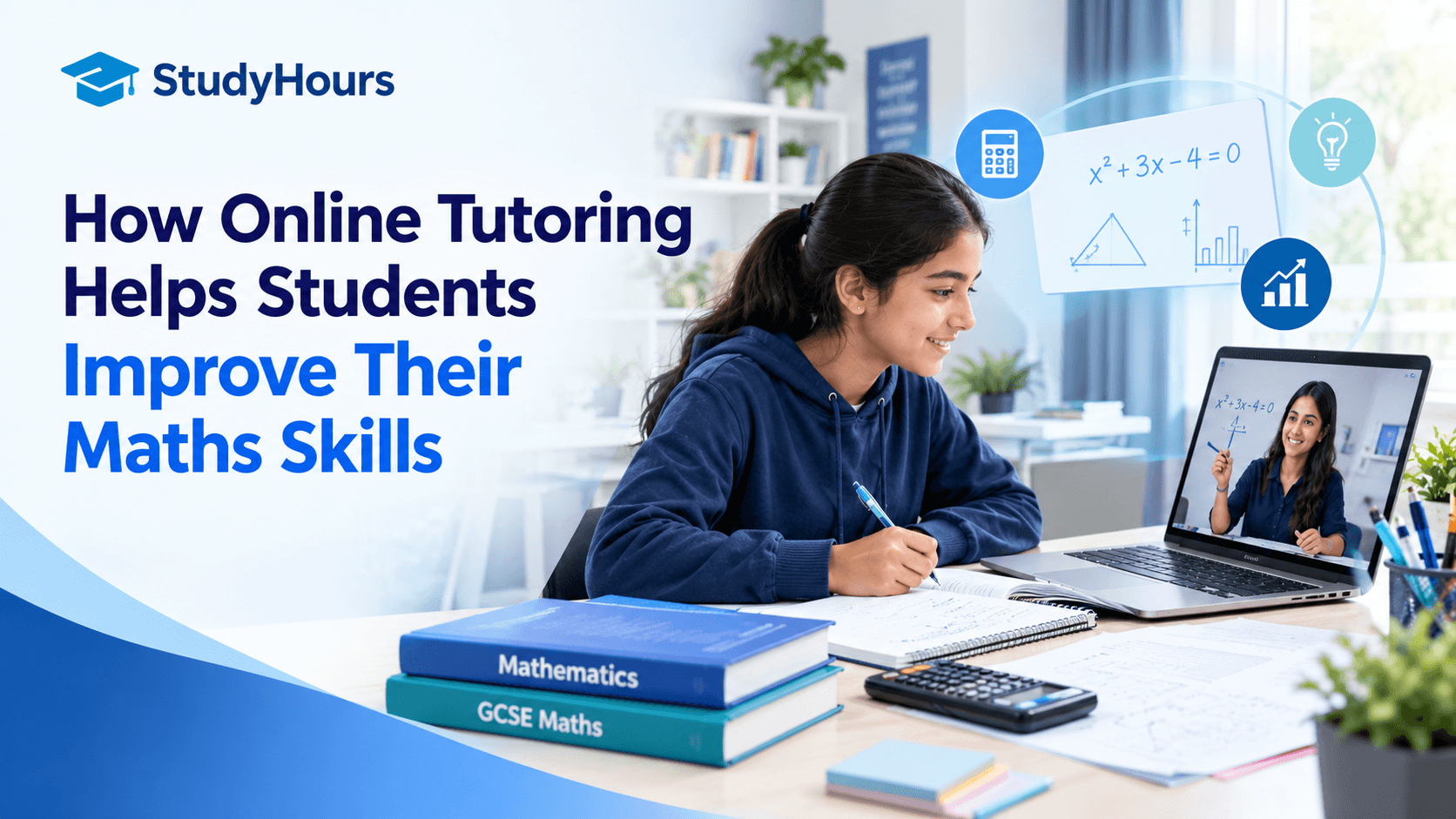
Mathematics is an important part of a child's education, from learning basic numbers and arithmetic in primary school to solving algebraic equations, interpreting graphs and applying advanced concepts in secondary school.
Strong maths skills can also support learning in subjects such as physics, chemistry, economics and computer science.
However, not every student finds mathematics easy. Some children struggle to understand fundamental concepts, while others find multi-step problems, fractions, algebra or geometry increasingly challenging as they progress through school.
A student who falls behind may lose confidence and begin to avoid practising the subject altogether.
Online maths tutoring can provide additional opportunities to revisit difficult topics, ask questions and practise at an appropriate pace.
With individual attention and a structured learning plan, students can work towards understanding mathematical concepts rather than relying on memorised procedures.
This guide explains how online tutoring can support maths learning, which challenges it can address, how parents can recognise when additional help may be useful, and what to look for when choosing a maths tutor.
Why Do Students Struggle With Mathematics?
Mathematics builds on previously learned concepts. Students need to understand foundational skills before they can confidently apply more advanced methods.
When an earlier concept remains unclear, new topics may become harder to understand.
Recognising the underlying difficulty is often more useful than simply asking a child to complete more questions.
Gaps in Foundational Maths Skills
Some students progress to advanced topics without fully understanding number relationships, place value, multiplication, division or fractions.
For example, a student who struggles with multiplication facts may find long division and algebraic manipulation more difficult.
Similarly, weak fraction skills can create problems when learning ratios, percentages and equations.
Revisiting the relevant foundations can help students develop a clearer understanding of later concepts.
Difficulty Understanding Mathematical Concepts
Students may know which formula to use in a familiar exercise but struggle when a question is presented differently.
This can happen when learning has focused heavily on memorising steps rather than understanding why a method works.
A useful approach is to explain the concept using examples, diagrams, practical situations and guided questions. Students should then practise applying the same idea to different problems.
Anxiety About Making Mistakes
Some students become nervous when solving maths problems, particularly if they have experienced repeated difficulties or feel pressured to answer quickly.
This anxiety may lead them to avoid questions, rush through calculations or give up when a problem requires several steps.
A supportive learning environment can help students approach mistakes as part of the learning process.
Encouraging them to explain their reasoning and correct errors can gradually improve confidence.
Challenges With Multi-Step Problems
Word problems and longer examination questions often require students to interpret information, identify relevant details, select a suitable method and check the final answer.
Students may understand the mathematical operations involved but struggle to decide which steps to use.
Breaking a question into smaller parts can make the reasoning process easier to follow.
Changes in Curriculum and Difficulty
Maths becomes more demanding as students move through school. Topics such as fractions, algebra, geometry, functions, probability and statistics require increasingly flexible thinking.
Students following different national or international curricula may also encounter different topic sequences, terminology and assessment formats.
Additional support is most effective when it reflects the student's actual grade, curriculum and current learning objectives.
How Online Maths Tutoring Helps Students Learn
Online maths tutoring provides a way for students to receive focused academic support outside their regular classroom lessons. Its value comes from how the sessions are structured and how well they address the student's individual needs.
1. Personalised Lessons Based on Learning Needs
Students do not all experience the same difficulties. One learner may need help with fractions, while another may understand the basics but struggle with algebraic equations or examination questions.
One-to-one tutoring allows the tutor to focus on the student's current understanding and adjust the explanation or pace when necessary.
Instead of moving through every topic at the same speed, sessions can prioritise the concepts that need the most attention.
For families exploring individual academic support, K–12 online tutoring with StudyHours provides a starting point for learning about personalised tutoring options across school stages.
2. Clear Explanations of Difficult Concepts
Mathematical ideas can be explained in different ways. A student who does not understand a textbook explanation may benefit from a diagram, worked example, visual model or practical application.
For example, fractions can be introduced using parts of a whole before progressing to numerical calculations.
Algebra can begin with simple patterns and unknown values before moving to equations containing multiple operations.
Online lessons can use shared digital whiteboards, written working and visual examples to demonstrate each step.
The aim is to help students understand the reasoning behind a method, not simply copy the final answer.
3. Immediate Feedback and Error Correction
When students practise independently, they may repeat the same mistake without realising why the answer is incorrect.
A tutor can review the student's working, identify the point where the error occurred and explain how to correct it.
For example, if a student makes a sign error while solving an algebraic equation, the tutor can show how the mistake affects the following steps and provide similar questions for practice.
This type of feedback helps students learn from errors and develop more reliable problem-solving habits.
4. Practice at an Appropriate Pace
Some concepts require repeated practice before students can use them confidently. Others become easier once a particular misunderstanding has been resolved.
Individual tutoring can provide additional time for challenging topics without requiring the student to keep pace with an entire classroom.
Students can work through simpler examples first, progress to more complex questions and revisit earlier material when needed.
The pace should remain purposeful: students need enough practice to build understanding, but they should also gradually learn to solve questions independently.
5. Improved Problem-Solving Skills
Successful maths learning involves more than knowing formulas. Students must understand the question, select an appropriate method, carry out calculations accurately and interpret the result.
A tutor can encourage students to explain each step and consider why a particular method is suitable.
Over time, this can help learners approach unfamiliar questions more systematically.
6. Support for Schoolwork and Examination Preparation
Students may need different types of maths support at different points in the school year.
During regular lessons, they may need help understanding new concepts or completing practice exercises.
Before examinations, they may need to revise several topics, improve time management and become familiar with question formats.
Tutoring can complement classroom learning by focusing on current school topics, relevant practice questions and the student's identified weaknesses.
Exam preparation should use materials that match the student's curriculum and current assessment requirements.
How Online Maths Tutoring Supports Different School Stages
The kind of support a student needs depends on their age, curriculum and stage of mathematical development.
Primary School Maths Tutoring
Primary school maths focuses on building the foundations that support future learning.
Students may work on:
Number recognition and place value.
Addition, subtraction, multiplication and division.
Fractions, decimals and percentages as appropriate to their grade.
Measurement, shapes and basic geometry.
Patterns and simple problem-solving.
Interpreting mathematical information.
At this stage, students often benefit from clear explanations, visual examples and short, varied practice activities.
For example, a tutor may use number lines or visual representations to help a child understand fractions before introducing more abstract calculations.
Parents can also reinforce learning through everyday activities, such as measuring ingredients, comparing prices or discussing time and distance.
Middle School Maths Tutoring
During middle school or lower secondary education, students begin working with more abstract concepts and increasingly complex problems.
Common topics include fractions, ratios, percentages, integers, algebra, geometry, probability and statistics, depending on the curriculum.
A tutor can help students connect foundational knowledge with new concepts.
For instance, understanding equivalent fractions can support later work with ratios and algebraic expressions.
A clear grasp of negative numbers can also make algebraic calculations easier.
Students at this stage benefit from practising how to explain their reasoning rather than relying solely on memorised procedures.
High School Maths Tutoring
Secondary school mathematics may include more advanced algebra, functions, trigonometry, coordinate geometry, statistics and calculus, depending on the student's programme.
Students may also need to prepare for formal examinations, where accuracy, clear working and time management are important.
Tutoring at this stage can focus on specific topics, examination-style questions, mathematical reasoning and reviewing recurring mistakes.
Students preparing for qualifications such as GCSEs, IGCSEs, A-Levels or other curriculum-specific assessments should receive support aligned with their actual syllabus and examination board.
What Maths Topics Can Online Tutoring Help With?
Online tutoring can support a wide range of mathematical topics. The exact content depends on the student's grade, curriculum and learning objectives.
Arithmetic and Number Skills
Arithmetic provides the foundation for many later maths topics. Students need to understand number relationships, operations, estimation and calculation accuracy.
Tutoring can help students identify common mistakes, strengthen mental maths where appropriate and understand how different operations relate to one another.
Fractions, Decimals and Percentages
Fractions, decimals and percentages are closely connected, but students may struggle to move confidently between them.
For example, a student might know how to calculate a percentage but find it difficult to apply the concept to discounts, ratios or multi-step word problems.
Visual representations, worked examples and progressively challenging questions can help students understand these relationships.
Algebra
Algebra introduces symbols to represent unknown values and relationships. Students may need to simplify expressions, solve equations, manipulate formulas or identify patterns.
Difficulties often arise when students have not fully understood negative numbers, the order of operations or the meaning of variables.
A tutor can break down each step and help the student practise applying the same principles to different equations.
Geometry and Measurement
Geometry involves understanding shapes, angles, properties, measurements and spatial relationships.
Students may struggle to identify which information is relevant to a problem or which formula should be applied.
Diagrams and clearly labelled worked examples can help learners connect mathematical rules with visual information.
Statistics and Probability
Statistics and probability require students to interpret data, understand distributions, calculate measures and reason about uncertainty.
Students may need help distinguishing between different methods or explaining what a numerical result means in context.
Practice with graphs, tables, examples and real-world scenarios can help them build these skills.
Advanced Mathematics
Older students may study functions, trigonometry, calculus and other advanced topics, depending on their curriculum.
Tutoring can help them revisit prerequisite knowledge, understand complex methods and practise applying concepts to examination-style questions.
For students following a specific qualification, the tutor should use the relevant syllabus and assessment criteria.
Online Maths Tutoring vs Independent Practice
Independent practice is an essential part of maths learning. Students need opportunities to solve questions without assistance so they can build confidence and recognise what they understand.
However, independent practice may be less productive when a student repeatedly makes the same mistakes or does not understand the underlying concept.
Online tutoring can complement independent study by providing explanation and feedback before the student returns to practising independently.
A balanced approach includes three stages:
Understand: Learn the concept through an explanation, example or visual model.
Practise: Attempt questions with guidance when necessary, then solve similar problems independently.
Review: Identify mistakes, revisit difficult steps and practise again to check understanding.
This process helps students move from following a demonstrated method to applying it on their own.
How Parents Can Tell If Their Child Needs Maths Support
Not every mistake indicates a serious problem. Students need time to learn new concepts, and occasional difficulty is a normal part of education.
However, some patterns may suggest that additional support would be useful.
Repeated Mistakes in the Same Topic
If a student repeatedly struggles with the same concept despite practising, they may need a different explanation or help with an earlier skill.
Reviewing the student's working can reveal whether the issue involves understanding, calculation accuracy or choosing the right method.
Homework Takes an Unusually Long Time
Long homework sessions can result from several factors, including distractions, unclear instructions or difficulty understanding the material.
Rather than assuming the student needs to work harder, identify which part of the task is causing the delay.
If they cannot begin a question without assistance, they may need to revisit the relevant concept.
Declining Confidence in Mathematics
A student who regularly describes maths as impossible or avoids the subject may be losing confidence.
Parents can encourage them to identify specific difficulties rather than treating maths as one large problem.
Small, achievable goals can help students recognise progress and become more willing to attempt challenging questions.
Difficulty Applying Knowledge to New Questions
Some students can complete familiar exercises but struggle when the question changes format.
This may indicate that they understand the steps superficially but have not yet developed a deeper understanding of the concept.
Ask the student to explain why a method works and practise using it in different situations.
Preparing for Important Assessments
Students may seek extra support before school tests or formal examinations, especially if several topics need revision.
Starting early gives them time to identify weak areas, practise exam-style questions and improve their approach without relying entirely on last-minute study.
How to Choose the Right Online Maths Tutor
Choosing a suitable tutor involves considering the student's academic needs, curriculum and learning preferences.
Check Subject and Curriculum Knowledge
The tutor should understand the topics and expectations relevant to the student's school stage.
If the student follows a specific curriculum or examination board, ask whether the tutor is familiar with the relevant syllabus and assessment approach.
Look for a Structured Learning Approach
A productive session should have a clear purpose.
The tutor may begin by checking the student's understanding, explain a difficult concept, guide practice and finish by identifying what the student should work on independently.
This structure helps ensure that sessions address specific learning goals.
Consider Communication and Teaching Style
Students should feel comfortable asking questions and explaining when they do not understand something.
Look for an approach that encourages participation, explains mistakes constructively and adapts examples to the student's level.
Ask How Progress Will Be Reviewed
Useful progress reviews focus on specific evidence, such as improved accuracy, stronger explanations, fewer recurring mistakes or greater independence.
Parents should be able to understand which areas have improved and what still needs practice.
No tutor can guarantee a particular grade or result, but a clear learning plan can make the support more focused and easier to evaluate.
How StudyHours Can Support K–12 Maths Learning
Students may need help with foundational number skills, school mathematics, challenging secondary topics or examination preparation.
The most appropriate support depends on their current understanding and learning goals.
StudyHours offers K–12 online tutoring for families exploring individual academic support across school stages and subjects.
When considering maths tutoring, parents can begin by identifying the topics their child finds difficult, the curriculum they follow and any feedback received from school. This information helps clarify the type of support that may be useful.
One-to-one sessions can then focus on explaining concepts, working through examples, practising relevant questions and encouraging students to complete similar tasks independently.
The aim is to complement school learning and help students develop stronger understanding, more effective problem-solving habits and greater confidence in their own work.
Practical Tips for Helping Children Improve Maths at Home
Tutoring and classroom instruction are only part of the learning process. Regular practice outside lessons can reinforce concepts and help students become more independent.
Encourage Short, Regular Practice Sessions
Consistent practice can help students revisit concepts without feeling overwhelmed by a large amount of work.
Choose activities appropriate to the student's age and current level. Short sessions with a clear objective may be more manageable than long periods of unfocused revision.
Ask Children to Explain Their Answers
Instead of asking only whether an answer is correct, ask how the student arrived at it.
Explaining a method helps reveal whether they understand the process or have guessed the answer.
It also gives parents an opportunity to notice misunderstandings and encourage clearer reasoning.
Connect Maths to Everyday Life
Everyday situations can make mathematical ideas more meaningful.
Cooking can involve measurement and fractions, shopping can involve prices and percentages, and travel can involve time and distance.
These activities should complement formal learning rather than replace practice of the required curriculum.
Treat Mistakes as Learning Opportunities
Avoid making every incorrect answer feel like a failure.
Help the student locate the first incorrect step, understand why it happened and try a similar question again.
The goal is to develop a reliable method that the student can use independently.
Celebrate Progress in Specific Ways
Recognise improvements such as explaining a concept clearly, checking calculations carefully or attempting a difficult problem without giving up.
Specific feedback helps children understand which learning behaviours are useful and encourages them to keep practising.
Frequently Asked Questions About Online Maths Tutoring
Can online tutoring help a child who struggles with maths?
Online tutoring can provide individual explanations, guided practice and feedback on difficult topics.
Its usefulness depends on the student's needs, the tutor's approach and the consistency of practice between sessions.
At what age can children start online maths tutoring?
The appropriate age depends on the child's learning needs, attention span and comfort with online lessons.
Younger students may benefit from shorter, interactive sessions, while older students may need more extended subject-focused practice.
Can an online maths tutor help with school homework?
A tutor can help students understand the concepts and methods needed to approach homework.
The aim should be to develop independent problem-solving rather than simply provide answers.
How often should a student have maths tutoring?
The frequency depends on the student's goals, current understanding, available time and workload.
Some students may benefit from regular weekly support, while others may need a different arrangement around particular topics or assessments.
Is online maths tutoring suitable for primary and secondary students?
It can be suitable for both, provided lessons are adapted to the student's age, curriculum and learning objectives.
Younger students may need more visual and interactive activities, while older students may focus on advanced concepts and examination preparation.
How can parents measure progress in maths?
Parents can review accuracy, the ability to explain methods, performance on relevant practice questions and confidence when approaching unfamiliar problems.
Progress should be considered over time rather than judged by a single test.
Final Thoughts
Mathematics becomes easier to manage when students understand the concepts behind the methods they use.
Strong foundations, regular practice and constructive feedback can help learners approach increasingly challenging topics with greater confidence.
Online maths tutoring can complement classroom learning by giving students time to ask questions, revisit difficult concepts and practise problem-solving at an appropriate pace.
For parents, the first step is to identify the specific difficulties their child is experiencing and establish realistic learning goals.
With suitable guidance and consistent independent practice, students can work towards stronger mathematical understanding and more confident learning habits.
Families interested in personalised academic support can explore StudyHours K–12 online tutoring to learn more about tutoring options for students at different school stages.
Published by StudyHours Global Editorial Board