Ask parents in Dubai, Abu Dhabi, or another part of the UAE what they think about the IB curriculum, and you will probably hear very different opinions.
Some parents describe it as academically demanding. Others like it because it is internationally recognised and gives students exposure to different subjects and ways of thinking.
Some families choose it because they expect to move between countries, while others are attracted to its emphasis on research, independent learning and critical thinking.
But what exactly is the IB curriculum, and what does studying IB actually involve?
The International Baccalaureate is more than a final school examination or a single qualification.
It is an international education framework made up of different programmes for students at different stages of their education.
The IB has become an important part of the private-school landscape in the UAE, particularly in international schools across Dubai, Abu Dhabi and other Emirates.
This guide explains what the IB curriculum means, how the different IB programmes work, what students study, how assessment is handled, how IB compares with other curricula in the UAE, and what parents should consider before choosing an IB school.
Understanding the IB Curriculum
The International Baccalaureate (IB) is an international education framework designed to develop students who are curious, independent and capable of thinking critically.
Rather than focusing only on memorising information, IB programmes encourage students to ask questions, investigate ideas, evaluate evidence, communicate effectively and apply what they learn in different situations.
The IB is administered by the International Baccalaureate Organization, and schools must be authorised to deliver IB programmes.
These authorised schools are known as IB World Schools.
One common misunderstanding is that the IB is simply the two-year Diploma Programme taken in the final years of school.
It is actually broader than that.
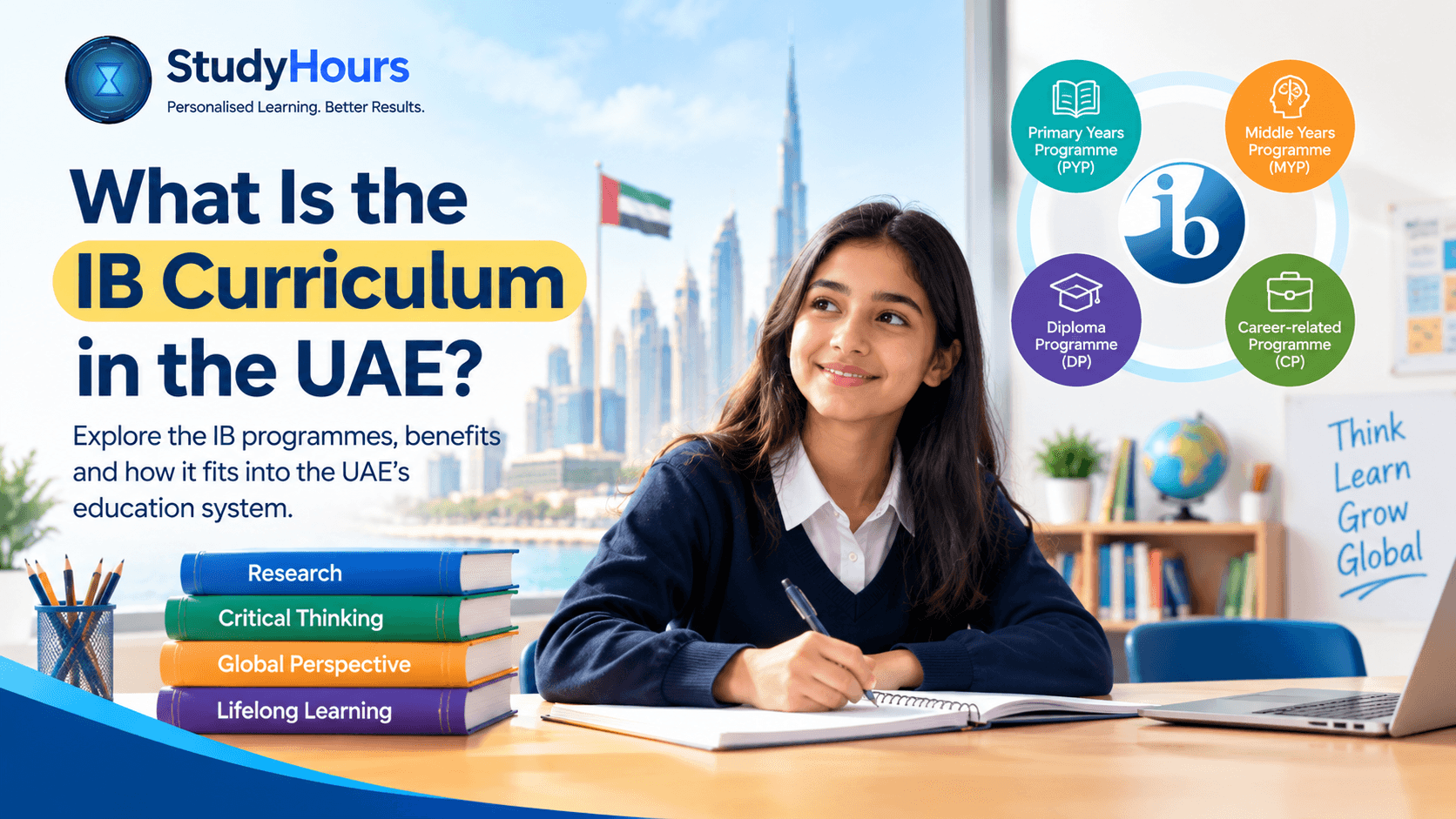
The IB offers four programmes:
Primary Years Programme (PYP)
Middle Years Programme (MYP)
Diploma Programme (DP)
Career-related Programme (CP)
A school may offer one programme or several, so parents should always check exactly which IB programmes are available before choosing a school in the UAE.
What Does IB Stand For?
IB stands for International Baccalaureate.
The word "international" reflects the global nature of the programme.
IB schools operate in many countries, allowing students to follow a broadly consistent educational framework even if their families relocate.
For families living in the UAE, this can be particularly useful.
The UAE is home to a highly international population, and many families move between countries because of work, business or family commitments.
A child who has already studied the IB in another country may find the general structure familiar when joining an IB World School in Dubai or Abu Dhabi.
However, the experience can still vary from school to school.
The IB provides the framework, but individual schools determine how that framework is delivered in their classrooms.
How Does the IB Curriculum Work in the UAE?
The IB operates within the UAE's wider private education system.
Private schools are regulated at the emirate level.
In Abu Dhabi, private schools are regulated by the Abu Dhabi Department of Education and Knowledge (ADEK), while private schools in Dubai are regulated by the Knowledge and Human Development Authority (KHDA).
Other Emirates have their own education authorities and regulatory arrangements.
This means that choosing an IB school in the UAE involves looking at more than the IB framework itself.
Schools also need to meet applicable UAE educational requirements.
Depending on the school and student's circumstances, programmes can include UAE-related subjects and requirements such as Arabic and Islamic Education, alongside the international curriculum.
The exact way these requirements fit around an IB programme can differ between schools.
For parents considering an IB school in the UAE, several practical points are worth remembering.
Availability differs between schools
Not every IB World School offers all four IB programmes.
One school may offer the PYP and MYP but not the Diploma Programme.
Another may focus primarily on the IB Diploma.
Always check which programmes are available and the ages or grades they cover.
IB schools can feel very different
The IB is a framework rather than a guarantee of teaching quality.
Two IB schools in Dubai or Abu Dhabi can have very different teaching styles, academic expectations, facilities, extracurricular opportunities and student-support systems.
The school's overall quality matters just as much as the curriculum label.
Look at school inspection information
Parents should also consider the relevant school inspection and regulatory information when comparing schools.
For Dubai families, KHDA information can provide useful context. Abu Dhabi families can look at ADEK's school information and inspection framework.
The goal is to compare the actual school environment rather than choosing a school simply because it offers IB.
What Are the Different IB Programmes?
The IB is divided into four programmes designed for different stages of a student's education.
Although they share the same broad educational philosophy, each programme has its own structure and objectives.
Primary Years Programme (PYP)
The IB Primary Years Programme is designed for younger students, generally from ages 3 to 12.
The PYP takes a transdisciplinary approach to learning.
Instead of treating every subject as completely separate, students are encouraged to explore themes and questions that connect different areas of knowledge.
A child may therefore study ideas through language, mathematics, science, social studies and other areas while developing connections between them.
The programme places emphasis on inquiry, communication, research, reflection and taking action.
For younger students in UAE IB schools, parents may notice that classroom activities focus not only on what children know but also on how they approach learning.
Students are encouraged to ask questions, investigate topics and explain their thinking.
The final year of the PYP commonly includes an exhibition where students demonstrate what they have learned through a collaborative or independent inquiry project.
Middle Years Programme (MYP)
The IB Middle Years Programme generally covers students from around ages 11 to 16.
It provides a broad academic programme that includes areas such as:
Language and literature
Language acquisition
Individuals and societies
Sciences
Mathematics
Arts
Physical and health education
Design
One of the main aims of the MYP is to help students understand connections between different subjects.
Students also develop research, communication, critical-thinking and organisational skills.
Towards the end of the programme, students generally complete a Personal Project, which gives them an opportunity to explore a topic of personal interest through independent work.
The exact way an MYP school structures its final years can vary.
Some schools may also offer additional qualifications alongside the MYP, so parents should ask the school how its programme is organised.
Diploma Programme (DP)
The IB Diploma Programme is the programme most commonly associated with the IB.
It is generally designed for students aged approximately 16 to 19 and is completed over two years.
The DP is a pre-university programme and combines subject study with three core components:
Theory of Knowledge (TOK)
Extended Essay (EE)
Creativity, Activity, Service (CAS)
Students study six subjects while also completing these core requirements.
The DP is academically demanding, but it is also designed to develop skills that can be useful beyond school, including research, communication, organisation and independent thinking.
Career-related Programme (CP)
The IB Career-related Programme is also aimed at students around ages 16 to 19.
It combines IB Diploma Programme courses with career-related education.
Students complete academic study alongside career-focused learning and a core involving areas such as personal and professional development, service learning and a reflective project.
The CP is less widely available than the Diploma Programme, so UAE families interested in it should check which schools offer it.
What Do Students Study in the IB Curriculum?
The subjects students study depend on their IB programme.
Younger students in the PYP follow a broader inquiry-based programme rather than simply choosing individual examination subjects.
MYP students generally study a wide range of subjects across different areas.
The Diploma Programme is more formally organised around six subject groups.
These include:
Studies in Language and Literature
Language Acquisition
Individuals and Societies
Sciences
Mathematics
The Arts
Depending on the student's school and subject choices, subjects may include English, Arabic, Economics, Business Management, History, Geography, Biology, Chemistry, Physics and Mathematics, among others.
Students normally take some subjects at Higher Level (HL) and others at Standard Level (SL).
Higher Level subjects involve greater depth and generally require more teaching time.
This makes subject selection particularly important.
For example, a UAE student planning to study Engineering at university may need particular Mathematics and Science subjects.
A student interested in Economics may need to consider the appropriate combination of Mathematics, Economics and other subjects.
University plans should therefore be considered before final DP subject choices are made.
Parents should also check the subject options available at their chosen school because not every IB school in Dubai or Abu Dhabi offers exactly the same combinations.
How Is the IB Curriculum Assessed?
Assessment in IB programmes depends on the student's age and programme.
The Diploma Programme has the most detailed and formal assessment structure.
Assessment in the IB Diploma Programme
DP assessment generally combines internal assessment and external assessment.
Internal Assessment
Internal Assessments, commonly known as IAs, are pieces of coursework completed during the programme.
Depending on the subject, an IA might involve an investigation, written work, analysis, experiment, presentation or another subject-specific task.
Teachers assess students' work according to IB criteria, with moderation processes used to maintain consistency.
The exact assessment format differs between subjects.
External Assessment
The Diploma Programme also includes externally assessed examinations and other externally marked components.
Students generally complete their final examinations towards the end of the two-year programme.
Each DP subject is graded on a scale from 1 to 7.
The final Diploma score is based on the student's subject results together with the relevant core components.
What Are TOK, the Extended Essay and CAS?
The three DP core components are an important part of what makes the IB Diploma different from many other secondary-school programmes.
Theory of Knowledge (TOK)
Theory of Knowledge encourages students to think about knowledge itself.
Students explore questions about evidence, reasoning, perspective and how people decide whether something is reliable or true.
Rather than simply asking students to remember information, TOK encourages them to examine how knowledge is created and evaluated.
Extended Essay (EE)
The Extended Essay is an independent research project of up to 4,000 words.
Students choose a focused research question and develop an extended piece of academic writing around it.
The process requires students to research, organise information, evaluate sources and develop an argument.
For many UAE students, the Extended Essay is one of their first experiences of completing a substantial independent research project.
Creativity, Activity, Service (CAS)
CAS encourages students to participate in activities beyond traditional academic study.
It includes experiences connected to creativity, physical activity and service.
Students reflect on their experiences and what they learn from them.
CAS is not simply another examination subject, but it is an important part of completing the Diploma Programme.
Why Do UAE Families Choose the IB Curriculum?
Families choose IB schools in the UAE for many different reasons.
There is no single reason that applies to everyone.
International outlook
The UAE is an international country, and many families value an education that encourages students to understand different cultures, perspectives and global issues.
The IB's international orientation can be attractive to families who expect their children to study or work in different countries.
Critical thinking
IB programmes place significant emphasis on questioning, analysis and evaluation.
Students are often encouraged to explain not only what they think but why they think it.
Research and independent learning
The Extended Essay, Internal Assessments and inquiry-based learning can help students develop research and organisational skills.
These skills can be useful when students move into university-level study.
Breadth of education
The IB Diploma requires students to maintain a broad academic programme.
Students do not specialise entirely in one area during the DP.
This can suit students who want to continue studying languages, mathematics, sciences, humanities and other areas.
International mobility
Because IB programmes are offered in many countries, they can be attractive to families who may relocate internationally.
However, parents should still plan transitions carefully because schools can differ in subject choices, academic calendars and programme implementation.
What Are the Challenges of the IB Curriculum?
The IB has many strengths, but it is not the right fit for every student.
Parents should understand the challenges before choosing it.
Workload
The Diploma Programme involves six subjects alongside TOK, the Extended Essay and CAS.
Students need to balance several responsibilities at the same time.
Time management
Deadlines can overlap.
A student may have an IA deadline, school assessments, Extended Essay work and examination preparation happening during the same period.
Strong planning becomes increasingly important.
Independent research
IB students are expected to become increasingly independent.
Students who are accustomed to having every step explained by a teacher may need time to adjust.
Balancing different subjects
The Diploma requires students to study a range of subjects.
A student may be excellent at Mathematics and Physics but find a language or humanities subject more challenging.
Because all parts of the programme matter, students need to manage their overall workload rather than focusing only on their strongest subjects.
Examination preparation
DP examinations cover substantial amounts of content.
Students need to develop effective revision habits rather than leaving preparation until the final weeks.
These challenges do not mean that the IB is unsuitable.
They simply mean that students need organisation, consistency and appropriate academic support.
IB Curriculum vs Other Curricula in the UAE
Parents in the UAE often compare IB with other popular international curricula.
IB vs American Curriculum
The American curriculum generally uses continuous assessment throughout the school year and offers greater flexibility in electives, particularly during high school.
The IB Diploma follows a more structured combination of six subject groups alongside TOK, the Extended Essay and CAS.
American curriculum schools may also offer AP courses depending on the school.
IB vs British Curriculum
The British pathway generally leads students towards IGCSE or GCSE qualifications and then A-Levels.
A-Level students normally specialise in fewer subjects and study them in greater depth.
The IB Diploma maintains greater breadth across six subject groups.
IB vs CBSE
CBSE follows a structured Indian national syllabus and is particularly popular among Indian families in the UAE.
Students in the senior years work towards important board examinations.
The IB places greater emphasis on inquiry, coursework, research and a broad subject combination.
Both can lead to universities in the UAE and abroad, but the best option depends on the student's goals and learning style.
Is the IB Curriculum Suitable for Every Student?
No.
The IB can be a strong choice for students who:
Enjoy learning across several subjects
Like asking questions and exploring ideas
Are comfortable with research and writing
Can manage long-term assignments
Enjoy independent learning
Are interested in international education
Want to keep several academic options open
On the other hand, students who strongly prefer highly structured instruction, a narrower subject focus or fewer long-term coursework requirements may find another curriculum more comfortable.
The key is not to choose IB because it is considered prestigious.
Choose it because the learning environment matches the student.
Does the IB Curriculum Help With University Admission?
The IB Diploma is considered by universities in the UAE and many countries around the world.
Students may apply to universities in the UAE, United States, United Kingdom, Canada, Australia, Europe and other destinations.
However, IB does not guarantee admission.
University requirements vary by institution and degree programme.
Some courses may require specific subjects or minimum grades, and certain UAE universities may have additional certificate equivalency or attestation requirements.
Parents should therefore research university requirements before students make their final subject selections.
For example, a student interested in Engineering, Medicine, Business or another specialised field should check the required subjects and grades well before completing the DP.
How Can IB Students Get Additional Academic Support?
Even students who generally perform well can experience difficulties during the IB.
A student might struggle with HL Mathematics, Physics, Chemistry, Biology, Economics or English.
Another student may understand the subject but struggle with time management, exam technique, Internal Assessment requirements or the Extended Essay.
Students joining an IB school after studying another curriculum may also need time to adjust to different expectations.
Additional academic support can help students understand difficult concepts, organise their study schedules and prepare for assessments.
Families looking for personalised one-to-one support can consider online IB tutoring in Dubai, particularly when a student needs help with a specific subject, HL or SL preparation, exam technique or understanding IB assessment expectations.
The most useful support should complement the student's school programme rather than replace it.
Parents should also make sure that any support with Internal Assessments or the Extended Essay follows IB academic-integrity requirements.
Tutors can explain requirements, discuss concepts and provide feedback, but the student's submitted work must remain their own.
At home, parents can also help by encouraging consistent routines, breaking large assignments into manageable steps and helping students avoid leaving major projects until the last minute.
Common Mistakes Parents Make When Choosing an IB School
Choosing IB Simply Because It Is International
Being internationally recognised does not automatically mean it is the best choice for every student.
Look at whether your child actually suits the learning approach.
Assuming Every IB School Is the Same
The IB framework may be consistent, but schools can differ considerably in teaching quality, facilities, academic expectations and student support.
Focusing Only on the Diploma
The IB includes PYP, MYP, DP and CP.
If your child is younger, look at how the school delivers the programme at your child's specific age rather than judging the school only by its DP results.
Ignoring University Plans
Subject selection can affect future university options.
Families should research potential university requirements early.
Underestimating Time Management
The IB involves several overlapping academic responsibilities.
Students should develop organisation and planning skills before the workload becomes overwhelming.
A Practical Way to Decide If IB Is Right for Your Child
If you are considering an IB school in the UAE, start with your child's learning style.
Ask yourself:
Does your child enjoy asking questions?
Do they like research and writing?
Can they manage several deadlines?
Are they comfortable studying different types of subjects?
Do they enjoy independent projects?
Then look at the schools available in your area.
If you live in Dubai, compare the IB programmes offered by shortlisted schools and review their KHDA information.
If you live in Abu Dhabi, compare schools under the ADEK framework and check which IB programmes they offer.
Also consider practical factors such as:
School location
Tuition fees
Programme availability
Subject choices
Academic results
Teacher quality
University guidance
Student support
Extracurricular activities
School culture
Finally, speak with the school.
Ask how the school supports students who struggle academically, how it manages the DP workload, which HL and SL subjects are available and how it prepares students for university.
The Bottom Line
The IB curriculum in the UAE is more than a final examination.
It is an international education framework that covers students from early years through secondary education through the PYP, MYP, DP and CP.
Its strengths include inquiry-based learning, critical thinking, research, international awareness and a broad academic approach.
At the same time, the IB can be demanding.
Students need to manage coursework, assessments, deadlines and, in the Diploma Programme, six subjects alongside TOK, the Extended Essay and CAS.
For UAE families, the best approach is not to ask whether IB is simply "better" than another curriculum.
Instead, consider whether it matches your child's learning style, academic strengths and future plans.
Look beyond the curriculum name and evaluate the individual school.
A strong IB school with effective teachers and student support can provide an excellent environment for the right student.
Frequently Asked Questions
What is the IB curriculum in the UAE?
The IB curriculum is an international education framework offered by authorised IB World Schools in the UAE.
It includes four programmes: PYP, MYP, DP and CP, covering different stages of a student's education.
What does IB stand for?
IB stands for International Baccalaureate. It refers to an international education framework designed around inquiry, critical thinking, research and broad academic development.
What are the four IB programmes?
The four programmes are the Primary Years Programme (PYP), Middle Years Programme (MYP), Diploma Programme (DP) and Career-related Programme (CP).
Is the IB curriculum recognised in the UAE?
IB programmes are offered by authorised private schools in the UAE, and IB qualifications are considered by universities in the UAE and internationally.
Specific admission, equivalency and attestation requirements can vary between institutions.
Is IB harder than CBSE or the American curriculum?
It is difficult to make a simple comparison.
The IB can be demanding because students manage multiple subjects, coursework, research and independent projects.
CBSE and American curricula have different academic structures and forms of assessment.
The better question is which type of learning and assessment suits the student.
What is the IB Diploma Programme?
The IB Diploma Programme is a two-year pre-university programme generally taken by students aged 16 to 19. Students study six subjects and complete TOK, the Extended Essay and CAS.
What subjects do IB students study?
DP students select subjects from six broad groups covering language and literature, language acquisition, individuals and societies, sciences, mathematics and the arts. Subject availability varies between UAE schools.
Is IB good for university admission?
The IB Diploma is accepted by universities in the UAE and many international destinations.
However, admission requirements differ by university and degree programme, so students should check specific requirements before selecting their final IB subjects.
Can IB students study at UAE universities?
Yes. IB students can apply to universities in the UAE, subject to each institution's academic, certificate and admission requirements.
Do IB students in the UAE need additional tutoring?
Not necessarily.
Some students manage the IB successfully without tutoring, while others benefit from one-to-one support in subjects such as Mathematics, Physics, Chemistry, Biology, Economics or English, or with exam preparation and study planning.
Can students move into the IB from another curriculum?
Yes.
Students may move from British, American, CBSE or other curricula into an IB school.
However, the transition can involve differences in subject content, assessment methods and independent learning expectations, particularly when entering the Diploma Programme.
Published by StudyHours Global Editorial Board