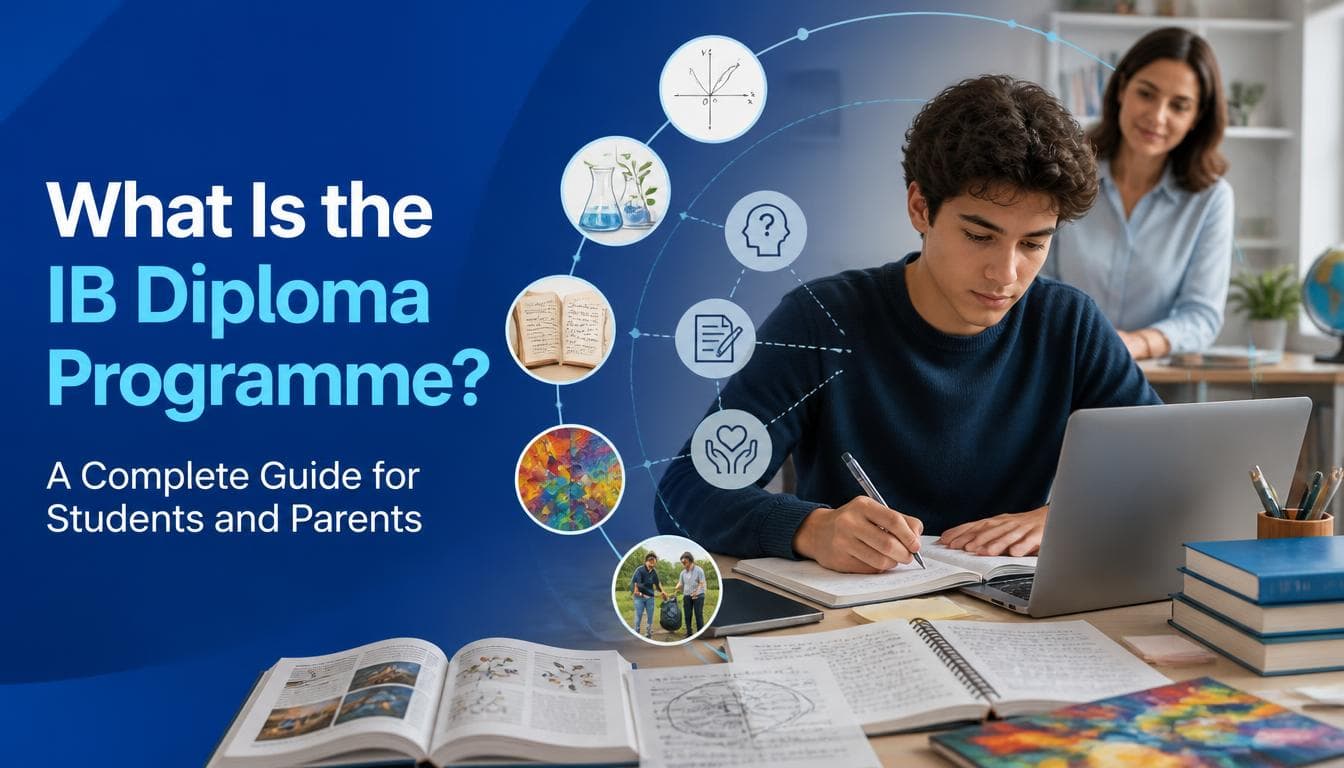
The International Baccalaureate (IB) Diploma Programme is a globally recognised educational pathway designed to prepare students for university and further learning.
It combines academic study across different subjects with independent research, critical thinking and practical experiences.
For students aged 16–19, the programme offers an opportunity to explore their interests while developing the skills needed for higher education.
However, the IB Diploma Programme can also feel demanding. Students must balance multiple subjects, internal assessments, examinations, the Extended Essay and Theory of Knowledge, alongside Creativity, Activity, Service (CAS).
Understanding how these components fit together can make the programme easier to manage.
This guide explains what the IB Diploma Programme involves, how its curriculum and assessment work, what students should expect, and how to prepare for success.
What Is the IB Diploma Programme?
The International Baccalaureate Diploma Programme, commonly called the IBDP, is a two-year educational programme generally taken by students aged 16–19.
It is designed to develop subject knowledge, independent thinking, research skills and an international outlook.
Unlike programmes that focus primarily on final examinations, the IBDP combines examinations with other forms of assessment.
Depending on the subject, students may complete coursework, investigations, oral presentations, written assignments or practical tasks.
The programme also encourages students to connect ideas across different subjects rather than treating each discipline as completely separate.
Students typically choose the IBDP because they want a broad academic education that supports university applications and develops skills for further study.
However, its suitability depends on a student's interests, learning preferences, subject requirements and ability to manage a varied workload.
How Is the IB Diploma Programme Structured?
The IB Diploma Programme consists of six subject groups and three core components: Theory of Knowledge (TOK), the Extended Essay (EE), and Creativity, Activity, Service (CAS).
Students usually select six subjects, commonly taking three at Higher Level (HL) and three at Standard Level (SL).
The exact subject combination depends on the school's available courses and the student's academic goals.
The Six IB Subject Groups
1. Studies in Language and Literature
This group focuses on language, literary analysis, communication and interpretation.
Depending on the available course, students may study literature, language and literature, or other approved options.
Students develop the ability to analyse texts, construct arguments, interpret meaning and communicate ideas clearly.
2. Language Acquisition
Language acquisition courses help students develop their ability to understand and use another language.
Depending on their experience and school offerings, students may study languages such as French, Spanish, German, Mandarin or Arabic.
Progress requires regular practice in reading, writing, listening and speaking, with the balance depending on the course and assessment requirements.
3. Individuals and Societies
This group explores human behaviour, communities, history, economies and political or geographical systems.
Subjects may include Economics, Business Management, Geography, History, Psychology and Global Politics.
Students learn to interpret evidence, evaluate perspectives and apply concepts to real-world situations.
4. Sciences
The sciences group develops scientific knowledge and investigative skills.
Available subjects may include Biology, Chemistry, Physics, Computer Science and Environmental Systems and Societies, depending on the school's provision.
Students may need to combine theoretical understanding with data analysis, practical investigations and scientific explanations.
5. Mathematics
The mathematics group includes Mathematics: Analysis and Approaches (AA) and Mathematics: Applications and Interpretation (AI).
Both courses develop mathematical reasoning, but they place different emphasis on areas such as abstract mathematical thinking, modelling, applications and the use of technology.
Students should compare the course content with their strengths and future university requirements before choosing.
6. The Arts
The arts group may include subjects such as Visual Arts, Music, Theatre, Film and Dance, depending on the school.
These courses can involve creative development, practical work, reflection and analysis.
Students should check the specific assessment requirements before selecting an arts subject.
Some students may be permitted to take an additional subject from another group instead of an arts subject, subject to the programme rules and school arrangements.
What Are Higher Level (HL) and Standard Level (SL) Subjects?
Higher Level and Standard Level are two levels of study within the IB Diploma Programme.
Higher Level subjects cover a broader or deeper body of course content and generally require more teaching and learning time.
Standard Level subjects cover a smaller scope of content while still requiring students to develop subject knowledge and analytical skills.
Both HL and SL subjects contribute to the diploma score. HL is not automatically the better choice for every student.
The right combination depends on academic strengths, interests, workload and intended university course.
For example, a student considering a degree in engineering may need to pay particular attention to mathematics and physics requirements.
A student interested in economics may need to investigate the mathematics and subject expectations of their preferred universities.
Before making a decision, students should speak with their school's IB coordinator and check university entry requirements.
For a more detailed comparison, read our upcoming guide to IB HL vs SL: What Is the Difference?
Understanding the IB Diploma Core
The three core components are an essential part of the Diploma Programme. They encourage students to think critically, conduct independent research and engage with activities beyond conventional academic lessons.
Theory of Knowledge (TOK)
Theory of Knowledge encourages students to examine how knowledge is developed, interpreted and justified.
Rather than simply memorising information, students consider questions about evidence, assumptions, perspectives and the reliability of different ways of knowing.
TOK assessment includes an exhibition and an essay. Students need to understand the task requirements, develop a clear line of reasoning and support their ideas with relevant examples.
A useful approach is to practise explaining why an example supports a claim, rather than merely describing the example itself.
The Extended Essay (EE)
The Extended Essay is an independent research project that culminates in a paper of up to 4,000 words.
Students investigate a focused question related to an approved subject or an eligible interdisciplinary approach.
The process involves selecting a suitable topic, developing a research question, finding and evaluating sources, organising evidence and presenting a reasoned conclusion.
Starting early is important because the work involves more than writing the final paper.
Students need time to refine their question, review research, organise their argument and respond to supervisor guidance.
Students should make sure their research is their own work and follow their school's rules on academic honesty, referencing and the use of digital tools.
Creativity, Activity, Service (CAS)
CAS encourages students to participate in creative activities, physical activity and service experiences.
It helps students reflect on personal development, responsibility, collaboration and engagement with their communities.
CAS is not calculated as part of the numerical diploma score, but students must meet the programme's CAS requirements to receive the diploma.
Keeping a regular record of activities and reflections can help students avoid leaving documentation until the end of the programme.
How Is the IB Diploma Scored?
IB Diploma Programme subjects are generally graded on a scale from 1 to 7, with 7 representing the highest grade.
Students receive grades for their six subjects. Theory of Knowledge and the Extended Essay can contribute a combined maximum of three additional points, depending on the grades achieved. CAS does not add numerical points, but its completion is required.
The maximum possible diploma score is 45 points. A total of at least 24 points is generally required for the diploma, but students must also satisfy additional conditions relating to subject grades, HL and SL performance, and the core components.
This means that reaching a particular total is not, by itself, a guarantee of receiving the diploma.
Students should check the current official IB requirements and consult their school for guidance.
Why Predicted Grades Matter
Schools may use predicted grades when supporting university applications.
These estimates are based on a student's demonstrated performance and the school's assessment processes; they are not a guarantee of final examination results.
Students can work towards stronger performance by identifying gaps in understanding, practising subject-specific questions, improving written responses and acting on teacher feedback.
A clear study plan is more useful than revising every subject equally regardless of need. Students should prioritise the topics and skills where improvement is most likely to make a meaningful difference.
How Are IB Students Assessed?
IB assessment varies by subject and course. Most Diploma Programme subjects include final examinations, while many also include internal or coursework-based assessment.
These components may test different skills, including knowledge, application, analysis, research, communication and evaluation.
External Assessment
External assessment includes examinations and other work assessed according to IB procedures. Students need to understand the demands of each paper, including the question types, time limits and assessment criteria specified for their subject.
Practising past papers under timed conditions can help students become familiar with the format and identify weaknesses.
However, students should use the correct subject guide and examination session materials, since requirements may differ across subjects and syllabus updates.
Internal Assessment (IA)
Internal Assessment refers to subject-specific work completed during the course.
Depending on the subject, it may involve an investigation, exploration, written task, oral assessment or another form of coursework.
Strong IA preparation usually starts with understanding the assessment criteria.
Students should choose a manageable topic, plan their work, maintain accurate records and use feedback appropriately.
For example, a science investigation may require a clear research question, suitable methodology, reliable data and thoughtful evaluation.
A subject in the humanities may place greater emphasis on evidence, interpretation and a well-supported argument.
The precise requirements depend on the subject. Students should follow their current subject guide and their school's instructions.
Why Do Students Find the IB Diploma Challenging?
The IB Diploma Programme can be rewarding, but balancing its different demands requires organisation and consistency.
Managing Multiple Subjects
Students must keep up with several subjects at once, each with its own concepts, assignments and assessment schedule.
Falling behind in one subject can become difficult to manage when deadlines from other subjects arrive at the same time.
A weekly timetable can help students allocate realistic study periods to each course.
Balancing Coursework and Exam Preparation
Internal assessments and the Extended Essay require sustained effort, while examinations demand regular revision and practice.
Focusing only on coursework may leave students underprepared for exams; concentrating only on exams can cause coursework deadlines to become stressful.
Planning backwards from important deadlines helps students reserve time for both.
Understanding Assessment Criteria
Knowing a topic is not always enough to achieve a strong result. Students must also demonstrate the skills required by the question and assessment criteria.
For example, a question may ask students to evaluate, compare or discuss.
Each command term calls for a different type of response. Learning how to structure answers around the task can make revision more effective.
Developing Independent Study Skills
IB students are expected to take responsibility for their learning. They need to identify areas of uncertainty, seek clarification and use feedback to improve.
Independent learning does not mean that students must solve every difficulty alone.
Teachers, school coordinators, study groups and appropriate academic support can help them build understanding and develop more effective study habits.
Practical Tips for Succeeding in the IB Diploma Programme
1. Build a Realistic Weekly Study Plan
List upcoming examinations, coursework deadlines, lessons and extracurricular commitments. Break large assignments into smaller tasks, such as research, outlining, drafting and reviewing.
Leave some flexible time for unexpected work. A timetable that is too demanding is difficult to maintain.
2. Revise Consistently Instead of Cramming
Short, regular study sessions can make it easier to revisit concepts before they are forgotten.
Use active recall, practice questions, flashcards where appropriate and spaced revision to reinforce learning.
At the end of each session, write down what you can explain confidently and what still needs attention.
3. Use Past Papers Strategically
Past papers are useful for understanding question styles and practising exam technique.
Start by reviewing questions topic by topic, then move towards timed papers as your knowledge improves.
After completing a paper, analyse mistakes carefully. Determine whether each error came from a knowledge gap, a misunderstanding of the question, weak reasoning or poor time management.
Simply completing more papers without reviewing errors can limit the value of the practice.
4. Start Internal Assessments and the Extended Essay Early
Choose topics that are focused, manageable and appropriate for the subject requirements.
Establish small milestones and schedule time for research, feedback, revision and proofreading.
Students should also maintain accurate citations and follow academic integrity requirements throughout the process.
5. Ask for Help When a Problem Persists
If a concept remains unclear after several attempts, identify the precise difficulty and seek support.
Bring specific questions, examples of attempted work and any teacher feedback to the discussion.
For students who need more individual attention, online IB tutoring with StudyHours offers subject-focused support across areas such as HL and SL subjects, Internal Assessments, TOK and exam preparation.
The purpose of additional tutoring should be to strengthen understanding, develop independent problem-solving skills and help students approach their own academic work with greater confidence.
6. Review Progress Regularly
At the end of each week, review completed tasks and upcoming deadlines. Identify which study methods worked, which topics remain difficult and what needs to change in the following week.
Students should adjust their plans as assessment dates approach rather than following a timetable that no longer reflects their needs.
Is the IB Diploma Programme Right for You?
The IB Diploma Programme may suit students who enjoy exploring different subjects, developing arguments, conducting research and learning independently.
It can also be a good fit for students who prefer a broad curriculum rather than concentrating on a narrow selection of subjects.
However, students should consider the full workload and their own interests before committing. The programme requires sustained effort across subjects and core components, so time management and willingness to seek feedback are important.
When choosing subjects, consider your strengths, future plans, school availability and the entry requirements of universities or courses you may want to apply for. Speak with your school's IB coordinator before finalising your choices.
Parents can help by encouraging consistent routines, discussing workload calmly and helping students find appropriate support when challenges arise.
How Online IB Tutoring Can Support Students
Students may need different types of help at different stages of the Diploma Programme.
Some need to revisit challenging concepts in mathematics or science; others want to improve essay structure, practise examination questions or understand subject-specific assessment criteria.
One-to-one online tutoring can provide an opportunity to focus on these individual needs.
A useful session should have a clear objective, include active practice and finish with specific next steps for independent study.
At StudyHours, students can explore online IB tutoring for subject-specific learning support, HL and SL guidance, Internal Assessment preparation, TOK and exam revision.
To make sessions productive, students should share their current subject, level, topics they find difficult and any relevant teacher feedback. This helps the tutor focus on the areas where guidance is most useful.
Tutoring is intended to support learning and independent work. Students remain responsible for their own assignments, research, reflections and final submissions.
Frequently Asked Questions About the IB Diploma Programme
How long does the IB Diploma Programme take?
The Diploma Programme is generally a two-year course for students aged 16–19, although individual school arrangements may vary.
How many subjects do IB Diploma students study?
Students generally study six subjects across the programme's subject groups, alongside TOK, the Extended Essay and CAS.
The precise subject combination depends on programme rules and the school's available courses.
What is the maximum IB Diploma score?
The maximum score is 45 points: up to 42 points from six subjects and up to three additional points from TOK and the Extended Essay.
Is the IB Diploma difficult?
The programme can be demanding because students balance multiple subjects, examinations and ongoing coursework.
The level of challenge depends on subject choices, preparation, learning preferences and time-management skills.
Can online tutoring help IB students?
Online tutoring can provide focused explanations, guided practice and feedback on subject knowledge and exam technique.
The most useful support addresses the student's specific learning needs while helping them become more independent.
When should students start preparing for IB exams?
Students should prepare consistently throughout the course rather than waiting until the examination period.
Regular revision, practice questions and review of mistakes can help build understanding over time.
Final Thoughts
The IB Diploma Programme combines academic study with independent research, critical thinking and personal development.
Success depends not only on understanding subject content but also on planning ahead, interpreting assessment requirements and maintaining consistent study habits.
Students who break large tasks into manageable steps, review their progress regularly and seek clarification when needed can approach the programme more confidently.
For students who would benefit from personalised subject guidance, StudyHours online IB tutoring provides a starting point for exploring one-to-one academic support tailored to their subjects, learning needs and preparation goals.
Published by StudyHours Global Editorial Board