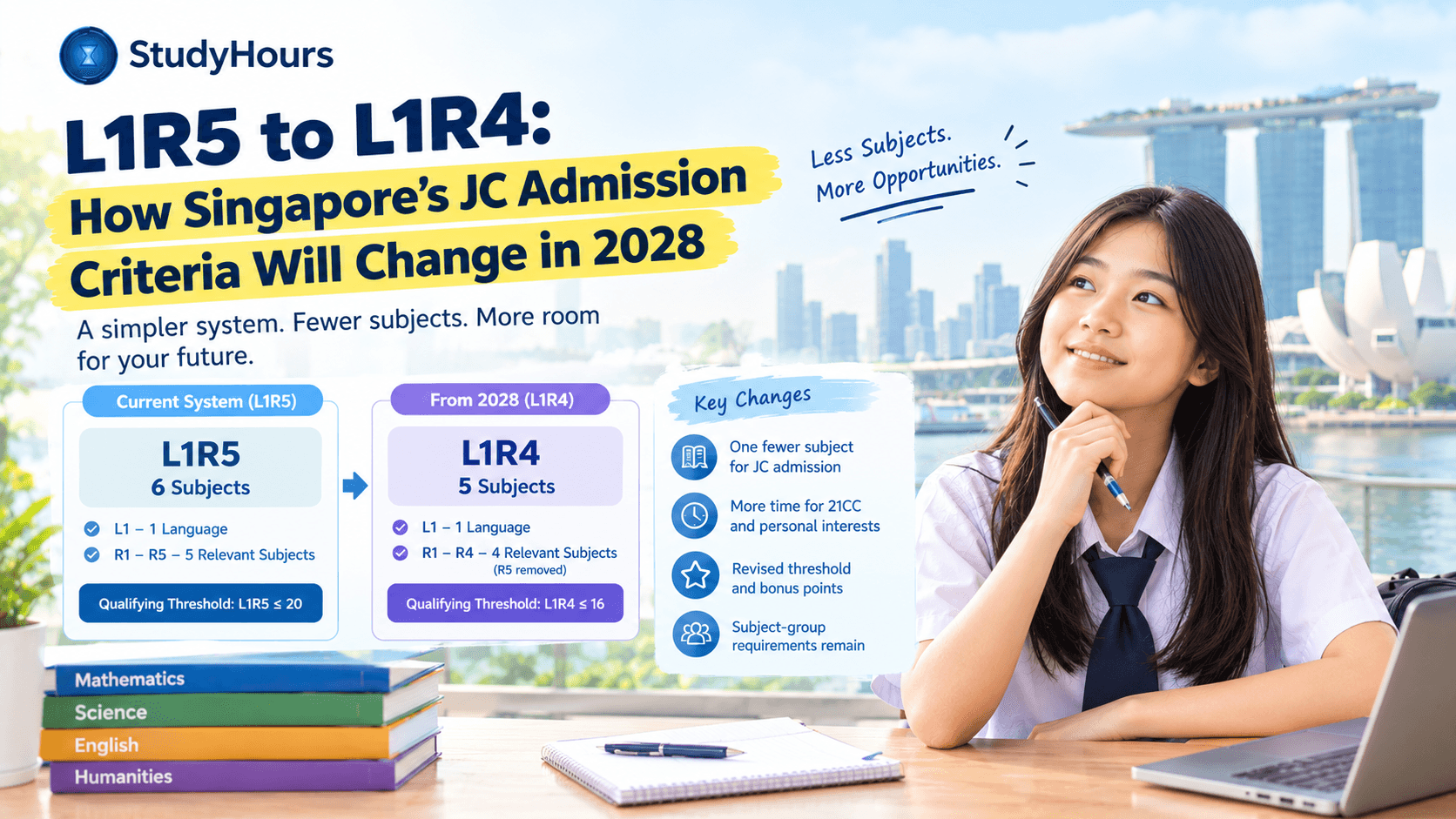
Singapore's Junior College (JC) admission criteria will change from the 2028 Joint Admissions Exercise (JAE).
The biggest change is the move from the current L1R5 gross aggregate to L1R4.
In simple terms, students applying for JC from 2028 will have five subjects counted in their admission aggregate instead of six.
MOE announced the change in 2025 as part of its wider effort to give students more time and space to develop 21st Century Competencies (21CC) and pursue interests beyond the subjects counted for JC admission.
But L1R4 is not simply L1R5 with one subject removed. The qualifying threshold changes, the subject-group requirements remain important, and the bonus-point cap will also be reduced.
For students and parents, understanding how the L1R4 aggregate is constructed will be more useful than simply remembering that the number changes from five to four relevant subjects.
What Does L1R5 Mean Under the Current System?
Under the current JC admission system, students are assessed using an L1R5 gross aggregate score.
L1R5 consists of:
L1 — one Language subject
R5 — five Relevant subjects
That means six subjects in total are used in the JC admission aggregate.
The current JC qualifying threshold is:
L1R5 ≤ 20
The subjects cannot simply be selected as any six subjects. The calculation includes specific subject-group requirements.
Under the current framework:
L1: English Language or Higher Mother Tongue Language
R1: One best-scoring subject from Humanities
R2: One best-scoring subject from Mathematics or Science
R3: One best-scoring subject from Humanities, Mathematics or Science
R4: One best-scoring subject
R5: One additional best-scoring subject
The existing L1R5 system therefore combines a language component with five relevant subjects.
What Is Changing From L1R5 to L1R4?
From the 2028 JAE, the number of subjects required for JC admission will fall from six to five.
The new structure is:
L1R4 = 1 Language + 4 Relevant subjects
The former R5 component is removed.
At the same time, the JC qualifying threshold changes from:
L1R5 ≤ 20
to:
L1R4 ≤ 16
MOE says the change will allow students to offer one fewer subject for JC admission and use the freed-up time to strengthen their 21CC and pursue other interests.
Importantly, the reduction does not remove the core subject-group requirements.
L1R5 vs L1R4: What Changes?
Feature | Current L1R5 | From 2028 JAE: L1R4 |
Subjects counted | 6 | 5 |
Language component | L1 | L1 |
Relevant subjects | R1–R5 | R1–R4 |
L1 subject | English or Higher Mother Tongue Language | English or Higher Mother Tongue Language |
R1 | 1 best-scoring Humanities subject | 1 best-scoring Humanities subject |
R2 | 1 best-scoring Mathematics or Science subject | 1 best-scoring Mathematics or Science subject |
R3 | 1 best-scoring Humanities, Mathematics or Science subject | 1 best-scoring Humanities, Mathematics or Science subject |
R4 | 1 best-scoring subject | 1 best-scoring subject |
R5 | 1 additional best-scoring subject | Removed |
JC qualifying threshold | L1R5 ≤ 20 | L1R4 ≤ 16 |
Maximum capped bonus points | 4 | 3 |
Implementation | Current system | 2028 JAE |
MOE's official subject-requirement document confirms the L1R4 structure and the revised qualifying threshold.
How to Build Your L1R4 Score (2028 Onwards)
Understanding this calculation is one of the most important parts of the 2028 change.
The L1R4 aggregate contains five components:
L1 + R1 + R2 + R3 + R4
Each component has a specific role.
Step 1: Calculate L1
The L1 component is based on:
English Language or Higher Mother Tongue Language
The relevant grade is included in the aggregate according to the applicable JC admission rules.
Step 2: Calculate R1
The R1 component requires:
One best-scoring subject from the Humanities group
This ensures that a Humanities subject remains represented in the JC admission aggregate.
Step 3: Calculate R2
The R2 component requires:
One best-scoring subject from the Mathematics or Science group
This keeps Mathematics or Science represented in the aggregate.
Step 4: Calculate R3
The R3 component can come from:
Humanities, Mathematics or Science
The best-scoring eligible subject that fits the relevant requirement is used.
Step 5: Calculate R4
The final component is:
One best-scoring subject
This is the fourth relevant subject in the new L1R4 structure.
The five components are therefore:
L1 + R1 + R2 + R3 + R4
The resulting figure is the student's gross L1R4 aggregate before applicable bonus points are taken into account.
MOE's official framework confirms that the L1R4 computation continues to require representation from the Humanities and Mathematics/Science subject groups.
A Simple Example
For illustration only, imagine a student has the following eligible grades:
L1 = 2
R1 = 3
R2 = 2
R3 = 3
R4 = 2
The gross L1R4 would be:
2 + 3 + 2 + 3 + 2 = 12
If the student has eligible bonus points, those may then be applied according to the applicable bonus-point rules to determine the net aggregate.
This example is only intended to demonstrate the calculation structure. It is not an indication of a particular JC's future admission standard.
Gross L1R4 vs Net L1R4: What Is the Difference?
Students may encounter two terms when reading about JC admissions:
Gross aggregate
and
Net aggregate
The gross L1R4 is calculated from the five required components before applicable bonus points are deducted.
The net aggregate reflects the relevant bonus points that the student is eligible to receive.
For example, if a student's gross aggregate is 12 and the student receives 2 applicable bonus points:
Gross L1R4 = 12
Bonus points = 2
Net aggregate = 10
The net score can therefore be lower than the gross score.
The exact bonus-point rules and conditions still apply, so students should use the official MOE requirements for their admissions year.
Which Subject Groups Remain Relevant Under L1R4?
Reducing the number of counted subjects does not mean that subject-group requirements disappear.
The revised L1R4 structure continues to include:
L1 — Language
English Language or Higher Mother Tongue Language
R1 — Humanities
One best-scoring subject from Humanities
R2 — Mathematics or Science
One best-scoring subject from Mathematics or Science
R3 — Humanities, Mathematics or Science
One best-scoring subject from Humanities, Mathematics or Science
R4 — Any Best-Scoring Subject
One best-scoring subject
This means the new L1R4 framework continues to ensure that students' aggregate scores include subjects from key academic groups.
The major structural change is the removal of R5, not the removal of these subject-group requirements.
Why Is MOE Moving From L1R5 to L1R4?
MOE's stated objective is to give students more time to develop beyond the subjects directly counted for JC admission.
By reducing the admission aggregate from six subjects to five, students can offer one fewer subject for the purpose of JC admission.
MOE says the time freed up can be used to:
Strengthen 21st Century Competencies
Pursue other interests
Develop more holistically
This is consistent with MOE's broader emphasis on developing confident, adaptable and well-rounded students rather than focusing exclusively on examination performance.
The reform therefore should not be interpreted simply as a reduction in academic expectations.
Instead, it changes the amount of academic content that must be counted towards the JC admission aggregate.
What Are 21st Century Competencies?
21st Century Competencies (21CC) are capabilities that MOE considers important for students to thrive in a changing world.
They include areas such as:
Critical and inventive thinking
Communication
Collaboration
Civic literacy
Global awareness
Cross-cultural skills
Socio-emotional competencies
MOE's wider curriculum approach aims to develop these capabilities alongside academic knowledge.
The L1R4 reform gives students more curriculum space to develop such competencies and pursue interests outside the subjects that contribute to the JC admission aggregate.
What Changes for Students Applying to JC From 2028?
Students applying through the 2028 JAE will use the revised L1R4 framework.
The key changes are:
Six counted subjects become five
The fifth relevant subject, R5, is removed from the aggregate.
The JC qualifying threshold changes
The current:
L1R5 ≤ 20
becomes:
L1R4 ≤ 16
Subject-group requirements remain
Students still need to meet the prescribed L1R4 subject requirements.
The bonus-point cap is reduced
The maximum capped bonus points fall from four to three.
The admissions calculation becomes more compact
Students will have one fewer subject contributing to their JC admission aggregate.
These changes apply from the 2028 JAE, not to earlier cohorts under the current O-Level admissions framework.
How Are Bonus Points Changing From 2028?
The bonus-point system is also being adjusted.
Under the current system, the maximum bonus points from the applicable capped categories is 4 points.
From the 2028 JAE, the cap will be reduced to 3 points.
MOE explains that the reduction in the bonus-point cap is intended to account for the reduction in the number of subjects included in the L1R4 aggregate.
The published bonus-point framework includes categories such as:
CCA grade
Certain English and Higher Mother Tongue Language achievements
Chinese/Malay Special Programme or Bahasa Indonesia achievement
Affiliation to a JC
The applicable bonus points are subject to the conditions specified by MOE.
There is also a separate provision for the Chinese, Malay or Tamil Language Elective Programme, which provides an additional two bonus points outside the three-point cap.
Students should therefore distinguish between the general bonus-point cap and bonus points that MOE specifically treats outside that cap.
How Does the L1R4 Change Affect MI?
The L1R4 reform also affects Millennia Institute (MI).
From 2028, MI's subject requirements will be revised to align with the new L1R4 structure used for JC admission.
The revised MI requirements include:
L1: English or Higher Mother Tongue Language
R1: One best-scoring Humanities subject
R2: One best-scoring Mathematics or Science subject
R3: One best-scoring Humanities, Mathematics or Science subject
R4: One best-scoring subject
However, there is an important difference:
MI's qualifying threshold remains L1R4 ≤20.
So while the subject-group requirements are aligned with the revised JC framework, MI does not adopt the JC qualifying threshold of L1R4 ≤16.
The bonus-point cap for MI will also be aligned with the JC system at 3 points from 2028.
Does L1R4 Mean Students Will Only Study Five Subjects?
No.
This is an important distinction.
The L1R4 reform concerns the number of subjects used to calculate the JC admission aggregate.
It should not automatically be interpreted as a rule that every secondary school student will study only five subjects.
A student may have studied more subjects, but only the required five components are used for the L1R4 admission calculation.
The policy change is therefore about JC admission assessment, rather than simply imposing a five-subject secondary school curriculum.
Does L1R4 Mean JC Admission Will Become Easier?
It is too simplistic to describe the reform as making JC admission easier.
Three important changes happen together:
The number of counted subjects falls from six to five.
The JC qualifying threshold changes from 20 to 16.
The maximum capped bonus points fall from 4 to 3.
The subject-group requirements also remain.
Therefore, students should not assume that the reduction from L1R5 to L1R4 automatically means that admission will become easier.
Actual admission outcomes will depend on the rules, student results, choices and available places in the relevant admissions exercise.
When Will L1R4 Take Effect?
The transition can be understood through three stages.
2025: MOE Announces the Reform
MOE announces the revised JC admission criteria as part of its Committee of Supply announcements.
The key decision is to reduce the number of subjects used for JC admission from six to five.
2027: First SEC Examination
The first graduating cohort under the new secondary education structure sits for the Singapore-Cambridge Secondary Education Certificate (SEC).
This marks the beginning of the new examination framework that replaces the separate N(T), N(A) and O-Level qualifications for the new cohort.
2028: First L1R4 JAE
The revised JC admission criteria take effect from the 2028 Joint Admissions Exercise.
Students applying for JC through the JAE will use the L1R4 framework.
The JC qualifying threshold will be:
L1R4 ≤16
MI will use the revised L1R4 subject requirements while retaining:
L1R4 ≤20
L1R4 and the Wider Education Reform
The move from L1R5 to L1R4 should be viewed as a targeted JC admission reform rather than an isolated change.
Singapore's education system is moving through several related changes:
Full Subject-Based Banding
Students have greater flexibility in the subjects and levels they take in secondary school.
SEC
The SEC brings G1, G2 and G3 subjects together under a common secondary qualification from 2027.
L1R4
From the 2028 JAE, five subjects rather than six are used for JC admission.
These reforms share a broader policy direction: maintaining academic standards while giving students greater flexibility and space to develop different strengths and interests.
What Parents Should Know About the 2028 Change
Parents preparing for the 2028 JAE should focus on understanding the new calculation framework, rather than comparing individual students against historical admission scores.
The key points are:
L1R5 becomes L1R4.
Five subjects are counted instead of six.
R5 is removed.
The JC qualifying threshold becomes L1R4 ≤16.
The Humanities and Mathematics/Science requirements remain.
The bonus-point cap falls from 4 to 3.
MI adopts the revised subject requirements.
MI's qualifying threshold remains L1R4 ≤20.
The first L1R4 JAE takes place in 2028.
Parents should also use official MOE information when checking the detailed rules applicable to their child's admissions year.
Frequently Asked Questions About L1R5 and L1R4
1. When will L1R4 replace L1R5?
The revised L1R4 criteria will apply from the 2028 Joint Admissions Exercise.
2. How many subjects are counted under L1R4?
Five components are counted:
L1 + R1 + R2 + R3 + R4
This replaces the six-component L1R5 structure.
3. What is the JC qualifying threshold from 2028?
The qualifying threshold will be:
L1R4 ≤16
4. Which subjects are included in L1R4?
The framework requires:
L1: English or Higher Mother Tongue Language
R1: Humanities
R2: Mathematics or Science
R3: Humanities, Mathematics or Science
R4: Any one best-scoring subject
5. What happened to R5?
R5 is removed from the JC admission aggregate from the 2028 JAE.
The new calculation ends at R4.
6. How many bonus points can students receive?
The maximum bonus points from the capped categories will be reduced from 4 to 3 from 2028.
7. Will MI also use L1R4?
Yes.
MI's subject requirements will be revised to align with the new L1R4 structure, but its qualifying threshold remains:
L1R4 ≤20.
8. Why is MOE introducing L1R4?
MOE says reducing the number of subjects required for JC admission will free up time for students to strengthen 21st Century Competencies and pursue other interests.
9. Does L1R4 mean every student will study only five subjects?
No.
L1R4 refers specifically to the JC admission aggregate calculation. It does not by itself mean that every student will study only five subjects in secondary school.
10. Will L1R4 make JC admission easier?
There is no basis for making a blanket prediction.
The number of counted subjects, qualifying threshold and bonus-point cap all change, while subject-group requirements remain. Actual admission outcomes will only be known from the relevant admissions exercise.
Final Takeaway
The move from L1R5 to L1R4 is one of the key changes to Singapore's JC admission criteria from 2028.
The basic difference is:
Current system: L1R5 — six subjects
From 2028: L1R4 — five subjects
The JC qualifying threshold changes from:
L1R5 ≤20 → L1R4 ≤16
The calculation still includes:
L1 + R1 + R2 + R3 + R4
with requirements covering Language, Humanities, Mathematics/Science and other eligible subjects.
The bonus-point cap also changes from 4 to 3 points, while MI adopts the revised subject requirements but retains its L1R4 ≤20 qualifying threshold.
Most importantly, the change is intended to give students more room to develop 21st Century Competencies and pursue interests beyond the subjects counted for JC admission.
For students and parents, understanding how the five L1R4 components work will be the key to understanding the new 2028 JC admission framework.
Published by StudyHours Global Editorial Board