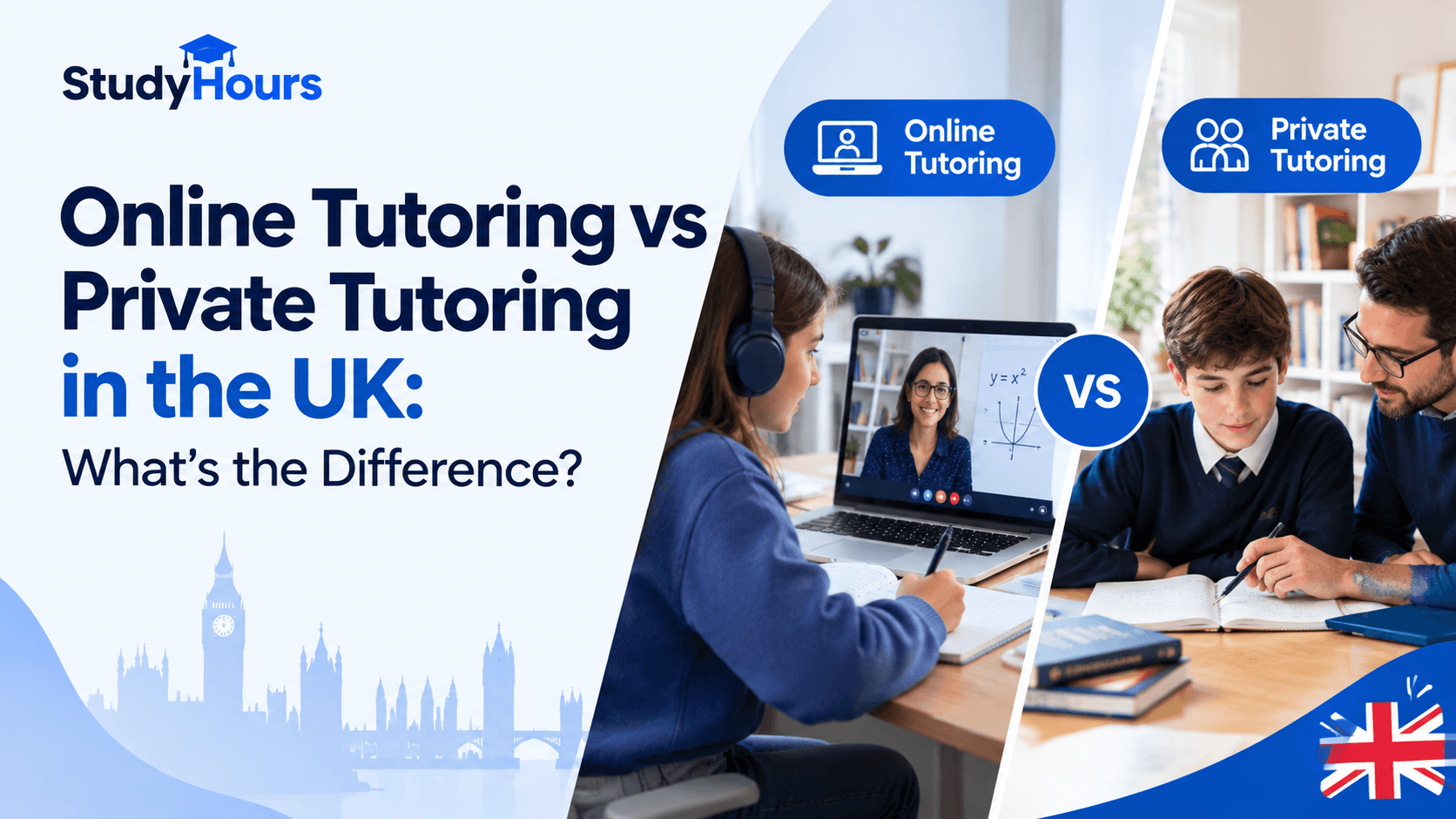
Choosing the right tutoring option can make a difference to how a student approaches difficult subjects, prepares for examinations and develops confidence in their learning.
For parents in the UK, one common question is whether to choose online tutoring or traditional private tutoring.
Both options can provide additional academic support outside school. The main difference is how lessons are delivered.
Online tutoring takes place through digital platforms, while traditional private tutoring often involves face-to-face lessons at home or another agreed location.
However, private tutoring can also take place online, so the two terms are not always mutually exclusive.
Understanding these distinctions can help families select a tutoring arrangement that suits their child's learning needs, schedule, subject requirements and preferences.
This guide compares online tutoring with face-to-face private tutoring, explores their advantages and limitations, and explains what UK parents should consider before making a decision.
What Is Online Tutoring?
Online tutoring is a form of academic support delivered through an internet-connected device.
Students usually meet tutors through live video lessons or a dedicated virtual classroom.
Depending on the provider, lessons may include digital whiteboards, shared documents, interactive exercises, practice questions and online learning resources.
For example, a Year 11 student preparing for GCSE Mathematics might work through algebra problems with a tutor using a shared whiteboard.
The tutor can demonstrate a method, observe the student's working and explain where a mistake occurred.
Similarly, an A-Level student could use an online session to discuss a difficult concept, improve essay structure or practise examination questions.
Online tutoring can be delivered one-to-one or in small groups, depending on the service.
One-to-one sessions allow the tutor to focus on an individual student's needs, while group sessions provide opportunities to learn alongside other students.
The main feature of online tutoring is its digital delivery. Students do not usually need to travel to meet their tutor, although they do need suitable technology and an environment where they can concentrate.
Families exploring this option can review the available subjects and support through online tutoring in the UK.
What Is Traditional Private Tutoring?
Traditional private tutoring generally refers to additional instruction arranged outside a student's regular school lessons.
In-person tutoring often takes place at the student's home, the tutor's home or another suitable learning environment.
The tutor works with the student to address specific academic needs. These might include understanding challenging concepts, completing practice questions, preparing for examinations or developing stronger study habits.
For example, a tutor might visit a student's home each week to help with GCSE English Literature.
During the session, they could discuss a novel, analyse quotations and practise structuring an essay.
Face-to-face lessons allow the tutor and student to interact in the same physical space.
Some students may find this environment easier for concentrating, asking questions or working through physical learning materials.
However, private tutoring does not necessarily mean in-person teaching. Many private tutors deliver lessons online, and some offer both formats.
When comparing tutoring services, therefore, it is important to distinguish between the type of tutoring arrangement and the way lessons are delivered.
Online Tutoring vs Face-to-Face Private Tutoring: Key Differences
Both formats can provide valuable academic support, but they differ in several practical ways.
1. Convenience and travel
One of the clearest differences is the need to travel.
With online tutoring, students can usually attend lessons from home or another suitable location.
This can simplify scheduling for families who live far from tutoring centres or have busy school and work commitments.
Face-to-face tutoring may require the tutor or student to travel. The additional journey can take time and may affect the number of available lesson slots.
However, a local tutor who visits the student's home may offer a convenient arrangement for some families.
The practical advantage depends on location, travel time and scheduling preferences.
Best suited to: Online tutoring may be more convenient for families who want to avoid travel, while in-person tutoring may work well when a suitable local tutor is readily available.
2. Personalised attention
Personalised attention depends more on the lesson format, group size and tutor's teaching approach than on whether the session takes place online or in person.
A one-to-one tutor in either setting can adapt explanations, adjust the pace and focus on the student's questions.
Online tutoring platforms may also provide digital resources that help tutors demonstrate concepts and review work.
In-person tutors can use physical materials, paper-based exercises and face-to-face demonstrations.
The most important consideration is whether the tutor identifies misunderstandings and responds appropriately.
Best suited to: Either format can support individual learning when lessons are well planned and the tutor adapts to the student.
3. Learning environment
Some students feel comfortable learning through a screen, while others prefer interacting with a tutor in person.
Online lessons require a quiet space, a suitable device and a reliable internet connection.
Students who are easily distracted by digital devices may need additional support to remain focused.
Face-to-face lessons can reduce some technology-related distractions, although the environment may still contain interruptions.
Parents should consider how their child normally studies. A student who concentrates well at a computer may adapt quickly to online lessons, while another may prefer having a tutor physically present.
Best suited to: The better environment is the one in which the student can concentrate, participate and practise independently.
4. Access to tutors
Online tutoring can expand the range of tutors available to a family because the tutor does not necessarily need to live nearby.
This can be useful when a student needs support with a particular subject, qualification or examination-board specification.
For example, a student studying a specific GCSE course may want a tutor who understands the relevant specification and assessment requirements. Online delivery can make it easier to consider tutors beyond the immediate local area.
Face-to-face tutoring is generally more dependent on local availability and travel arrangements.
However, the largest possible choice is not automatically the best choice. Parents should assess subject expertise, teaching experience, communication and suitability before selecting a tutor.
Best suited to: Online tutoring may offer greater geographical flexibility, especially for specialist subjects or less common academic requirements.
5. Cost and overall value
Tutoring costs vary considerably. The price may depend on the tutor's qualifications, experience, subject specialism, lesson duration, location and the provider's pricing model.
In-person tutoring may involve travel expenses or additional time costs. Online tutoring can remove the need for a physical journey, although the lesson fee itself is not necessarily lower.
Families should compare the complete arrangement rather than assuming that one format always costs less.
Consider:
The price of each session.
The length of the lesson.
Whether learning materials are included.
Any registration or subscription fees.
Cancellation and rescheduling policies.
Travel time and associated expenses.
The tutor's relevant experience.
It is also worth considering the value of the teaching. A lower-priced lesson may not meet the student's needs, while a higher-priced option does not automatically guarantee better outcomes.
Best suited to: The best-value option is one that fits the family budget and provides appropriate teaching, feedback and support.
6. Technology and learning resources
Online tutoring relies on digital tools to deliver lessons. These may include virtual whiteboards, screen sharing, online worksheets, quizzes and shared documents.
Such tools can be useful for demonstrating mathematical methods, annotating written work or reviewing diagrams together.
Face-to-face tutors may use printed worksheets, textbooks, physical equipment and handwritten explanations.
Neither approach is inherently superior. The usefulness of a resource depends on the subject, the student's preferences and how effectively the tutor uses it.
Some practical activities may also be better suited to an in-person setting, particularly where physical equipment or hands-on demonstrations are required.
Best suited to: Online tutoring may be convenient for digital resources and screen-based work, while face-to-face sessions may be preferable for certain physical or practical activities.
7. Communication and student confidence
Students need to feel comfortable asking questions, admitting confusion and explaining where they are struggling.
Online lessons can provide this opportunity through live discussion, shared work and direct feedback.
Some students feel more comfortable participating from their own homes.
Others may prefer face-to-face interaction, where they can communicate with the tutor without using a screen.
Parents should look for a tutor who encourages questions, listens carefully and explains ideas without making the student feel uncomfortable about mistakes.
Best suited to: The most appropriate format is the one in which the student feels able to participate honestly and actively.
Is Online Tutoring as Effective as Face-to-Face Tutoring?
Online tutoring can be an effective way to provide additional academic support, but its effectiveness depends on several factors.
These include the tutor's subject knowledge, the quality of explanations, lesson structure, student participation and opportunities for independent practice.
A well-organised online lesson may help a student understand a difficult concept, while an unsuitable face-to-face session may provide little benefit. The reverse can also be true.
It is therefore more useful to assess the quality of the teaching than to assume that the delivery format determines the outcome.
For online tutoring to work well, students should have:
A suitable learning environment.
Reliable access to the required technology.
Opportunities to ask questions.
Clear explanations and relevant practice.
Feedback that helps them understand mistakes.
Time to apply what they learn independently.
Parents should also review progress regularly. Evidence of progress might include improved understanding, more accurate answers, stronger problem-solving methods or greater independence when completing work.
Tutoring should complement school education and independent revision rather than replace them.
Which Option Is Better for GCSE Students?
GCSE students often need to balance multiple subjects, school assignments, mock examinations and revision.
Both online and face-to-face tutoring can help them address specific difficulties and prepare for assessments.
When online tutoring may be suitable
Online tutoring may be a good option when a student:
Needs support with several subjects.
Wants access to a tutor with specific examination-board experience.
Has a busy timetable.
Prefers studying at home.
Benefits from digital whiteboards and online resources.
Needs regular lessons without travelling.
For example, a Year 10 student struggling with algebra could work through targeted questions with an online tutor and receive immediate feedback on their method.
When face-to-face tutoring may be suitable
In-person tutoring may be worth considering when a student:
Concentrates better with someone physically present.
Finds digital learning environments distracting.
Benefits from physical learning materials.
Needs practical activities that are difficult to deliver online.
Has access to a suitable local tutor.
The decision should be based on the student's learning needs and the type of support required, rather than assumptions about which format is always better.
Families considering additional help can explore online GCSE tutoring as one option for subject-focused support.
Which Option Is Better for A-Level Students?
A-Level students often study subjects in greater depth and need to develop independent learning, analytical thinking and examination skills.
Online tutoring can provide access to subject specialists who may not be available locally. This can be useful for students studying less common subjects or seeking support with a particular topic.
Face-to-face tutoring may appeal to students who prefer direct physical interaction or find it easier to concentrate without digital distractions.
For either format, the tutor should understand the student's syllabus, assessment objectives and examination requirements.
A-Level students should also have enough time between sessions to complete independent reading, practice questions and revision. Tutoring is most useful when it helps students become more capable of working on their own.
How to Choose the Right Tutoring Option for Your Child
Rather than choosing a format first, start by identifying what your child needs from tutoring.
Assess the academic challenge
Determine whether the student needs help with foundational concepts, homework, examination technique, revision planning or a particular subject.
A clear understanding of the problem makes it easier to select an appropriate tutor.
Consider the student's learning preferences
Ask your child where they concentrate best and whether they feel comfortable using online learning tools.
If you are unsure, an introductory session may help you evaluate their response to the format.
Check the tutor's expertise
Look for relevant subject knowledge, teaching experience and familiarity with the student's qualification.
For GCSE and A-Level courses, confirm that the tutor understands the appropriate examination board and specification.
Ask about teaching methods
A tutor should be able to explain how lessons are structured and how they respond when a student struggles.
Look for an approach that combines explanation, guided practice, feedback and independent work.
Understand the practical arrangements
Compare pricing, scheduling, cancellation policies, lesson duration and technology requirements.
For face-to-face tutoring, also consider travel arrangements and the suitability of the teaching location.
Review progress regularly
Ask whether the student understands topics more clearly and can complete similar questions independently.
If progress is limited, discuss whether the teaching approach, lesson frequency or learning priorities need to change.
Can Online and Face-to-Face Tutoring Be Combined?
Yes. Some families choose a blended approach that combines online and in-person tutoring, where both options are available.
For example, a student might attend regular online sessions for Mathematics and arrange occasional face-to-face support for a subject that benefits from physical materials.
Another student might use online tutoring during a busy examination period and attend local lessons when their schedule allows.
A blended approach can offer flexibility, but it should still follow a coherent learning plan. Students need clear goals and enough time to practise between sessions.
Using multiple tutors without coordination can sometimes lead to repeated explanations, inconsistent methods or unnecessary workload. Where possible, make sure the student's learning priorities remain clear.
Common Mistakes to Avoid When Choosing a Tutor
Parents can make a more informed decision by avoiding several common assumptions.
Assuming online tutoring is always cheaper. Costs vary by provider, tutor and subject. Compare the full arrangement rather than the format alone.
Choosing based only on price. Subject knowledge, communication and teaching quality are also important.
Assuming private tutoring always means in-person lessons. Private tutors may offer online, face-to-face or blended arrangements.
Ignoring the student's preferences. A format that looks convenient to a parent may not suit the child's learning habits.
Expecting immediate results. Students generally need time to practise and apply what they learn.
Failing to review progress. Regularly checking understanding helps families determine whether the current approach remains appropriate.
Frequently Asked Questions
What is the difference between online tutoring and private tutoring?
Online tutoring describes lessons delivered through digital platforms. Private tutoring describes additional instruction arranged for an individual or small group outside regular classroom teaching.
Private tutoring can be delivered online or in person, so the terms are not mutually exclusive.
Is online tutoring cheaper than face-to-face tutoring in the UK?
Not necessarily. Prices depend on the tutor, subject, qualifications, location and provider. Online lessons may reduce travel costs, but families should compare the total cost and what each service includes.
Is online tutoring suitable for GCSE and A-Level students?
Yes, it can be suitable for both. Students can receive explanations, targeted practice and examination preparation online, provided the tutor understands the relevant qualification and the student can participate effectively.
Do students need special equipment for online tutoring?
Usually, students need a reliable internet connection, a suitable computer or tablet, and access to the tutor's chosen platform. Headphones, a microphone and a quiet study space may also be helpful.
How do parents know whether tutoring is working?
Look for evidence that the student understands concepts more clearly, makes fewer recurring mistakes and can apply methods independently. Practice work, tutor feedback and school assessments can help inform this review.
Can online tutoring replace school lessons?
Online tutoring is generally intended to provide additional support rather than replace a student's regular school education.
It can complement classroom teaching by helping students revisit difficult topics and practise specific skills.
Final Thoughts
Online tutoring and face-to-face private tutoring can both provide valuable academic support.
The right choice depends on the student's needs, learning preferences, subject requirements, schedule and family circumstances.
Online tutoring offers geographical flexibility and access to digital learning resources.
Face-to-face tutoring provides direct physical interaction and may suit students who prefer an in-person environment.
Neither format guarantees better academic outcomes. What matters most is choosing a suitable tutor, setting clear goals, practising consistently and reviewing progress.
For UK families, the best starting point is to identify the areas where a child needs help and then compare the available options carefully.
A well-matched tutoring arrangement can support classroom learning, strengthen subject understanding and help students become more independent learners.
Published by StudyHours Global Editorial Board