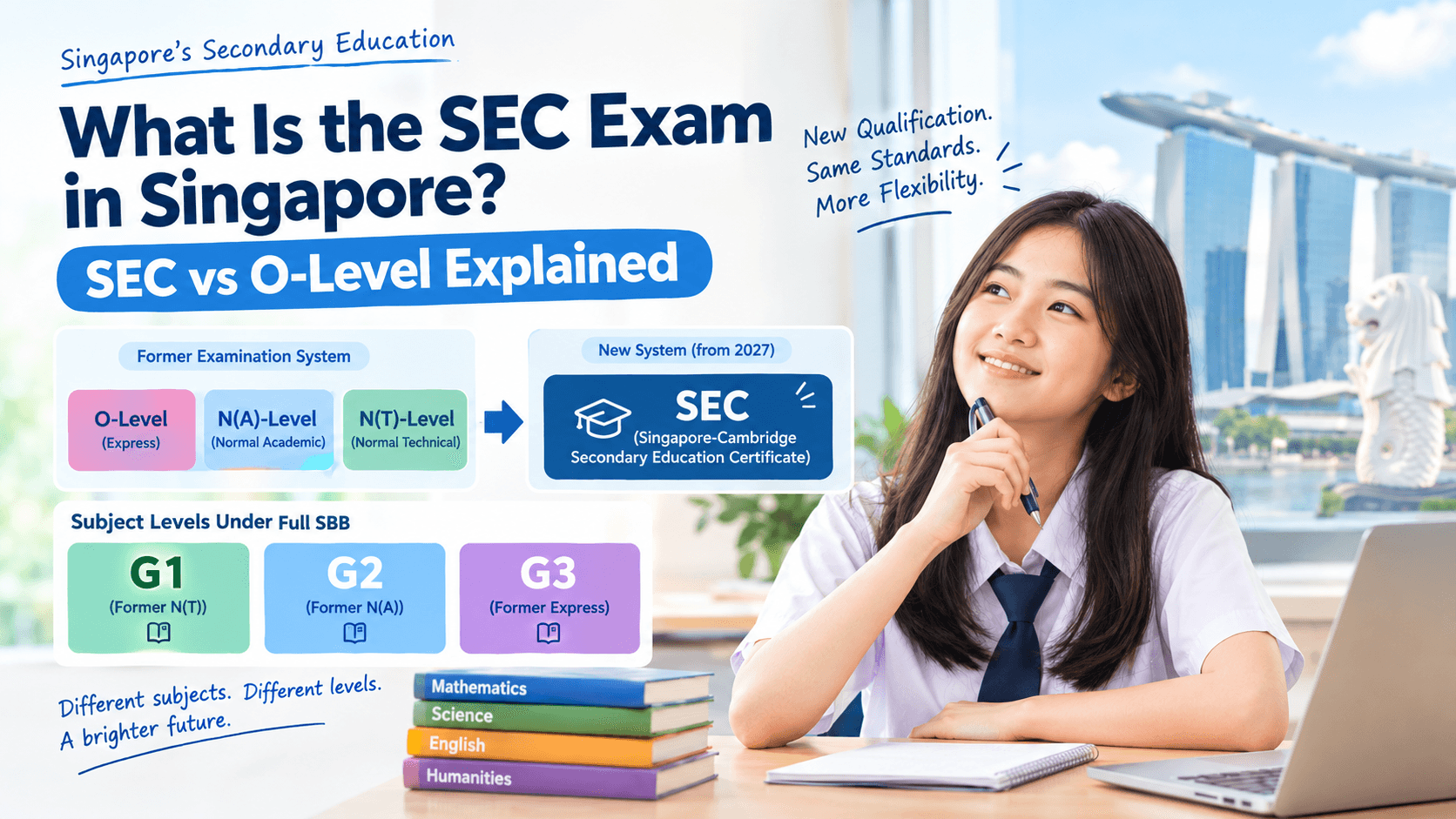
Singapore’s secondary school examination system is changing significantly from 2027.
The familiar GCE O-Level, N(A)-Level and N(T)-Level qualifications will be replaced by a single Singapore-Cambridge Secondary Education Certificate (SEC) examination.
For parents and students who are familiar with the O-Level or N-Level system, this change can understandably raise questions: Is the SEC the new O-Level?
What happens to N-Level? Are G1, G2 and G3 the same as the old examination levels? Will the SEC be harder?
The short answer is that the examination system is being reorganised to support Full Subject-Based Banding (Full SBB).
Instead of students being placed into an overall secondary school course such as Express, N(A) or N(T), students can take individual subjects at different levels — G1, G2 or G3 — according to their strengths, interests and learning needs.
The first graduating cohort under this new system will take the SEC examinations in 2027.
The overall examination standards are not being raised or lowered; the main change is how subjects and qualifications are organised.
What Is the SEC Exam?
The Singapore-Cambridge Secondary Education Certificate (SEC) is the new common national secondary school examination qualification that will be introduced from 2027.
It is jointly examined and awarded by the Singapore Examinations and Assessment Board (SEAB), Singapore's Ministry of Education (MOE), and Cambridge International Education.
Under the SEC system, students will take individual subjects at one of three subject levels:
G1
G2
G3
The final SEC certificate will show the subjects a student has taken and the corresponding subject levels.
This is an important distinction: SEC is the qualification, while G1, G2 and G3 are subject levels.
A student could therefore have different subjects at different levels rather than being placed into one overall examination stream.
Why Is Singapore Replacing O-Level and N-Level?
The change is closely connected to Full Subject-Based Banding, which was fully implemented for the Secondary 1 cohort from 2024.
Under the previous system, students were generally associated with one of three courses:
Express
Normal (Academic), or N(A)
Normal (Technical), or N(T)
Although there were already opportunities for students to take selected subjects at different levels, the broader structure was still based on course placement.
Full SBB changes this approach.
Instead of defining a student's academic pathway primarily through an overall stream, students can study individual subjects at an appropriate level.
MOE maps the three new subject levels broadly to the standards of the former N(T), N(A) and Express pathways:
G1 → broadly mapped from N(T) standards
G2 → broadly mapped from N(A) standards
G3 → broadly mapped from Express standards
The purpose is to give students greater flexibility to learn at a level that matches their strengths and interests.
This is why Singapore needed a new common examination qualification that could accommodate students taking different combinations of subject levels.
What Was the O-Level?
The Singapore-Cambridge GCE O-Level was an annual national examination taken by students offering subjects at the former Express standard.
It has been part of Singapore's education system since 1971 and is closely aligned with the Singapore school curriculum designed by MOE.
Under the former structure, students generally studied within the Express course and sat for O-Level examinations at the end of their secondary education.
The O-Level qualification has been widely used for progression to post-secondary pathways such as junior colleges, polytechnics, ITE and other educational routes, depending on a student's results and eligibility.
However, the O-Level is being phased out for the graduating cohort from 2027 as Singapore moves to the common SEC qualification.
What Were N-Level Examinations?
The term N-Level covered two separate national examinations:
GCE N(A)-Level
The Normal (Academic) Level, or N(A)-Level, was taken by students studying subjects at the former N(A) standard.
It was an annual national examination for eligible school and private candidates.
GCE N(T)-Level
The Normal (Technical) Level, or N(T)-Level, was taken by students studying subjects at the former N(T) standard.
The N(T) curriculum included subjects with greater technical and practical emphasis, alongside core subjects such as English Language and Mathematics.
With Full SBB, these separate examination pathways are no longer needed in the same form because students can take individual subjects at G1, G2 or G3.
SEC vs O-Level: Is the SEC Just the New O-Level?
No.
This is one of the most important points for parents to understand.
G3 subjects are broadly mapped to the former Express/O-Level standards, but G3 itself is not a new name for the O-Level examination.
The difference is structural.
Under the old system:
O-Level = an examination qualification
Under the new system:
SEC = the examination qualification
G1/G2/G3 = subject levels within the SEC
This means a student taking several G3 subjects is not technically "taking the new O-Level". They are taking G3-level subjects as part of the SEC examination.
Likewise, G1 and G2 should not simply be viewed as N(T) and N(A) examinations with new names.
The subject standards are broadly mapped, but the overall examination structure has changed.
What Happened to Express, N(A) and N(T)?
The move to SEC did not happen independently. It is part of a larger change in how secondary education is organised.
With the full implementation of Full SBB:
Express, N(A) and N(T) courses were phased out for new Secondary 1 cohorts.
Students instead study in mixed form classes and take subjects at G1, G2 or G3 according to their learning needs.
This creates greater flexibility.
For example, a student may be stronger in Mathematics and take it at G3 while taking another subject at G2. Another student may take most subjects at G2 but take a particular subject at G1.
The key idea is that a student's learning level does not have to be identical across every subject.
When Will the SEC Start?
The first SEC examinations will be taken by the 2027 graduating cohort.
The transition is therefore happening in stages.
2026
2026 is the final year in which the existing GCE N(T)-Level, N(A)-Level and O-Level qualifications are awarded.
Students taking those examinations in 2026 remain under the existing examination system.
2027
From the 2027 graduating cohort, students will take the Singapore-Cambridge SEC examination at their respective subject levels.
SEAB confirms that the old N(T), N(A) and O-Level qualifications will be replaced by the SEC from this point.
What Does G1, G2 and G3 Mean?
The three levels represent different levels of subject demand.
G1
G1 is broadly mapped to the former N(T) standard.
Students taking G1 subjects will be assessed using the G1 examination and grading structure.
G2
G2 is broadly mapped to the former N(A) standard.
Students taking G2 subjects will sit G2-level papers and receive G2 grades.
G3
G3 is broadly mapped to the former Express/O-Level standard.
Students taking G3 subjects will sit G3-level papers and receive G3 grades.
The important point is that these levels apply to individual subjects.
They are not three separate national certificates.
Can Students Take Different Subjects at Different SEC Levels?
Yes.
This is one of the central features of Full SBB.
A student does not necessarily need to take every subject at G1, every subject at G2 or every subject at G3.
Subject combinations can reflect a student's strengths, interests and learning needs.
For example, a student might take:
English at G3
Mathematics at G3
Science at G2
Another subject at G1
The exact subject combination depends on the student's school, subject offerings and eligibility.
This flexibility is one of the biggest differences between the new system and the traditional course-based structure.
Will the SEC Be Harder Than the O-Level or N-Level?
There is no indication that the SEC is intended to make secondary examinations generally harder.
SEAB states that there is no change in the overall standards of examinations under the SEC.
The mode of assessment and overall examination standards remain aligned with the existing N(T), N(A) and O-Level examinations.
The main change is therefore not about making the national examination more difficult.
It is about creating an examination structure that works with Full SBB.
How Will SEC Grading Work?
Each subject level has its own grading structure.
G1 grading
G1 subjects use:
A, B, C, D and E
G2 grading
G2 subjects use:
1, 2, 3, 4, 5 and 6
G3 grading
G3 subjects use:
A1, A2, B3, B4, C5, C6, D7, E8 and 9
SEAB also provides grade mapping where grades from subjects taken at a more demanding level need to be considered for specific post-secondary progression calculations.
This does not mean that a student's subject level is being changed; the mapping is used for particular aggregate-score purposes.
Will Students Receive Separate G1, G2 and G3 Certificates?
No.
Students will receive one SEC examination certificate showing the subjects and subject levels they took.
This is another major difference from thinking about G1, G2 and G3 as separate examination qualifications.
SEAB states that a certificate is awarded when a candidate achieves the required grade in at least one subject — E8 or better for G3, Grade 5 or better for G2, or Grade D or better for G1.
When Will SEC Exams Take Place?
The SEC examination timetable will bring students together under one common examination framework.
According to SEAB:
English Language and Mother Tongue Languages written examinations will be held in September.
Written examinations for other subjects will take place from October to November.
There will be one common written examination sitting for MTL across G1, G2, G3 and G3 Higher MTL.
Practical, oral and listening components will take place before the written examinations where applicable.
Results will be released in January of the following year.
This creates a more unified national examination calendar compared with the previous N-Level and O-Level arrangements.
What Happens to Students Taking O-Level or N-Level in 2026?
Students taking the existing examinations in 2026 do not suddenly move to the SEC system.
2026 is the final year for the existing GCE N(T)-Level, N(A)-Level and O-Level qualifications.
The SEC applies to the graduating cohort from 2027.
Parents should therefore be careful when reading older examination information online.
A page explaining the 2026 O-Level or N-Level system may still be accurate for that examination year but may not describe the structure students will encounter from 2027 onwards.
Are Old O-Level and N-Level Certificates Still Valid?
Yes.
The introduction of the SEC does not invalidate qualifications that students earned under the previous system.
Existing GCE N(T), N(A) and O-Level certificates remain valid after the transition.
The change affects the examination system for future graduating cohorts; it does not erase previously awarded qualifications.
What Should Parents and Students Be Careful About?
The transition has created several common misunderstandings.
Don't assume G3 simply means "O-Level"
G3 is a subject level under the SEC, although its standard is broadly mapped to the former Express/O-Level level.
Don't treat G1, G2 and G3 as three separate certificates
They are subject levels within one SEC qualification.
Don't assume every subject must be at the same level
Full SBB allows students to take different subjects at different levels, subject to school arrangements and eligibility.
Don't use old examination information without checking the year
Information about O-Level, N(A)-Level and N(T)-Level remains relevant for earlier cohorts, but it should not automatically be applied to the 2027 SEC system.
Don't assume the SEC means tougher national examinations
SEAB has stated that there is no change in the overall examination standards.
How Should Students Prepare for the SEC?
Students preparing for the first SEC examinations should focus on the syllabus and examination requirements for their specific subject and level.
This is especially important because the 2027 SEC syllabus is organised separately for G1, G2 and G3 subjects.
SEAB publishes the relevant syllabus information for school candidates and private candidates through its SEC section.
Students should:
Confirm the subject level they are taking.
Use the relevant 2027 SEC syllabus.
Check the examination format and assessment components.
Review official specimen papers where available.
Avoid assuming that an older N-Level or O-Level paper completely represents the new SEC assessment.
Check official SEAB information for updates as the examination year approaches.
The goal should be to understand the specific SEC subject requirements, rather than simply preparing for an examination based on its old equivalent.
Frequently Asked Questions About SEC, O-Level and N-Level
1. Will O-Level and N-Level still exist after 2026?
No. 2026 is the final year for the existing GCE N(T)-Level, N(A)-Level and O-Level qualifications. From the 2027 graduating cohort, students will take the SEC examination.
2. What is replacing O-Level and N-Level in Singapore?
The Singapore-Cambridge Secondary Education Certificate (SEC) is replacing the separate N(T), N(A) and O-Level examination qualifications.
Students will take subjects at G1, G2 or G3 under the common SEC framework.
3. Is G3 the new O-Level?
Not exactly.
G3 is broadly mapped to the former Express/O-Level standard, but G3 is a subject level, not a separate examination qualification. Students receive an SEC certificate that records the subjects and levels they took.
4. Is G2 the same as N(A)-Level and G1 the same as N(T)-Level?
G2 and G1 are broadly mapped to the former N(A) and N(T) standards respectively.
However, they are not simply renamed N-Level examinations. They operate as subject levels within the new SEC and Full SBB framework.
5. Can a student take G1, G2 and G3 subjects together?
Yes.
One of the main purposes of Full SBB is to allow students to take different subjects at different levels according to their strengths, interests and learning needs.
6. If my child is taking O-Level or N-Level in 2026, do they need to switch to SEC?
No.
Students taking the existing N(T), N(A) or O-Level examinations in 2026 remain under the current system. The SEC applies to the 2027 graduating cohort onwards.
7. Will the SEC be harder than O-Level or N-Level?
There is no overall increase in examination standards announced for the SEC.
SEAB states that the overall examination standards and assessment modes remain aligned with the existing N(T), N(A) and O-Level examinations.
8. Will old O-Level and N-Level certificates still be recognised after 2027?
Yes.
Previously awarded N(T), N(A) and O-Level qualifications do not become invalid simply because the examination system changes. The SEC replaces the qualifications for future graduating cohorts; it does not cancel existing certificates.
Final Takeaway
The move from O-Level and N-Level to the SEC is more than a change of examination name.
It reflects Singapore's broader move towards Full Subject-Based Banding, where students can study different subjects at G1, G2 or G3 instead of being defined primarily by a single secondary school course.
The key points to remember are simple:
O-Level, N(A)-Level and N(T)-Level → existing examination qualifications ending after the 2026 cycle
G1, G2 and G3 → subject levels under Full SBB
SEC → the common national secondary education qualification from 2027
For parents and students, the most useful approach is to focus on the specific subjects and levels being taken, follow the relevant 2027 SEC syllabus, and use official SEAB information when checking examination requirements.
The transition may look complicated at first, but its central idea is straightforward: one common secondary qualification, with greater flexibility in the level at which students take individual subjects.
Published by StudyHours Global Editorial Board