Singapore is changing the way students apply for post-secondary education from 2028, following the introduction of the new Singapore-Cambridge Secondary Education Certificate (SEC) examination in 2027.
The Ministry of Education (MOE) announced the new Post-Secondary Admissions Exercise (PSE) in 2026 as part of the wider changes associated with Full Subject-Based Banding (Full SBB) and the SEC.
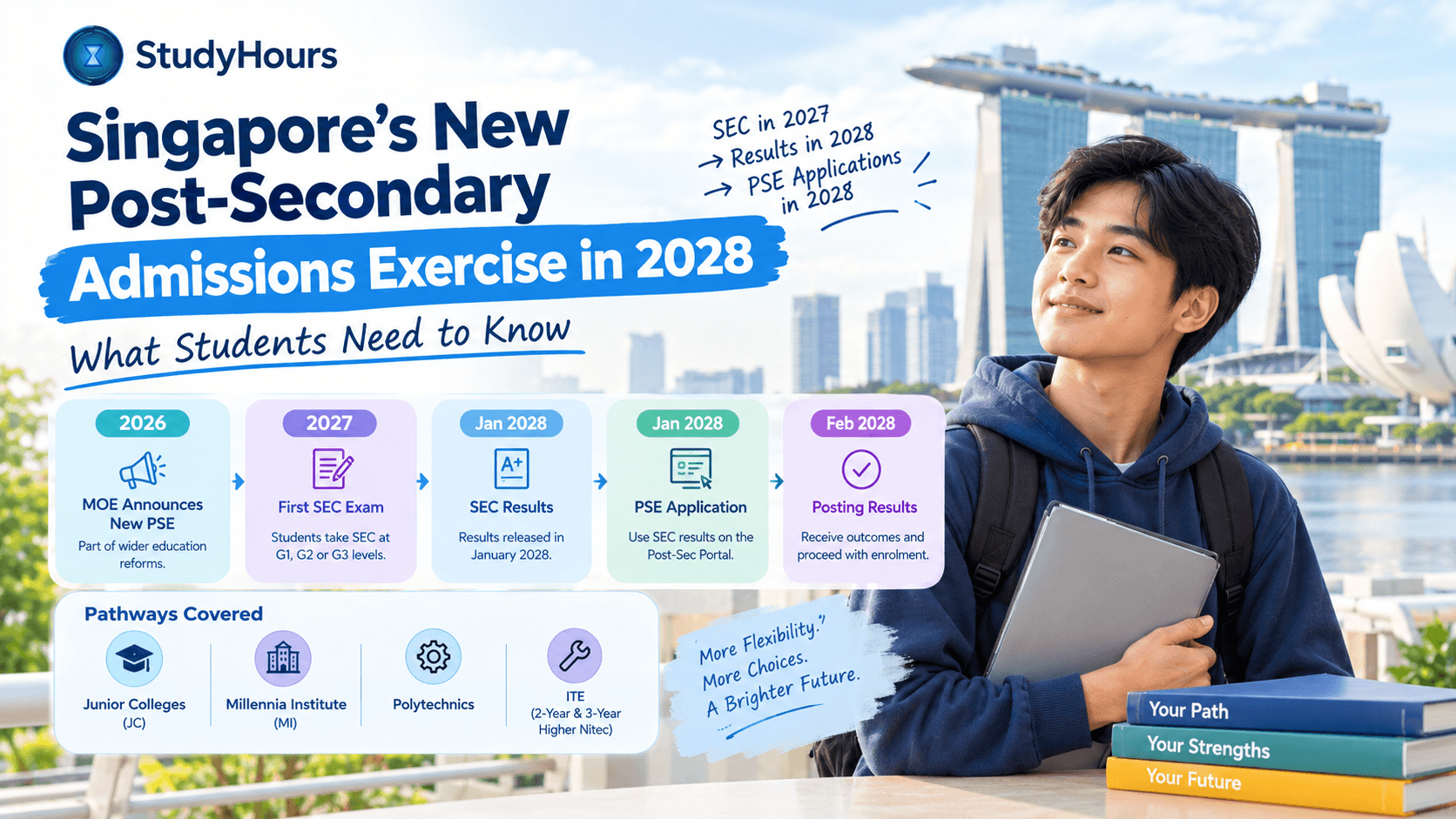
For students and parents, the timing is important. The first SEC examinations will be taken in 2027, results will be released in January 2028, and students will then use those results to apply for post-secondary pathways through the new PSE.
MOE describes the PSE as a streamlined admissions process covering Junior Colleges, Millennia Institute, polytechnics and specified ITE pathways.
The change is intended to make post-secondary admissions better aligned with the broader education reforms, including greater recognition of students' strengths and interests.
What Is the New Post-Secondary Admissions Exercise?
The Post-Secondary Admissions Exercise (PSE) is a new admissions process that will be introduced in 2028.
It is being introduced alongside the new SEC examination. From 2027, students will sit for the SEC at the subject levels appropriate to them — G1, G2 or G3 — instead of taking separate N(T)-Level, N(A)-Level and O-Level qualifications.
The first SEC cohort will receive their results in January 2028. At that point, students will be able to use their SEC results to apply for eligible post-secondary pathways through the new PSE.
The new process is designed to streamline applications across several post-secondary institutions rather than requiring students to navigate completely separate post-results admission exercises.
The pathways covered include:
Junior Colleges (JC)
Millennia Institute (MI)
Polytechnics
Institute of Technical Education (ITE), including the 2-Year and 3-Year Higher Nitec pathways covered by MOE
MOE's 2026 announcement describes this as a new PSE for admission to these Post-Secondary Education Institutions (PSEIs).
Why Is MOE Changing Post-Secondary Admissions?
The admissions reform is connected to a much larger change in Singapore's education system.
Under Full Subject-Based Banding, students are no longer placed into a single secondary school course such as Express, N(A) or N(T). Instead, they can take individual subjects at G1, G2 or G3 according to their strengths, interests and learning needs.
The SEC brings these subject levels together under one common national secondary qualification.
The new PSE is intended to continue this approach after secondary school.
MOE has said that the new admissions process will encourage students to prioritise schools and courses according to their strengths and interests.
One of the clearest changes is that choice order will become a posting tie-breaker when applicants have the same net aggregate score.
This gives students' stated preferences a more formal role in the
admissions process.
It does not, however, mean that students can gain admission simply by ranking a course first. Academic eligibility and aggregate scores remain important.
How the 2027 SEC Leads to the 2028 PSE
The easiest way to understand the reform is to look at the sequence.
2026: MOE announces the new PSE
MOE announces the new Post-Secondary Admissions Exercise as part of the wider reforms to secondary and post-secondary education.
2027: First SEC examination
The first graduating cohort under the Full SBB system takes the new Singapore-Cambridge SEC examination.
Students receive results for the G1, G2 and G3 subjects they have taken.
January 2028: SEC results
The first SEC results are released in January 2028.
January 2028: PSE application
Students then use the new Post-Sec Portal to indicate their eligible post-secondary choices during the application window.
February 2028: Posting results
Students receive their posting outcomes and proceed with the next stage of enrolment or reporting.
The 2026 MOE timeline therefore connects the two reforms directly:
Full SBB → SEC in 2027 → SEC results in January 2028 → PSE in 2028
Which Institutions Are Covered by the 2028 PSE?
The PSE is designed as a common admissions process covering several major post-secondary pathways.
Junior Colleges
Junior Colleges will be part of the new PSE.
Students from the first SEC cohort will use their SEC results when applying for JC admission under the new system.
There are also changes to the academic criteria for JC admission from the 2028 intake. Students should therefore use the requirements published for their own admissions cohort rather than relying on older O-Level-era information.
The purpose of this article is not to provide a full JC admissions guide; the important point here is that JC admission will be incorporated into the new PSE framework.
Millennia Institute
Millennia Institute (MI) will also be included in the new PSE.
As with JC admission, students should refer to the requirements applicable to the 2028 admissions cycle when making their choices.
The new system is designed to bring MI into the same broader post-secondary admissions framework as the other pathways covered by the PSE.
Polytechnics
The five polytechnics are covered by the new admissions framework:
Nanyang Polytechnic
Ngee Ann Polytechnic
Republic Polytechnic
Singapore Polytechnic
Temasek Polytechnic
Students will be able to see the post-secondary courses for which they are eligible through the new admissions process and rank their choices.
This does not mean every student will qualify for every course. Course-specific eligibility requirements continue to matter.
The important change is that polytechnic applications become part of the streamlined PSE process.
Institute of Technical Education
ITE is also included in the PSE.
MOE's announcement specifically covers the 2-Year and 3-Year Higher Nitec pathways.
This is significant because the new admissions framework is not designed only around JC and polytechnic routes. It brings several post-secondary pathways into a common application process.
Students interested in ITE should therefore consider their interests, eligibility and preferred pathway rather than viewing the new system only through the traditional O-Level-to-JC or O-Level-to-polytechnic lens.
What Happens to DSA-JC, Poly-EAE and ITE-EAE?
The introduction of the PSE does not mean that all existing admissions routes will disappear.
MOE has confirmed that the following early admissions exercises will continue:
Direct School Admission-JC (DSA-JC)
Polytechnic Early Admissions Exercise (Poly-EAE)
ITE Early Admissions Exercise (ITE-EAE)
These remain separate early admissions pathways.
The distinction is important:
PSE is the new post-results admissions process linked to the SEC results.
DSA-JC, Poly-EAE and ITE-EAE provide earlier opportunities for students to be considered based on the respective exercise's selection criteria.
Students should therefore not wait until SEC results day before learning about early admissions options.
Choice Order Will Become a Tie-Breaker
One of the most notable changes under the new PSE is the introduction of choice order as a posting tie-breaker.
The tie-breaker applies when applicants have the same net aggregate score and are competing for available places.
In such a situation, the order in which students rank their choices can affect the outcome.
This gives students a stronger reason to think carefully about their preferences.
For example, students should not automatically place a school or course higher simply because they believe it is more popular. They should consider whether it is genuinely one of their preferred options.
The new approach is intended to encourage students to make choices based on their strengths and interests, rather than treating the application simply as an exercise in chasing perceived admission competitiveness.
What Is the Order of PSE Tie-Breakers?
MOE has announced the following sequence when applicants have the same net aggregate score:
1. Citizenship
Citizenship is considered first under the admissions framework.
2. Choice Order
The applicant's ranked preference is then considered.
3. Gross Aggregate Score
If applicants remain tied, their gross aggregate scores are considered.
4. Computerised Balloting
If applicants remain tied after the previous tie-breakers, computerised balloting is used.
The order can therefore be remembered as:
Citizenship → Choice Order → Gross Aggregate Score → Computerised Balloting
These are tie-breakers, not a replacement for the underlying eligibility and aggregate-score requirements.
Why Does Choice Order Matter More Under the New System?
Choice order is being introduced to encourage students to think about what they genuinely want to study and where they want to study.
This fits with the wider direction of Full SBB.
In secondary school, students can take subjects at different levels based on their strengths and learning needs.
At the post-secondary stage, students will also be encouraged to make choices that reflect their interests.
The new tie-breaker therefore gives a practical consequence to the order students submit their preferences.
However, students should not interpret this as meaning that choosing a course first guarantees admission.
Choice order matters when the relevant applicants are tied on net aggregate score and the tie-breaker is reached.
A Detailed Timeline for the First 2028 PSE Cycle
For the first SEC cohort, the admissions process will unfold over several important dates.
By September 2027: Check CCA Records
Students should verify their Co-Curricular Activities (CCA) records with their secondary school.
This is important because eligible CCA bonus points can contribute to a student's net aggregate score, which is relevant to post-secondary admissions.
Students and parents should therefore check that the recorded CCA information is accurate rather than waiting until the admissions exercise begins.
Mid-January 2028: SEC Results
The first SEC results will be released in mid-January 2028.
This is the point at which students will know their examination results and can begin the next stage of the post-secondary admissions process.
Six Calendar Days From Results Day: PSE Application Window
The PSE application window will open around the SEC results release.
Students will have six calendar days to submit their applications through the Post-Sec Portal.
The application window will be open 24 hours a day during this period.
Students should therefore prepare their choices before results day rather than trying to research every option after receiving their results.
The 2026 MOE timeline indicates that students will be able to indicate up to 12 choices through the PSE portal.
By Early February 2028: Posting Results
Posting results are expected to be released by early February 2028.
Students will receive their outcomes through the Post-Sec Portal and SMS.
At this stage, students will know the post-secondary institution and course to which they have been posted.
By End-February 2028: Acceptance and Reporting
Students will then need to complete the relevant acceptance or enrolment steps.
For JC and MI, students who are posted will report to the institution on the next school morning, following the applicable instructions.
For polytechnic and ITE, students will follow the enrolment instructions communicated by the institution, including information provided through their enrolment email.
The exact administrative instructions should be checked when the 2028 admissions cycle opens.
What Should Students Prepare Before the 2028 PSE?
The new process makes preparation particularly important because the application period after SEC results is relatively short.
Students should not wait until results day to start thinking about their choices.
1. Understand Your SEC Subjects
Know which subjects you are taking and the relevant G1, G2 or G3 levels.
The SEC is different from the previous N-Level and O-Level structure, so students should understand how their subjects contribute to post-secondary eligibility.
2. Check Your CCA Record
By September 2027, students should verify their CCA records with their school.
This is especially important because CCA bonus points can affect the net aggregate score used in admissions.
3. Research Your Eligible Pathways
Before the SEC results are released, research the post-secondary routes you may be eligible for.
These can include:
JC
MI
Polytechnic
ITE
Students should look at the requirements and course characteristics rather than choosing solely based on perceived popularity.
4. Prepare a Meaningful Preference List
Because choice order becomes a tie-breaker, students should rank their choices thoughtfully.
The list should reflect genuine preferences.
A student's first choice should ideally be a pathway they would genuinely want if they are posted there.
5. Understand Early Admissions
Students with relevant strengths, talents or interests should also investigate:
DSA-JC
Poly-EAE
ITE-EAE
These remain separate from the new PSE.
6. Do Not Depend on Old O-Level Cut-Offs
The first PSE cycle will operate under a new SEC-based framework.
Past O-Level admission cut-offs may provide historical context, but they should not be treated as guaranteed indicators of 2028 admission outcomes.
Future admission outcomes will depend on factors including eligibility, student choices, results and available places.
Students should wait for official 2028 information rather than relying on predicted thresholds.
What Does the New System Mean for Parents?
For parents, the biggest change is that post-secondary planning should begin before the SEC results are released.
The six-day application period means families will have limited time to finalise choices once results are available.
A practical approach is to discuss potential pathways during Secondary 3 and Secondary 4 rather than waiting until January 2028.
Parents can help by encouraging students to consider:
Their strongest subjects
Areas they genuinely enjoy
Preferred learning styles
Academic versus applied learning
Possible post-secondary environments
Course eligibility
Personal preferences
The goal should not be to predict the "best" pathway.
It should be to identify pathways that fit the student's strengths, interests and longer-term goals.
How Is the 2028 PSE Different From the Old Admissions System?
The biggest difference is the move towards a more streamlined post-secondary application process following the SEC.
The old system developed around different examination qualifications and separate admissions exercises.
The new system follows the structure created by Full SBB:
Subject-based secondary education → common SEC → common post-secondary admissions process
Students will be able to view eligible post-secondary options, make choices and rank them through the new process.
This does not mean that every course has identical admission requirements.
Rather, the application process is being brought together while course-specific eligibility requirements remain relevant.
Will the New PSE Change Admission Standards?
Students should be careful about this question.
The introduction of a new admissions exercise does not mean MOE has announced that all courses will suddenly become easier or harder to enter.
Admission outcomes will continue to depend on factors such as:
Eligibility
Student results
Choices submitted
Available places
The relevant admissions rules
The first PSE cycle will also provide the first actual set of outcomes under the new system.
Therefore, students should not assume that historical O-Level cut-offs will simply carry over into the SEC-based PSE.
What Students Should Remember About the 2028 PSE
The most important points are:
2026: MOE announces the new Post-Secondary Admissions Exercise.
2027: First SEC examination cohort sits for the SEC.
By September 2027: Students should verify their CCA records.
Mid-January 2028: SEC results are released.
Six calendar days after results release: Students apply through the PSE window.
Students can indicate up to 12 choices through the Post-Sec Portal.
By early February 2028: Posting results are released through the Post-Sec Portal and SMS.
By end-February 2028: Students complete the relevant acceptance/enrolment steps.
JC, MI, polytechnic and specified ITE Higher Nitec pathways are included in the new PSE.
DSA-JC, Poly-EAE and ITE-EAE will continue.
Choice order becomes a tie-breaker when applicants have the same net aggregate score.
The tie-breaker order is citizenship → choice order → gross aggregate score → computerised balloting.
Students should not rely on predicted 2028 admission cut-offs.
Frequently Asked Questions About Singapore's 2028 PSE
1. What is the Post-Secondary Admissions Exercise in 2028?
The Post-Secondary Admissions Exercise (PSE) is a new MOE admissions process beginning in 2028.
It will streamline applications to JC, MI, polytechnics and specified ITE Higher Nitec pathways following the introduction of the SEC.
2. Who will use the new PSE first?
The first students to use the new PSE will be the 2027 SEC graduating cohort, who will receive their SEC results in January 2028.
3. When will SEC results be released?
The first SEC results are scheduled for release in mid-January 2028.
4. How long will students have to apply through the PSE?
The application window will run for six calendar days from the SEC results release and will be open 24 hours a day during that period.
5. How many choices can students make?
MOE's published timeline indicates that students will be able to indicate up to 12 choices through the Post-Sec Portal.
6. Does choice order affect admission?
Yes, but as a tie-breaker when applicants have the same net aggregate score.
The order is:
Citizenship → Choice Order → Gross Aggregate Score → Computerised Balloting
7. Do students still receive CCA bonus points?
CCA bonus points continue to be relevant to the calculation of the net aggregate score. Students should therefore verify their CCA records with their secondary school by September 2027.
8. What happens after students submit their PSE choices?
Posting results are expected by early February 2028 through the Post-Sec Portal and SMS.
Students then follow the relevant reporting or enrolment instructions. JC and MI students will report on the next school morning, while polytechnic and ITE students will follow the enrolment instructions provided by their institutions.
9. Are DSA-JC, Poly-EAE and ITE-EAE being removed?
No.
MOE has confirmed that DSA-JC, Poly-EAE and ITE-EAE will continue alongside the new PSE.
10. Will old O-Level admission cut-offs apply to the 2028 PSE?
Students should not assume so.
The 2028 PSE is part of the new SEC-based admissions framework. Historical cut-offs may provide context, but they cannot reliably predict the first PSE outcomes.
Final Takeaway
Singapore's new Post-Secondary Admissions Exercise in 2028 is the next major step following the introduction of Full Subject-Based Banding and the SEC.
The change connects the secondary and post-secondary education systems more closely:
Full SBB → G1/G2/G3 → SEC in 2027 → SEC results in January 2028 → PSE application → posting in early February 2028
For the first SEC cohort, preparation will matter because the application window is only six calendar days.
Students should verify their CCA records by September 2027, research eligible pathways before results day, understand the courses they may apply for and rank their choices carefully.
Most importantly, students should make choices based on their strengths, interests and genuine preferences, rather than trying to predict which courses will have the lowest or highest future admission scores.
The 2028 PSE is not simply a renamed O-Level admissions exercise. It is part of a broader shift towards a more flexible, subject-based education system in Singapore — from the way students learn in secondary school to the way they make choices after graduation.
Published by StudyHours Global Editorial Board