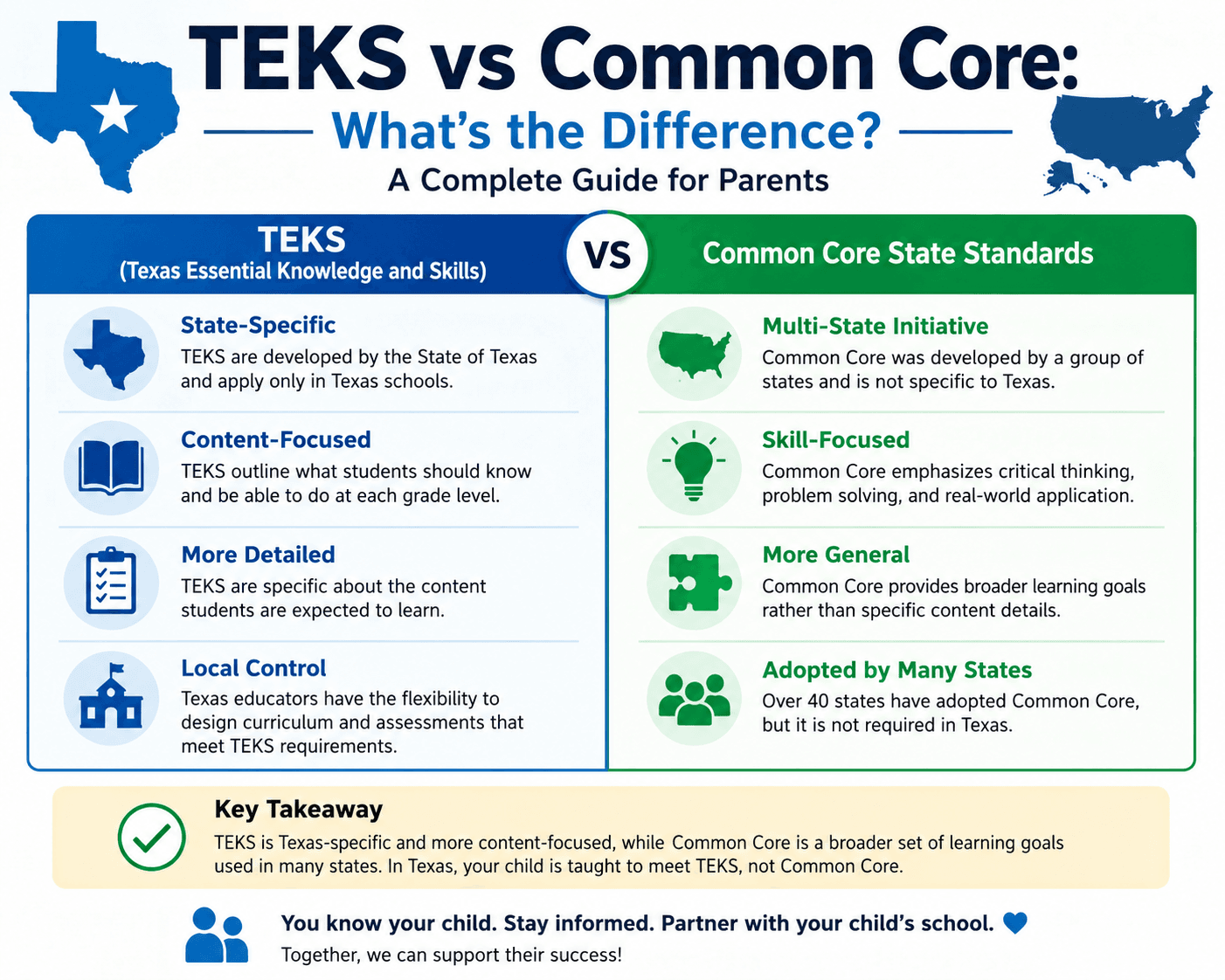
If you're a parent in Texas, recently moved from another state, or are searching for the best academic support for your child, you've probably come across the terms TEKS and Common Core.
While both define what students should learn at each grade level, they are not the same and understanding their differences is important for helping your child succeed in school.
Many parents ask questions like:
Is Texas part of Common Core?
What does TEKS stand for?
Is TEKS harder than Common Core?
Which curriculum is better for my child?
The answer depends on your child's state, grade level, and educational goals.
Texas follows its own set of academic standards known as the Texas Essential Knowledge and Skills (TEKS), while many other U.S. states use or have adapted the Common Core State Standards (CCSS). Although both aim to prepare students for college, careers, and lifelong learning, they differ in curriculum design, instructional priorities, assessments, and state control.
Whether you're comparing school systems, preparing for a move to Texas, or looking for a qualified TEKS tutor, this guide will help you make informed decisions.
What Are Educational Standards?
Before comparing TEKS and Common Core, it's important to understand what educational standards actually are.
Educational standards describe what students should know and be able to do at each grade level. They guide teachers, curriculum developers, schools, and assessment programs by establishing clear learning expectations.
These standards are not textbooks or lesson plans. Instead, they define learning outcomes while giving schools flexibility in how instruction is delivered.
Academic standards help ensure that students progressively build knowledge and skills from kindergarten through high school. They also provide consistency within a state so students receive a similar educational experience regardless of their school district.
Strong academic standards support:
Consistent classroom instruction
Measurable learning outcomes
Fair student assessments
Curriculum planning
College and career readiness
Parent understanding of grade-level expectations
Although every U.S. state sets academic expectations, the specific standards differ. Texas uses TEKS, while many other states use Common Core or state-specific adaptations.
What is TEKS
TEKS, or Texas Essential Knowledge and Skills, is the official set of academic standards used in all Texas public schools. These standards define what students are expected to learn in every subject and grade level from pre-kindergarten through Grade 12.
The standards are developed, reviewed, and updated by the Texas Education Agency (TEA) with input from educators, subject-matter experts, and community stakeholders. Because they are designed specifically for Texas, TEKS reflects the state's educational priorities and workforce needs.
TEKS covers core subjects including:
Mathematics
English Language Arts and Reading (ELAR)
Science
Social Studies
Fine Arts
Physical Education
Health
Career and Technical Education (CTE)
Technology Applications
Languages Other Than English
Each TEKS standard outlines the specific knowledge and skills students should master before advancing to the next grade level. Teachers use these standards to plan lessons, create classroom activities, and prepare students for state assessments such as the STAAR (State of Texas Assessments of Academic Readiness).
Key Features of TEKS
Created specifically for Texas students
Used in all Texas public schools
Updated periodically to reflect changing educational needs
Includes detailed grade-level expectations
Aligns classroom instruction with state assessments
Covers a broad range of academic and career-focused subjects
Encourages both foundational knowledge and real-world application
Because TEKS is unique to Texas, students transferring from another state may notice differences in content sequencing and instructional emphasis.
What is Common Core
The Common Core State Standards (CCSS) are a set of academic standards developed through a state-led initiative to establish consistent expectations in English Language Arts and Mathematics across participating states.
Unlike TEKS, Common Core is not a national curriculum. Instead, it provides learning standards that individual states may adopt, adapt, or replace based on their own educational policies.
The primary goals of Common Core include:
Preparing students for college and careers
Promoting critical thinking
Improving problem-solving skills
Encouraging analytical reading and evidence-based writing
Creating greater consistency among participating states
Common Core focuses mainly on two subject areas:
Mathematics
English Language Arts (ELA)
Science and social studies standards are generally developed separately by individual states or through other frameworks.
Key Features of Common Core
State-led initiative rather than a federal curriculum
Used or adapted by many U.S. states
Focuses heavily on conceptual understanding
Encourages critical thinking and analytical reasoning
Supports consistency for students moving between participating states
Emphasizes real-world problem solving and communication skills
Although many states initially adopted Common Core, several have since revised, renamed, or replaced portions of the standards while maintaining similar educational objectives.
TEKS vs Common Core: Quick Comparison
Feature | TEKS | Common Core |
Full Name | Texas Essential Knowledge and Skills | Common Core State Standards |
Used In | Texas only | Many U.S. states (or adapted versions) |
Governing Authority | Texas Education Agency (TEA) | Individual participating states |
Subjects Covered | Multiple subjects across K–12 | Primarily Mathematics and English Language Arts |
Assessments | STAAR | State-specific assessments (varies by state) |
Focus | Texas-specific academic expectations | Shared learning expectations across participating states |
Flexibility | Designed for Texas educational priorities | Provides common learning goals that states can implement in different ways |
Curriculum Alignment | Texas curriculum | State curriculum aligned to Common Core where adopted |
This comparison highlights the biggest distinction: TEKS is Texas-specific, while Common Core was designed to provide a shared framework that participating states can use or adapt.
In the next section, we'll explore the detailed differences between TEKS and Common Core, compare mathematics and English standards, explain how assessments differ, and help you determine which system best supports your child's learning needs.
Major Differences Between TEKS and Common Core
Although TEKS and Common Core share the goal of preparing students for academic success, they differ in how learning standards are developed, organized, taught, and assessed. Understanding these differences can help parents choose the right educational resources and tutoring support.
1. State Control vs Shared Standards
The biggest difference is ownership.
TEKS was developed specifically for Texas and is maintained by the Texas Education Agency (TEA). Every public school in Texas follows these standards, ensuring the curriculum reflects the state's educational priorities.
Common Core, on the other hand, was created through a state-led initiative to establish shared academic expectations. States choose whether to adopt, adapt, or replace these standards, meaning implementation can vary.
TEKS
Exclusive to Texas
Regularly reviewed and updated by Texas educators
Tailored to Texas students and workforce needs
Common Core
Adopted or adapted by many states
Implementation varies by state
Focuses on consistency across participating states
2. Curriculum Design
Both systems outline learning goals, but they organize instruction differently.
TEKS provides detailed expectations for each grade level and subject. Teachers often have more specific objectives to cover throughout the school year.
Common Core emphasizes broader learning goals, encouraging teachers to build conceptual understanding and critical thinking through multiple instructional approaches.
3. Subjects Covered
One major distinction is the scope of each framework.
TEKS Covers
Mathematics
English Language Arts and Reading (ELAR)
Science
Social Studies
Fine Arts
Health
Physical Education
Career and Technical Education (CTE)
Technology Applications
Languages Other Than English
Electives
Common Core Covers
Mathematics
English Language Arts
Science, social studies, and other subjects are typically governed by separate state standards.
4. Learning Objectives
TEKS places strong emphasis on mastering specific knowledge and skills at every grade level.
Common Core focuses on developing transferable skills such as:
Critical thinking
Analytical reasoning
Problem-solving
Collaboration
Evidence-based communication
Both approaches are valuable but emphasize different aspects of student learning.
5. Classroom Instruction
Teachers following TEKS often use lessons closely aligned with state standards and STAAR expectations.
Teachers using Common Core typically encourage:
Classroom discussions
Inquiry-based learning
Multi-step problem solving
Project-based activities
Evidence-based writing
6. Student Assessments
Assessment methods differ significantly.
Texas students are assessed using the STAAR (State of Texas Assessments of Academic Readiness), which measures mastery of TEKS standards.
States using Common Core administer their own state assessments, which are aligned with their adopted standards and may include performance-based tasks and other assessment formats.
TEKS Math vs Common Core Math
Mathematics is one of the most noticeable areas where parents observe differences.
TEKS Mathematics
TEKS emphasizes:
Strong number sense
Computational accuracy
Algebra readiness
Geometry foundations
Financial literacy
Real-world mathematical applications
Students are expected to master grade-level skills while applying mathematics to practical situations.
TEKS Math Skills
Addition and subtraction fluency
Multiplication and division mastery
Fractions and decimals
Algebraic reasoning
Geometry
Data analysis
Financial mathematics
Probability
Common Core Mathematics
Common Core mathematics focuses on understanding why mathematical procedures work rather than simply memorizing formulas.
Students learn to:
Explain their reasoning
Solve problems using multiple methods
Recognize mathematical patterns
Apply concepts to unfamiliar situations
Common Core Math Skills
Conceptual understanding
Mathematical reasoning
Problem-solving
Modeling
Precision
Strategic thinking
Which Math Curriculum is Better?
Neither system is universally better.
TEKS provides detailed, structured expectations and aligns closely with Texas classroom instruction and assessments.
Common Core emphasizes conceptual learning and flexible problem-solving strategies.
For Texas students, learning with TEKS-aligned resources is the best way to stay on track with classroom instruction and STAAR preparation.
TEKS English Language Arts vs Common Core ELA
English Language Arts is another area where the two frameworks differ.
TEKS English Language Arts (ELAR)
The Texas ELAR standards focus on helping students become confident readers, writers, speakers, and critical thinkers.
Students learn to:
Read literary and informational texts
Build vocabulary
Analyze themes
Improve grammar
Develop writing skills
Conduct research
Present ideas effectively
Common Core English Language Arts
Common Core emphasizes:
Close reading
Text-based evidence
Informational texts
Analytical writing
Academic vocabulary
Communication skills
Students are encouraged to support opinions with evidence from the text and engage in deeper analysis.
Science Standards Comparison
Science education differs because Common Core does not establish national science standards.
TEKS Science
Texas science standards include:
Scientific investigation
Laboratory experiences
Earth and space science
Life science
Physical science
Engineering design
STEM integration
Students are expected to apply scientific concepts through observation, experimentation, and inquiry.
States Using Common Core
States that adopted Common Core generally use separate science standards, often integrating engineering, inquiry-based learning, and scientific practices alongside state-specific requirements.
Social Studies Standards Comparison
Social studies is another area where TEKS stands out.
TEKS Social Studies
Texas places significant emphasis on:
Texas history
United States history
Geography
Economics
Government
Civics
World history
Global cultures
Because TEKS is state-specific, students gain a deeper understanding of Texas history, government, and economy.
States Following Common Core
Common Core does not include social studies standards. Each state develops its own framework, which means course content and instructional emphasis can differ.
STAAR vs Common Core Assessments
Many parents wonder whether the tests are the same.
The answer is no.
STAAR (Texas)
STAAR is designed specifically to measure student mastery of the Texas Essential Knowledge and Skills (TEKS).
The assessment evaluates whether students have learned the required knowledge and skills for their grade level.
Subjects Tested
Reading
Mathematics
Science
Social Studies
English I
English II
Algebra I
Biology
U.S. History
Results help schools identify learning gaps and guide instructional planning.
Assessments in Common Core States
States that use Common Core administer their own assessments aligned with state standards. The format, testing schedule, and reporting methods can vary by state.
These assessments often include:
Multi-step reasoning
Extended-response questions
Evidence-based writing
Performance tasks
Real-world problem solving
Is Texas Part of Common Core?
No.
Texas has never adopted the Common Core State Standards.
Instead, Texas continues to use the Texas Essential Knowledge and Skills (TEKS) as the official academic standards for public schools.
This means students attending Texas public schools learn according to TEKS and take assessments aligned with those standards, including the STAAR exam.
For parents moving to Texas from another state, it's helpful to review TEKS expectations so children can transition smoothly into the Texas education system.
Which States Use TEKS?
Only Texas uses the Texas Essential Knowledge and Skills (TEKS).
Every Texas public school follows these standards, ensuring consistency in instruction, curriculum planning, and state assessments.
Which States Use Common Core?
Many states have adopted or adapted Common Core standards, while others have replaced them with revised state-specific standards that still share many of the same principles.
If your family is relocating, it's a good idea to check your destination state's current academic standards through its education department, as policies can change over time.
Why Texas Created TEKS
Texas developed TEKS to maintain control over its educational standards and ensure that instruction reflects the needs of students, educators, higher education institutions, and employers across the state.
Key goals of TEKS include:
Preparing students for college and careers
Supporting workforce readiness
Maintaining rigorous academic expectations
Reflecting Texas history and culture
Giving the state flexibility to update standards based on educational needs
By creating its own standards, Texas can revise curriculum requirements independently while keeping assessments, classroom instruction, and graduation expectations aligned.
Advantages of TEKS
The Texas Essential Knowledge and Skills (TEKS) framework is designed to meet the educational goals of Texas students. Because it is developed specifically for the state, it offers several benefits for students, parents, and educators.
1. Texas-Specific Learning Standards
TEKS is tailored to the needs of Texas schools and communities. It includes state-specific content particularly in social studies while aligning academic expectations with the skills students need for higher education and future careers.
2. Clear Grade-Level Expectations
Each TEKS standard outlines what students should know and be able to do by the end of each grade. This clarity helps teachers plan instruction and allows parents to better understand their child's academic progress.
3. Comprehensive Subject Coverage
Unlike Common Core, which focuses mainly on English Language Arts and Mathematics, TEKS provides standards across a wide range of subjects, including:
Science
Social Studies
Technology Applications
Career and Technical Education (CTE)
Fine Arts
Health
Physical Education
Languages Other Than English
4. Alignment with STAAR
Since classroom instruction follows TEKS, students are better prepared for the State of Texas Assessments of Academic Readiness (STAAR), helping schools monitor academic achievement and identify areas for improvement.
Advantages of Common Core
Common Core was created to provide consistent academic expectations across participating states. Families who move frequently between those states may find the transition easier because many learning goals are similar. Find the best Common Core tutors online at StudyHours.com.
Some benefits include:
Emphasis on critical thinking and reasoning
Strong focus on reading comprehension and evidence-based writing
Conceptual understanding in mathematics
Consistent expectations across many participating states
Preparation for college-level analytical skills
Challenges Parents Should Know
No educational framework is perfect. Understanding potential challenges can help families provide the right support.
Challenges of TEKS
Students transferring into Texas may need time to adjust to different grade-level expectations.
Because TEKS is unique to Texas, learning sequences may differ from those in other states.
Preparing for STAAR can create additional academic pressure for some students.
Challenges of Common Core
Standards are implemented differently across states.
Some parents find the teaching methods unfamiliar, especially in mathematics.
Students moving to non-Common Core states may encounter different curriculum expectations.
Which Curriculum Is More Difficult?
Parents often ask whether TEKS is harder than Common Core.
There is no universal answer.
The level of difficulty depends on several factors, including:
The student's learning style
Grade level
Subject area
Previous educational background
Teacher instruction
Individual strengths and challenges
For example, some students may find TEKS mathematics more structured, while others may prefer the conceptual approach emphasized in Common Core.
Likewise, students who enjoy analytical reading may adapt well to Common Core's emphasis on evidence-based writing, whereas Texas students benefit from TEKS' detailed learning objectives and alignment with classroom instruction.
Rather than comparing difficulty, parents should focus on ensuring that learning resources and tutoring align with the standards their child follows.
How TEKS Affects Online Learning
As online education continues to grow, curriculum alignment has become increasingly important.
A general tutoring program may not fully address the specific concepts and learning objectives taught in Texas classrooms. TEKS-aligned online instruction ensures that students receive support that matches what they are learning in school.
Benefits of TEKS-aligned online learning include:
Lessons based on current TEKS standards
Personalized instruction for each student's needs
Flexible scheduling
Interactive learning tools
Regular progress tracking
Homework support
Preparation for classroom quizzes and STAAR assessments
Why TEKS Online Tutoring Helps Students
Every student learns differently. Some need extra practice with challenging concepts, while others benefit from enrichment that keeps them ahead of the class.
Working with a tutor who understands TEKS standards can provide targeted support that reinforces classroom learning.
At StudyHours, our TEKS Online Tutoring program is designed specifically for Texas students. Lessons are aligned with the latest Texas Essential Knowledge and Skills standards, ensuring students receive instruction that matches what they learn in school.
Our experienced tutors provide:
One-on-one live online tutoring
Personalized learning plans
Homework assistance
TEKS-aligned math tutoring
English Language Arts support
Science tutoring
Social studies tutoring
STAAR preparation
Flexible scheduling for busy families
Regular progress updates for parents
Whether your child needs help catching up, building confidence, or preparing for upcoming assessments, TEKS-aligned tutoring can provide focused academic support.
Learn more about our TEKS tutoring services here:
https://studyhours.com/tutoring/teks-tutoring-online
Tips for Parents Supporting Students in the TEKS Curriculum
Parents play an important role in helping children succeed academically. Here are a few practical strategies:
Review Grade-Level Expectations
Become familiar with the TEKS standards for your child's grade so you understand what they are expected to learn.
Communicate with Teachers
Regular communication helps you stay informed about classroom progress, assignments, and any areas where additional support may be needed.
Encourage Daily Reading
Reading for at least 20–30 minutes each day helps strengthen vocabulary, comprehension, and critical thinking skills.
Practice Math Regularly
Consistent practice builds confidence and reinforces foundational skills.
Use TEKS-Aligned Resources
Choose educational materials and tutoring programs that follow the Texas curriculum to ensure students are learning the right concepts at the right time.
Seek Extra Help Early
If your child begins struggling with a subject, early intervention through personalized tutoring can prevent learning gaps from growing.
Conclusion
Both TEKS and Common Core are designed to help students build the knowledge and skills they need for future success, but they take different approaches.
TEKS is a Texas-specific framework that provides detailed learning expectations across a broad range of subjects and aligns closely with the STAAR assessment.
Common Core, meanwhile, focuses primarily on English Language Arts and Mathematics and aims to establish consistent academic expectations across participating states.
For families in Texas, understanding TEKS is essential because it guides classroom instruction, curriculum planning, and student assessments.
Choosing learning resources and tutoring programs that align with TEKS can make a meaningful difference in academic performance and confidence.
If your child needs personalized support, StudyHours' TEKS Online Tutoring offers experienced tutors, customized lesson plans, and one-on-one instruction aligned with the latest Texas standards to help students thrive.
Frequently Asked Questions (FAQs)
1. What is the main difference between TEKS and Common Core?
TEKS is the official academic standards framework used only in Texas, while Common Core is a set of learning standards adopted or adapted by many other U.S. states. TEKS covers a wider range of subjects, whereas Common Core primarily focuses on English Language Arts and Mathematics.
2. Is Texas part of Common Core?
No. Texas has never adopted the Common Core State Standards and instead uses the Texas Essential Knowledge and Skills (TEKS) for all public schools.
3. What does TEKS stand for?
TEKS stands for Texas Essential Knowledge and Skills, the academic standards that define what students should learn at each grade level in Texas public schools.
4. Is TEKS harder than Common Core?
Neither system is universally harder. The level of difficulty depends on the student's learning style, subject, grade level, and familiarity with the curriculum.
5. Does TEKS include science and social studies?
Yes. TEKS includes standards for science, social studies, technology applications, career and technical education, fine arts, health, physical education, and more, in addition to mathematics and English Language Arts.
6. What assessment is used with TEKS?
Texas public school students take the STAAR (State of Texas Assessments of Academic Readiness), which measures mastery of TEKS standards.
7. Why should students use TEKS-aligned tutoring?
TEKS-aligned tutoring reinforces classroom instruction, helps students prepare for STAAR assessments, fills learning gaps, and provides personalized academic support based on Texas standards.
8. Does StudyHours offer TEKS online tutoring?
Yes. StudyHours provides one-on-one online tutoring aligned with the latest TEKS standards for subjects such as mathematics, English Language Arts, science, and social studies, helping Texas students improve confidence and academic performance.
Published by StudyHours Global Editorial Board