
Choosing the right educational opportunities for your child often begins with understanding the assessments schools use to evaluate learning potential. One of the most widely recognized assessments for identifying gifted students is the Cognitive Abilities Test (CogAT).
If you've recently heard your child's school mention the CogAT or you're preparing for an upcoming gifted program assessment, you may be wondering what the test measures, why it matters, and how to prepare effectively.
Unlike traditional academic exams that focus on subjects such as mathematics, science, or English, the CogAT Test measures a student's reasoning and problem-solving abilities.
It evaluates how well children recognize patterns, solve unfamiliar problems, understand relationships between ideas, and apply logical thinking.
Because of this, schools use the test to identify students who may benefit from gifted education programs, advanced learning opportunities, or specialized instructional support.
What is The CogAT Test
The CogAT (Cognitive Abilities Test) is a standardized assessment designed to measure a student's reasoning and problem-solving abilities rather than their academic knowledge.
Instead of asking students to recall facts they have memorized in class, the CogAT evaluates their ability to:
Identify patterns
Solve logical problems
Understand relationships between ideas
Analyze information
Think critically
Apply reasoning skills in different situations
This makes the CogAT an effective tool for identifying students with strong learning potential, including those who may qualify for gifted and talented education programs.
It's important to understand that the CogAT is not an IQ test and not an achievement test. Rather, it measures cognitive abilities that support learning across many academic subjects.
Key Facts About the CogAT Test
Feature | Details |
Full Name | Cognitive Abilities Test |
Purpose | Measures reasoning and cognitive skills |
Used By | Schools and school districts |
Primary Audience | Kindergarten through Grade 12 students |
Common Use | Gifted program identification |
Question Format | Multiple Choice |
Test Areas | Verbal, Quantitative, Nonverbal |
Why Do Schools Use the CogAT Test?
Many parents assume the CogAT is simply another school exam. In reality, schools administer the CogAT for several important reasons beyond grading students.
1. Identify Gifted Students
One of the primary purposes of the CogAT is identifying students who demonstrate exceptional reasoning abilities and may benefit from gifted education programs or advanced academic opportunities.
Students with strong cognitive skills often learn new concepts quickly, solve problems creatively, and adapt to challenging learning environments.
2. Understand Learning Potential
The CogAT helps educators identify how students learn rather than what they already know. A child who performs well on the test may have strong reasoning abilities even if they haven't yet achieved top grades in school.
This information can help teachers tailor instruction to better meet each student's needs.
3. Support Instructional Planning
Schools use CogAT results to make informed decisions about classroom instruction. Understanding students' cognitive strengths enables teachers to:
Differentiate lessons
Provide enrichment activities
Group students appropriately
Offer targeted academic support
4. Improve Student Placement
Some schools use CogAT scores when considering placement into:
Gifted and Talented Education (GATE)
Honors classes
Accelerated learning programs
Advanced mathematics courses
Specialized academic tracks
The CogAT is typically one part of a broader evaluation process that may also include classroom performance, teacher recommendations, achievement tests, and other assessments.
5. Identify Different Learning Strengths
Not every student excels in the same way. The CogAT helps schools recognize strengths in:
Language-based reasoning
Mathematical reasoning
Visual-spatial reasoning
Understanding these differences allows educators to provide more personalized learning experiences.
Who Takes The CogAT Test?
The CogAT is commonly administered to students from Kindergarten through Grade 12, although elementary school students are the most frequent test takers.
Schools may schedule the assessment at different grade levels depending on district policies and gifted education screening requirements.
Typical Grade Levels
Grade | Typical Age |
Kindergarten | 5–6 years |
Grade 1 | 6–7 years |
Grade 2 | 7–8 years |
Grade 3 | 8–9 years |
Grade 4 | 9–10 years |
Grade 5 | 10–11 years |
Grade 6 | 11–12 years |
Grade 7 | 12–13 years |
Grade 8 | 13–14 years |
Many school districts administer the CogAT during:
Kindergarten
Grade 2
Grade 3
Grade 5
Grade 7
However, testing schedules vary by school district and country.
Which Countries Use The CogAT Test
Although the CogAT originated in the United States, it is also used in several international schools worldwide.
Common regions include:
United States
Canada
Singapore
United Arab Emirates (UAE)
Australia
United Kingdom
International American curriculum schools
Parents whose children attend international schools should check with their school to determine whether the CogAT is part of the admissions or placement process.
What Does the CogAT Measure
One of the biggest misconceptions about the CogAT is that it measures intelligence. While reasoning skills are related to learning, the CogAT is designed to assess how students think, not simply how much they know.
The assessment focuses on three major areas of reasoning.
Verbal Reasoning
Measures a student's ability to:
Understand language
Recognize relationships between words
Solve verbal analogies
Build vocabulary
Think using language
Students with strong verbal reasoning often perform well in reading comprehension, writing, and language arts.
Quantitative Reasoning
Measures the ability to:
Work with numbers
Recognize numerical patterns
Solve mathematical relationships
Analyze quantitative information
Apply logical reasoning to numbers
This section emphasizes reasoning rather than arithmetic calculations.
Nonverbal Reasoning
Measures a student's ability to:
Identify visual patterns
Analyze shapes
Recognize sequences
Solve abstract problems
Think without relying on language
Because it minimizes language demands, the nonverbal battery is particularly useful for multilingual learners and students whose first language is not English.
Skills the CogAT Evaluates
The CogAT is designed to measure a broad range of cognitive skills that support success across subjects.
These include:
Critical thinking
Analytical reasoning
Pattern recognition
Logical reasoning
Flexible thinking
Problem-solving
Abstract reasoning
Decision-making
Learning potential
These are lifelong thinking skills that help students adapt to new challenges both inside and outside the classroom.
CogAT Test Structure
The CogAT is divided into three separate batteries, each designed to evaluate a different type of reasoning ability.
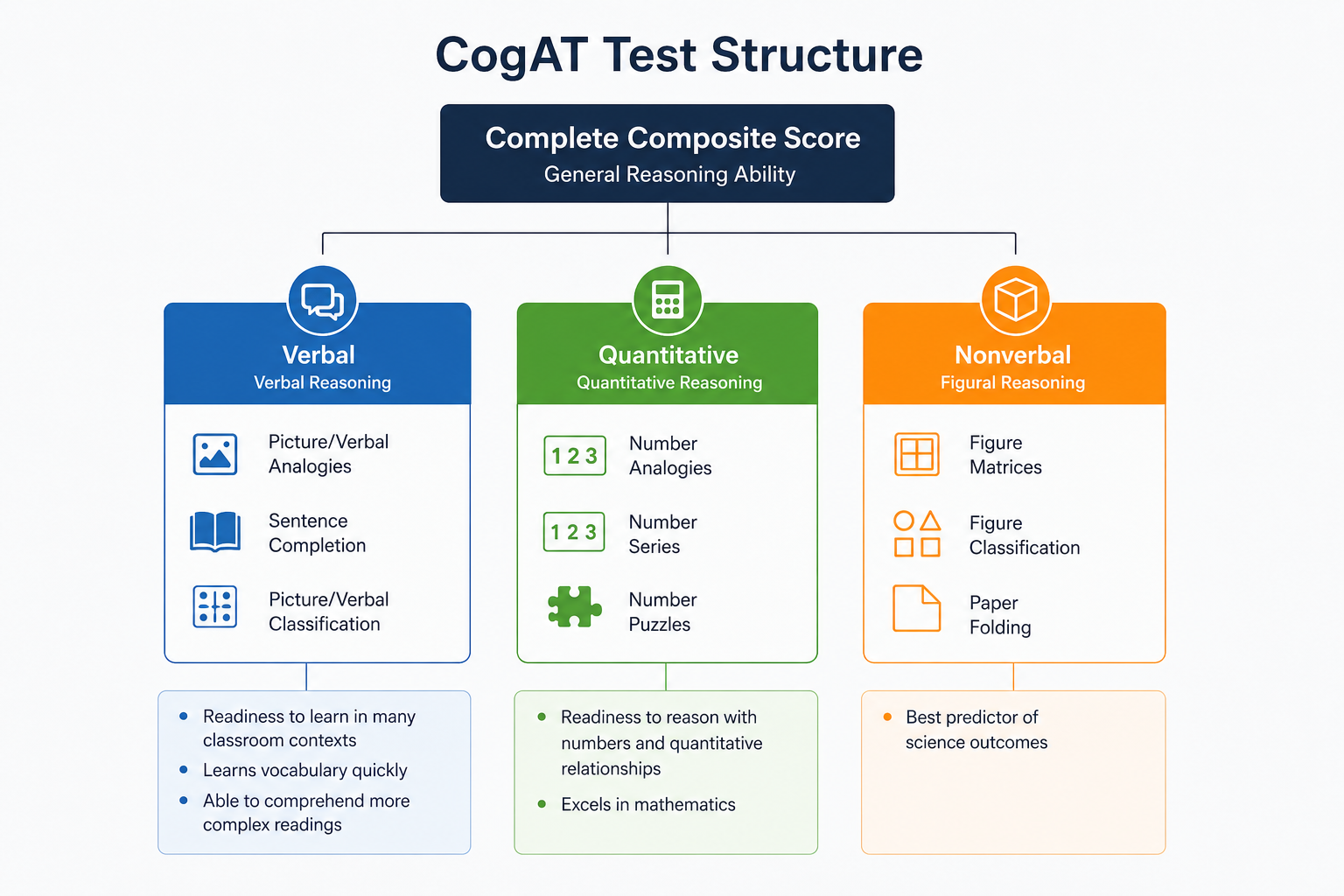
These batteries work together to provide schools with a comprehensive understanding of a student's cognitive strengths.
The three batteries are:
Verbal Battery
Quantitative Battery
Nonverbal Battery
Let's explore each one in detail.
Verbal Battery
The Verbal Battery measures how effectively students use language to solve problems and understand relationships between words and ideas.
Skills Assessed
Vocabulary
Word relationships
Analogies
Sentence completion
Classification
Verbal reasoning
Common Question Types
Picture analogies (younger students)
Sentence completion
Verbal analogies
Verbal classification
Students are encouraged to identify logical relationships rather than simply recall word definitions.
Quantitative Battery
The Quantitative Battery evaluates how students reason with numbers and mathematical concepts.
Unlike a standard math exam, students are not tested on memorized formulas or advanced calculations. Instead, they solve problems by recognizing numerical relationships and patterns.
Skills Assessed
Number analogies
Quantitative concepts
Number puzzles
Mathematical reasoning
Logical thinking
Students who enjoy solving puzzles and recognizing patterns often perform well in this section.
Nonverbal Battery
The Nonverbal Battery measures reasoning using figures, shapes, and visual patterns instead of words or numbers.
This section is particularly valuable because it minimizes the influence of language proficiency and focuses on abstract thinking.
Skills Assessed
Visual reasoning
Pattern recognition
Shape relationships
Figure classification
Matrix reasoning
Spatial thinking
Students analyze diagrams, identify missing patterns, and determine how shapes relate to one another.
Because the questions rely on images rather than language, this battery provides a fairer assessment for students from diverse linguistic backgrounds.
CogAT Test Levels
The CogAT is designed for students from Kindergarten through Grade 12, but the questions are not the same for every grade. Instead, the test uses different test levels that match students' ages and developmental stages. Each level contains age-appropriate questions while measuring the same core reasoning abilities.
As students move to higher grades, the complexity of the questions gradually increases.
CogAT Test Levels by Grade
CogAT Level | Typical Grade |
Level 5 | Kindergarten |
Level 6 | Grade 1 |
Level 7 | Grade 2 |
Level 8 | Grade 3 |
Level 9 | Grade 4 |
Level 10 | Grade 5 |
Level 11 | Grade 6 |
Level 12 | Grade 7 |
Level 13 | Grade 8 |
Levels 14–18 | High School |
Although the content becomes more challenging, every level evaluates the same three reasoning domains:
Verbal Reasoning
Quantitative Reasoning
Nonverbal Reasoning
CogAT Question Types
The CogAT includes a variety of question formats designed to measure different types of reasoning. Students are not expected to memorize facts; instead, they solve unfamiliar problems using logic and critical thinking.
Verbal Question Types
1. Verbal Analogies
Students identify the relationship between two words and choose another pair with the same relationship.
Example:
Bird is to Nest as Dog is to _____
A. Bone
B. Kennel
C. Cat
D. Food
Answer: Kennel
2. Sentence Completion
Students complete a sentence using the most appropriate word.
Example:
Plants need sunlight to ______.
A. Sleep
B. Grow
C. Swim
D. Jump
3. Verbal Classification
Students identify which word does not belong in a group.
Example:
Apple
Banana
Carrot
Orange
Answer: Carrot
Quantitative Question Types
Number Analogies
Students identify numerical relationships.
Example:
2 : 4 :: 5 : ?
A. 8
B. 10
C. 15
D. 20
Answer: 10
Number Series
Students determine the next number in a sequence.
Example:
3, 6, 9, 12, ?
Answer: 15
Number Puzzles
Students solve mathematical reasoning problems using logic rather than lengthy calculations.
Nonverbal Question Types
Students solve visual problems involving figures, patterns, and shapes.
Examples include:
Figure Classification
Matrix Reasoning
Paper Folding
Pattern Completion
Shape Analogies
These questions measure visual-spatial reasoning without relying heavily on language skills.
CogAT Test Format
Although schools may administer the CogAT either on paper or digitally, the overall structure remains similar.
Feature | Details |
Test Format | Paper or Computer-Based |
Question Type | Multiple Choice |
Calculator Allowed | No |
Adaptive Test | No |
Tested Skills | Reasoning Ability |
Grades | K–12 |
How Long Does the CogAT Take?
The complete CogAT typically takes around two to three hours, often divided into shorter testing sessions to reduce fatigue, especially for younger students.
The duration may vary depending on:
Grade level
School district
Testing accommodations
Administration format
CogAT Test Scoring Explained
Receiving a CogAT score report can be confusing because it includes several different score types. Understanding these scores helps parents interpret a child's performance more accurately.
Raw Score
The raw score is simply the number of questions answered correctly. Schools generally do not use this score directly because different test levels contain different questions.
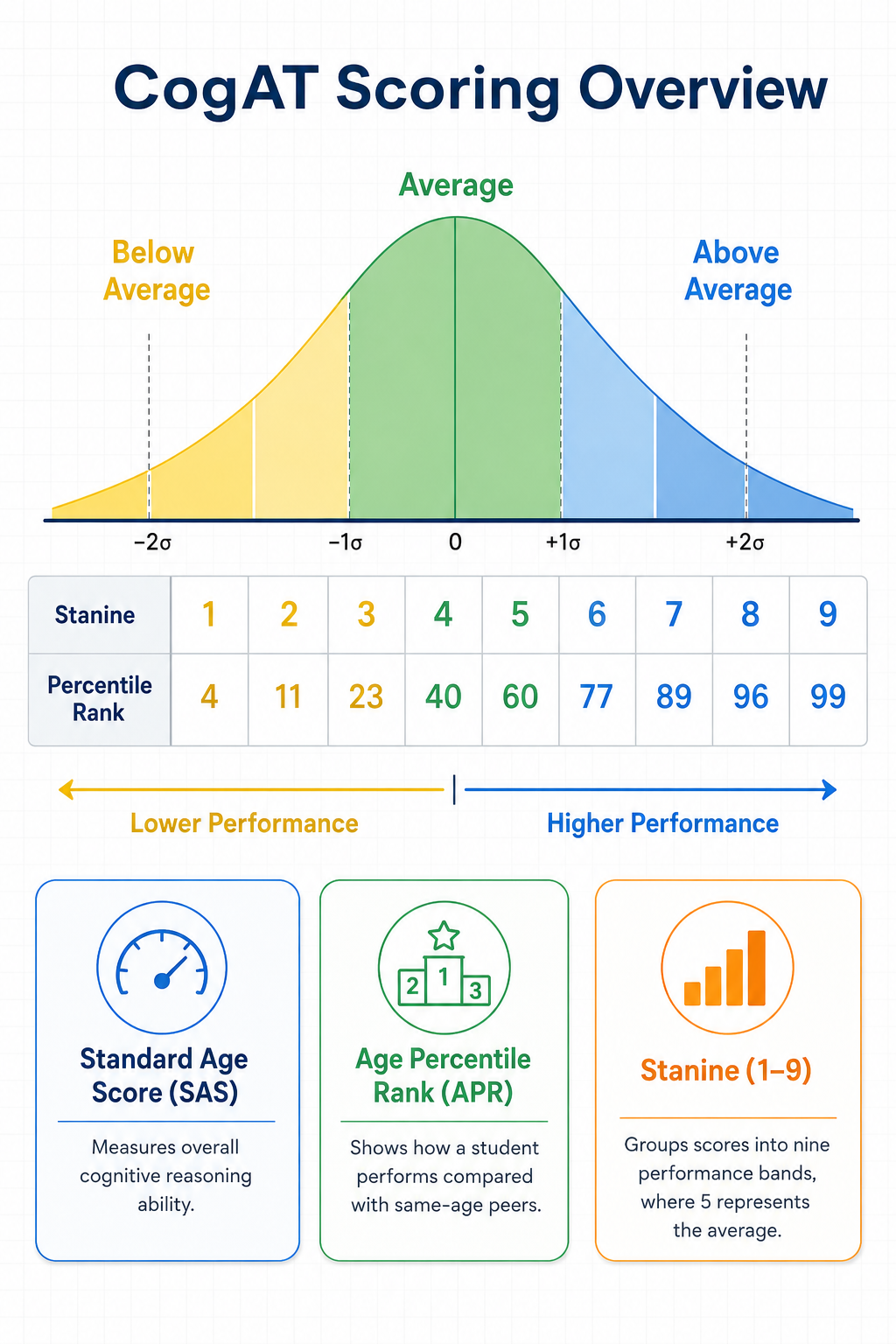
Standard Age Score (SAS)
The Standard Age Score (SAS) is the most widely used CogAT score.
It compares a student's reasoning ability with other students of the same age.
Typical SAS scores range from approximately 50 to 150, with 100 representing the average.
Higher SAS scores indicate stronger reasoning performance relative to age peers.
Age Percentile Rank (APR)
The Age Percentile Rank shows how a student performed compared with other students of the same age.
Examples:
50th percentile = Average
75th percentile = Better than 75% of students
90th percentile = Better than 90% of students
98th percentile = Better than 98% of students
Many gifted programs consider students with percentile ranks of 95 or above, although eligibility criteria differ by district.
Stanine Score
Stanines divide performance into nine broad categories.
Stanine | Performance |
1 | Very Low |
2 | Low |
3 | Below Average |
4 | Average |
5 | Average |
6 | Above Average |
7 | High |
8 | Very High |
9 | Exceptional |
Most students score between Stanine 4 and 6.
What is a Good CogAT Score?
There is no single "passing score" for the CogAT because schools use the results differently. However, higher scores generally indicate stronger reasoning abilities.
General Interpretation
Percentile | Interpretation |
90–94 | High Performing |
95–97 | Highly Gifted Candidate |
98–99 | Exceptional Reasoning Ability |
Remember that many schools also consider:
Classroom performance
Teacher recommendations
Achievement test scores
Portfolios
Interviews (in some districts)
The CogAT is usually one component of a broader evaluation process.
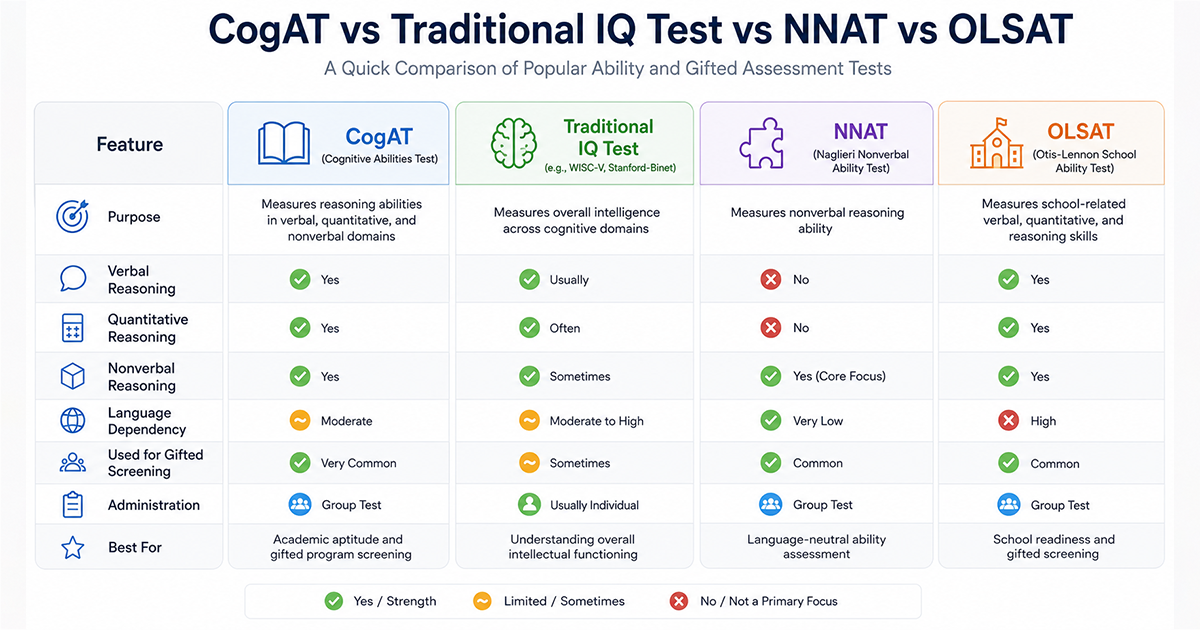
CogAT vs IQ Test
Many parents assume the CogAT is an IQ test, but the two assessments serve different purposes.
CogAT | IQ Test |
Used primarily in schools | Often administered by psychologists |
Measures reasoning for learning | Measures broader intellectual functioning |
Supports educational planning | Supports clinical and psychological evaluation |
Focuses on learning potential | Focuses on overall cognitive ability |
Commonly used for gifted identification | Used for various diagnostic purposes |
CogAT vs NNAT
The Naglieri Nonverbal Ability Test (NNAT) focuses only on nonverbal reasoning.
CogAT | NNAT |
Three reasoning batteries | Nonverbal reasoning only |
Includes verbal questions | No language-based questions |
Includes quantitative reasoning | No math-based reasoning section |
Broader assessment | Focused visual reasoning |
CogAT vs OLSAT
The Otis-Lennon School Ability Test (OLSAT) is another reasoning assessment used by schools
CogAT | OLSAT |
Three reasoning batteries | Verbal and Nonverbal |
Strong emphasis on reasoning patterns | Focus on school learning aptitude |
Widely used for gifted screening | Also used for gifted placement |
CogAT vs MAP Test
The Measures of Academic Progress (MAP) assessment differs significantly from the CogAT.
CogAT | MAP Test |
Measures reasoning ability | Measures academic achievement |
Does not test classroom curriculum | Tests learned academic skills |
Focuses on thinking ability | Focuses on reading, math, language usage |
Parents often see both tests administered because they provide complementary information about a student's abilities and academic progress.
Benefits of Taking the CogAT Test
The CogAT provides valuable insights for students, parents, and educators.
Some of the key benefits include:
Identifying gifted and talented students
Recognizing hidden learning strengths
Supporting personalized instruction
Helping schools make placement decisions
Encouraging advanced learning opportunities
Guiding academic planning
Building a better understanding of each student's reasoning abilities
Rather than labeling students, the test helps educators create learning environments where students can thrive based on their strengths
Common Mistakes Students Make on the CogAT
Even students with strong reasoning abilities can lose points because of avoidable mistakes.
Common errors include:
Rushing through questions without reading carefully
Spending too much time on one difficult question
Ignoring instructions
Guessing without using logical reasoning
Feeling anxious during the test
Skipping practice opportunities beforehand
Parents can help by encouraging steady practice and maintaining a calm, positive attitude toward testing.
How to Prepare for the CogAT Test
Preparing for the CogAT Test is different from studying for a traditional school exam. Since the test measures reasoning and problem-solving skills rather than memorized knowledge, the goal is to strengthen your child's thinking abilities, build confidence, and become familiar with the test format.
The following strategies can help students perform at their best on test day.
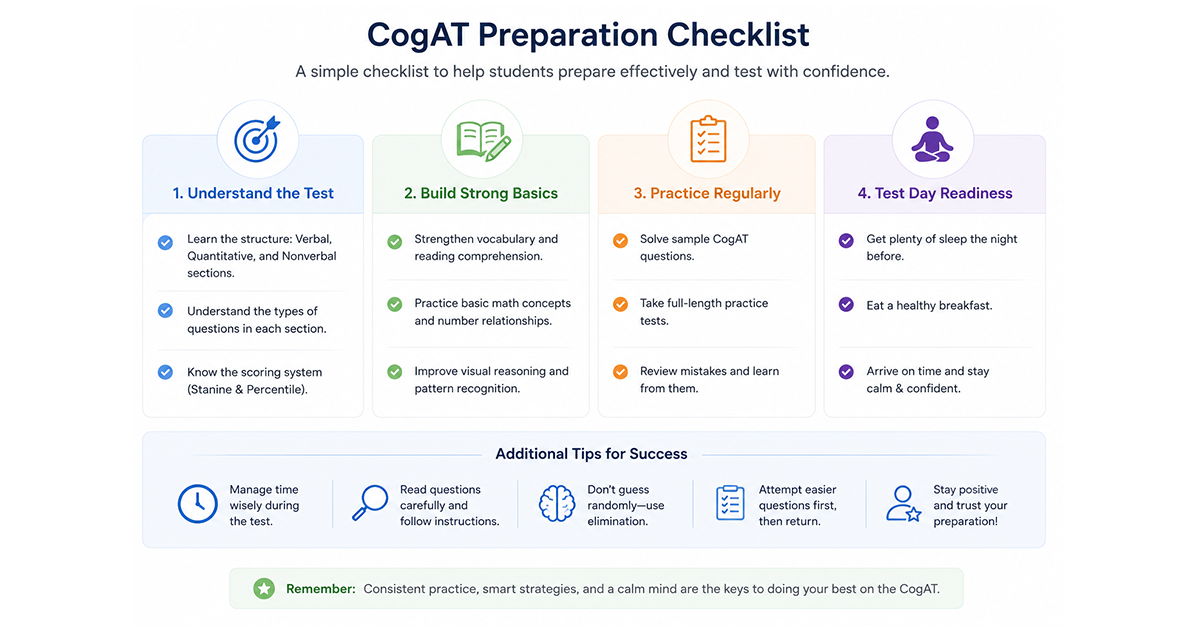
1. Understand the Test Format
Before beginning preparation, make sure your child understands:
The three CogAT batteries (Verbal, Quantitative, and Nonverbal)
The types of questions they will encounter
The timing of each section
The instructions for answering multiple-choice questions
When students know what to expect, they often feel more confident and less anxious.
2. Practice Reasoning Skills Daily
The CogAT rewards logical thinking, so regular practice is more effective than last-minute cramming.
Encourage activities such as:
Logic puzzles
Sudoku
Pattern recognition games
Brain teasers
Classification exercises
Sequencing activities
Even 20–30 minutes of daily practice can help improve reasoning skills over time.
3. Improve Vocabulary Naturally
The Verbal Battery assesses language reasoning rather than rote memorization, but a strong vocabulary can still be beneficial.
Helpful activities include:
Reading books and articles
Learning new words in context
Solving word analogies
Playing vocabulary games
Discussing synonyms and antonyms
4. Build Quantitative Thinking
Students should become comfortable identifying numerical relationships instead of simply performing calculations.
Practice:
Number patterns
Number analogies
Mental math
Logical math puzzles
Quantitative reasoning questions
5. Strengthen Visual-Spatial Skills
The Nonverbal Battery relies on recognizing patterns and relationships between shapes.
Good practice activities include:
Tangram puzzles
Shape-matching games
Jigsaw puzzles
Pattern completion exercises
Matrix reasoning puzzles
6. Take Full-Length Practice Tests
Mock tests help students:
Understand timing
Build endurance
Improve accuracy
Reduce test anxiety
Identify weak areas
After each practice test, review mistakes carefully rather than focusing only on the score.
7. Encourage Healthy Test-Day Habits
A child's physical and emotional well-being also affects performance.
Before the test:
Get a full night's sleep
Eat a balanced breakfast
Arrive early
Bring required materials
Stay calm and positive
Parents should avoid placing excessive pressure on children, as confidence often leads to better performance.
Best Resources for CogAT Preparation
Choosing high-quality study resources can make preparation more effective.
Some recommended resources include
CogAT practice books
Online reasoning worksheets
Educational puzzle apps
Logic games
Vocabulary-building activities
Mock examinations
Personalized tutoring
How StudyHours Can Help
If your child is preparing for the CogAT, personalized support can make a significant difference.
At StudyHours, experienced tutors work one-on-one with students to strengthen the reasoning skills tested in the CogAT. Rather than focusing on memorization, tutors help students develop:
Verbal reasoning
Quantitative reasoning
Nonverbal reasoning
Critical thinking
Problem-solving strategies
Time management skills
Through personalized learning plans, regular assessments, and targeted practice, students can build confidence while preparing for gifted program assessments and other competitive academic tests.
Sample CogAT Practice Questions
Here are a few examples to help students understand the style of CogAT questions.
Sample Verbal Question
Dog is to Puppy as Cat is to ______
A. Kitten
B. Mouse
C. Lion
D. Fur
Correct Answer: A. Kitten
Sample Quantitative Question
3, 6, 9, 12, ?
A. 13
B. 14
C. 15
D. 16
Correct Answer: C. 15
Tips for Parents
Parents play an important role in helping children prepare for the CogAT without creating unnecessary stress.
Encourage Curiosity
Ask open-ended questions that encourage your child to think and explain their reasoning.
Make Learning Fun
Use games, puzzles, and real-life problem-solving activities to build reasoning skills naturally.
Avoid Excessive Pressure
The CogAT is just one assessment. Focus on learning and growth rather than achieving a perfect score.
Establish a Routine
A consistent study schedule is usually more effective than long, infrequent study sessions.
Celebrate Progress
Recognize effort and improvement, regardless of the final score.
Tips for Students
If you're taking the CogAT, keep these strategies in mind:
Read every question carefully.
Look for patterns before choosing an answer.
Don't spend too much time on one difficult question.
Stay calm if you don't know an answer right away.
Use logical reasoning instead of guessing randomly.
Practice regularly to build confidence.
Remember, the CogAT measures how you think, not how much you've memorized.
What Happens After the CogAT Test?
Once students complete the CogAT, schools review the results alongside other information such as classroom performance and teacher observations.
Depending on school policies, the results may be used to:
Identify students for gifted and talented programs.
Recommend advanced academic courses.
Develop personalized learning plans.
Provide additional enrichment opportunities.
Support instructional decisions.
Parents typically receive a score report explaining how their child performed compared with students of the same age or grade.
Is the CogAT Test Difficult?
The difficulty of the CogAT depends on each student's reasoning skills and familiarity with the test format.
Some students find the questions challenging because they require logical thinking rather than memorized knowledge. Others enjoy the puzzle-like nature of the test.
The best way to reduce difficulty is through regular practice and understanding the types of questions that appear on the assessment.
Why CogAT Preparation Matters
Preparing for the CogAT isn't about memorizing answers, it's about developing the thinking skills that support long-term academic success.
Effective preparation can help students:
Become familiar with the test structure.
Improve reasoning and analytical skills.
Increase confidence.
Reduce test anxiety.
Manage time effectively.
Perform closer to their true potential.
Even if a student isn't applying for a gifted program, strengthening these cognitive skills can benefit classroom learning across many subjects.
Conclusion
The Cognitive Abilities Test (CogAT) is more than just another school assessment. It provides valuable insights into how students reason, solve problems, and approach new learning challenges.
Unlike traditional academic exams, the CogAT focuses on a student's ability to think critically rather than recall memorized information. Schools use these insights to identify gifted learners, support personalized instruction, and guide academic planning.
For parents, understanding the purpose and structure of the CogAT can help reduce uncertainty and create a more positive testing experience for their children.
By encouraging curiosity, practicing reasoning skills, and maintaining a balanced approach to preparation, students can build the confidence needed to perform at their best.
If your child is preparing for the CogAT or other gifted program assessments, consistent practice and expert guidance can make a meaningful difference.
With personalized instruction, structured practice, and experienced tutors, StudyHours helps students strengthen the reasoning skills needed for success in the CogAT and beyond.
Frequently Asked Questions (FAQs)
1. What is the CogAT Test used for?
The CogAT measures students' reasoning and problem-solving abilities. Schools often use it to identify gifted students, support academic placement decisions, and better understand learning strengths.
2. Is the CogAT the same as an IQ test?
No. The CogAT measures reasoning skills related to learning, while an IQ test is designed to assess broader intellectual functioning and is often used in clinical settings.
3. Which grades take the CogAT Test?
The CogAT is available for students from Kindergarten through Grade 12, although many schools administer it in elementary and middle school.
4. How long does the CogAT Test take?
The complete assessment usually takes 2–3 hours, often divided into shorter sessions depending on the student's grade level.
5. What subjects are included in the CogAT?
The test consists of three reasoning batteries:
Verbal
Quantitative
Nonverbal
6. What is considered a good CogAT score?
There is no universal passing score. Many gifted programs consider students scoring in the 95th percentile or above, but requirements vary by school district.
7. Can students prepare for the CogAT?
Yes. Students can improve familiarity with the test by practicing reasoning questions, solving puzzles, expanding vocabulary, and taking mock tests. Preparation should focus on developing thinking skills rather than memorizing content.
8. Is the CogAT Test difficult?
The test can be challenging because it measures reasoning rather than classroom knowledge. Regular practice and familiarity with the question types can make students more comfortable.
9. Which countries commonly use the CogAT?
The CogAT is widely used in the United States and is also administered by many international schools in Canada, Singapore, the United Arab Emirates (UAE), Australia, and the United Kingdom.
10. How can StudyHours help with CogAT preparation?
StudyHours offers personalized one-on-one tutoring that focuses on building verbal, quantitative, and nonverbal reasoning skills through structured lessons, guided practice, and mock assessments. This targeted support helps students gain confidence and prepare effectively for the CogAT.
Published by StudyHours Global Editorial Board