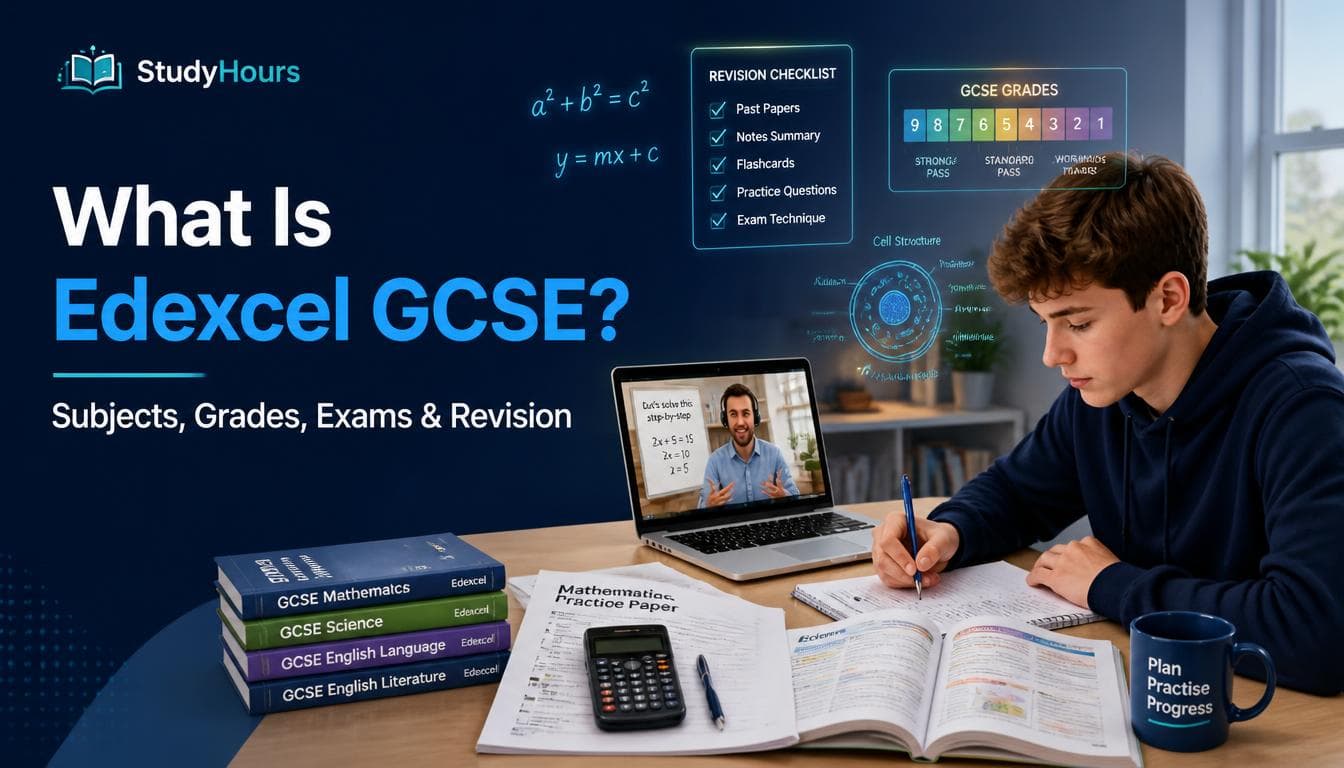
Edexcel GCSEs are widely studied qualifications in the UK, helping students develop subject knowledge and prepare for further education.
For students approaching their GCSE examinations, understanding how Edexcel works can make revision more organised, improve exam preparation and help them choose appropriate study resources.
Edexcel is part of Pearson, an education and awarding organisation that offers qualifications across a range of subjects.
Its GCSE specifications explain what students need to learn, how their knowledge will be assessed and which skills they must demonstrate in examinations.
However, preparing for Edexcel GCSEs involves more than memorising facts or completing revision notes.
Students need to understand their individual subject specifications, practise relevant exam questions, interpret mark schemes and learn how to apply knowledge under timed conditions.
In this guide, we explain what Edexcel GCSE means, which subjects students can study, how the grading system works, what to expect from examinations and how to prepare effectively.
We also explore how subject-specific tutoring can support students who want to strengthen their understanding and improve their exam technique.
What Is Edexcel GCSE?
Edexcel is an awarding organisation owned by Pearson. It offers GCSE qualifications in various subjects, including Mathematics, English, Science, Humanities, Languages and other academic areas.
GCSE stands for General Certificate of Secondary Education. In England, students typically study GCSE subjects during Key Stage 4, usually between the ages of 14 and 16.
Edexcel GCSE qualifications are designed to assess students' understanding of the subjects they study. Depending on the course, students may need to demonstrate knowledge, problem-solving, analysis, evaluation, practical skills or the ability to communicate ideas clearly.
Each subject has its own specification, which outlines the content and assessment requirements.
For example, students studying Edexcel GCSE Mathematics need to understand the relevant mathematical topics and apply their knowledge to different types of problems.
Students taking Edexcel GCSE English Language need to develop reading and writing skills appropriate to their specification.
This is why students should use revision resources designed for their particular exam board and qualification rather than assuming that every GCSE course follows exactly the same structure.
Students who need additional subject-specific guidance can explore Edexcel GCSE tutors online for support with understanding topics, practising examination questions and developing effective revision habits.
Which Subjects Are Available Through Edexcel GCSE?
Pearson Edexcel offers GCSE qualifications across a range of subject areas. The subjects available to individual students depend on their school, course options and the qualifications currently offered.
1. Edexcel GCSE Mathematics
Mathematics is a core subject for many GCSE students. It develops numerical fluency, logical reasoning and the ability to solve problems using mathematical methods.
Depending on the specification and tier, students may study:
Number, fractions, decimals and percentages
Ratio, proportion and rates of change
Algebraic expressions, equations and sequences
Graphs, coordinates and functions
Geometry, angles, shapes and measures
Probability and statistics
Mathematical reasoning and problem-solving
Students need to understand how to choose an appropriate method, show their working clearly and check whether their answers are reasonable.
Edexcel Mathematics questions may require students to connect different topics within one problem.
Practising a range of question types helps students become more confident in recognising the information they need and deciding how to use it.
2. Edexcel GCSE English Language
English Language focuses on reading, writing and communication. Students develop the ability to understand texts, analyse language and structure, and produce written responses for different purposes and audiences.
Preparation may involve analysing fiction and non-fiction, explaining the effects of writers' choices and developing clear, organised writing.
Students should practise planning responses, selecting relevant evidence and checking their written work for accuracy.
3. Edexcel GCSE English Literature
English Literature involves studying literary texts and developing interpretations supported by evidence.
Depending on the specification, students may study Shakespeare, modern drama, prose, poetry and unseen texts.
Successful preparation requires more than memorising quotations. Students should understand the characters, themes, context and literary techniques relevant to their set texts.
They also need to practise explaining how writers create meaning and support their interpretations with appropriate evidence.
Students should always check the current specification and school reading list to confirm which texts they need to study.
4. Edexcel GCSE Science
Pearson Edexcel offers GCSE Science qualifications, including Biology, Chemistry, Physics and Combined Science.
Students develop an understanding of scientific concepts and learn how to apply them to unfamiliar situations. Depending on the qualification, they may also need to interpret experimental results, analyse graphs, use formulas and understand practical methods.
Science revision should combine knowledge recall with application. Students should practise explaining processes, interpreting data and completing calculations rather than relying entirely on reading notes.
5. Edexcel GCSE Computer Science
Computer Science develops students' understanding of computing systems, algorithms, programming and data.
Preparation may involve learning technical terminology, tracing algorithms, understanding programming concepts and explaining how computer systems operate.
Students benefit from practising problems independently and explaining why a particular solution works.
6. Edexcel GCSE Humanities
Edexcel offers qualifications in subjects such as History and Geography.
History students develop their ability to understand historical events, interpret sources and construct supported explanations.
Geography students may study physical and human processes, geographical patterns, data interpretation and fieldwork-related skills.
The precise content depends on the subject specification, so students should confirm their selected topics and assessment requirements before creating a revision plan.
7. Languages and Other GCSE Subjects
Pearson Edexcel also offers qualifications in areas such as French, Spanish, German, Business, Economics, Psychology, Religious Studies, Music, Drama and other subjects.
Assessment methods vary. Some subjects focus heavily on written examinations, while others may include spoken, practical or non-examination assessment components.
Students should review their current specification and follow their teacher's guidance to understand exactly what their qualification requires.
How Does the Edexcel GCSE Grading System Work?
Understanding GCSE grades helps students set targets and monitor their progress.
Many reformed Pearson Edexcel GCSE qualifications in England use the 9–1 grading scale, with grade 9 being the highest and grade 1 the lowest available numerical grade. An unclassified result may be recorded as U.
However, students should check the grading arrangements for their exact qualification because not every qualification offered by Pearson necessarily follows the same grading convention.
What Does Each GCSE Grade Mean?
The numerical grading system allows schools, colleges and other institutions to assess students' achievements against the requirements of their qualifications.
Grade 9 represents the highest level of attainment in the 9–1 GCSE grading scale. Grades 7–9 are generally associated with strong performance, while grades 4 and 5 are commonly discussed as important benchmarks in England.
However, entry requirements vary between schools, colleges, sixth forms and courses.
Students should check the requirements of their intended next step rather than assuming that one grade is sufficient for every destination.
What Are Edexcel GCSE Grade Boundaries?
Grade boundaries are the minimum marks required to achieve a particular grade in an examination or qualification.
They may vary between examination series because papers can differ in difficulty. Students should not assume that a fixed percentage will always guarantee a particular grade.
Published grade boundaries can help students understand their performance, but they should be used alongside the relevant mark scheme and specification.
For example, if a student repeatedly loses marks on algebra questions, the most useful next step is to identify the underlying difficulty and practise that skill.
Simply aiming to achieve a certain percentage without reviewing mistakes may not lead to meaningful improvement.
How Can Students Set a Realistic Grade Target?
A useful target should reflect a student's current performance, remaining preparation time and the requirements of their chosen course.
Students can begin by completing relevant practice questions or a past paper under appropriate conditions.
They can then review the results to identify strengths and weaknesses.
A realistic revision plan should prioritise the topics that need the most attention while continuing to revisit material the student already understands.
How Are Edexcel GCSE Exams Structured?
Edexcel GCSE assessment arrangements depend on the subject and qualification.
Students should consult their current specification to understand the number of papers, assessment objectives, weighting of components and any additional assessment requirements.
Linear GCSE Qualifications
Many reformed GCSE qualifications in England use a linear structure. In these courses, students generally complete their main examinations at the end of the course.
This means that students may need to retain knowledge from Year 10 through Year 11 rather than preparing only for a series of separate unit examinations.
Regular revision throughout the course can help students strengthen long-term recall and reduce the pressure of learning large amounts of material shortly before the final exams.
Written Examinations
Written examinations may include multiple-choice questions, short answers, calculations, extended responses or problem-solving tasks.
The format depends on the subject. Students should practise the types of questions used in their specific qualification so they become familiar with the expected level of detail and the way marks are awarded.
Practical and Non-Examination Assessment
Some subjects may include practical work, spoken assessments or other non-examination components. The exact requirements depend on the qualification.
Students should identify these requirements early and understand the relevant deadlines and assessment rules.
Where assessed work must be completed independently, students should follow their school's instructions and the awarding organisation's regulations.
How to Revise for Edexcel GCSE Exams
Effective revision combines understanding, practice and regular review. Reading a textbook repeatedly may help students recognise information, but it does not always show whether they can recall or apply it independently.
The following strategies can help students prepare more effectively.
1. Start With the Specification
The specification should be the foundation of a student's revision plan.
Review the topics and learning objectives for each subject. Divide them into manageable sections and assess your confidence in each one.
For example:
Confident: You can explain the topic and answer relevant questions independently.
Developing: You understand the main ideas but make occasional mistakes.
Needs more practice: You struggle to recall the information or apply it to exam questions.
This simple system helps students identify where to focus their time.
2. Practise With Edexcel Past Papers
Past papers help students become familiar with examination questions, command words and mark allocations.
Choose papers that match your current qualification and specification. Older papers may still be useful, but students should check whether the content and assessment format remain relevant.
Try answering questions without notes before checking the mark scheme. This gives a more realistic indication of what you can recall and apply independently.
3. Understand the Mark Scheme
Mark schemes explain how answers are assessed and what information is required to earn marks.
After completing a question, compare your answer with the relevant mark scheme.
Identify which points were correct, which were missing and where your reasoning went wrong.
For longer answers, check whether you have explained your ideas clearly and included the evidence or reasoning required by the question.
4. Keep an Error Log
An error log records mistakes and helps students avoid repeating them.
For each mistake, note the topic, the reason for the error, the correct approach and what you need to practise next.
Mistakes may arise because of missing knowledge, incorrect calculations, misunderstanding a question or giving an incomplete explanation.
Reviewing these notes regularly makes revision more focused than repeatedly working through familiar material.
5. Use Active Recall
Active recall involves retrieving information from memory without immediately checking notes.
Students can use flashcards, practice questions, blank-page summaries or verbal explanations to test what they know.
For example, a Science student could try explaining a process from memory before checking whether the explanation includes all the important stages.
This method helps students identify what they genuinely remember and what still needs attention.
6. Apply Spaced Revision
Spaced revision means returning to topics over several days or weeks instead of studying them only once.
A student might revise a topic on Monday, test their understanding later in the week and revisit it again the following week.
The exact schedule can be adapted to the subject and the student's workload. The key is to return to previously studied material often enough to strengthen recall.
7. Practise Under Timed Conditions
As examinations approach, students should practise completing questions and papers within the appropriate time limits.
Start with short sections and gradually progress to full papers. This helps develop concentration, time management and familiarity with the examination format.
After each practice session, review the answers carefully. Understanding why marks were lost is more valuable than simply recording the final score.
8. Build a Balanced Revision Timetable
A revision timetable should reflect the student's subjects, upcoming assessments and areas of difficulty.
Include time for:
Reviewing subject content
Practising examination questions
Revisiting difficult topics
Reviewing previous mistakes
Taking regular breaks
Preparing for practical or other assessment components, where applicable
A realistic timetable that can be followed consistently is generally more useful than an intensive plan that leaves too little time for rest or other responsibilities.
Common Challenges Students Face With Edexcel GCSEs
Students can encounter several difficulties during GCSE preparation. Recognising the cause of a problem makes it easier to choose the right strategy.
Struggling With Multi-Step Mathematics Questions
Some Mathematics questions require students to combine several concepts before reaching an answer.
Students may understand individual methods but find it difficult to recognise which ones to use in an unfamiliar problem.
To improve, practise questions that combine different topics. Write down each step, explain why it is needed and check your answer against the mark scheme.
Losing Marks Despite Knowing the Content
A student may understand a topic but still lose marks because their answer lacks detail or does not address the question fully.
Practising command words, identifying the key instruction and checking answers against mark schemes can help students develop more precise responses.
Forgetting Topics Studied Earlier
When students study several subjects, it is easy to forget information learned months before.
Spaced revision, short retrieval exercises and regular practice questions help students revisit older material throughout the course.
Difficulty Managing Multiple Subjects
Preparing for several GCSEs requires planning and prioritisation.
Students should consider upcoming exam dates, weaker subjects and the amount of content remaining.
They should also make sure that important assessment components are not neglected while focusing on written examinations.
Not Knowing Where to Start
Students who feel overwhelmed may try to revise everything at once or spend too much time deciding what to study.
A useful starting point is to identify three priority topics for the week, schedule manageable sessions and review progress at the end of the week.
How Can an Edexcel GCSE Tutor Help?
A subject-specific tutor can help students understand difficult concepts, practise examination questions and create a structured revision plan.
The most useful support is tailored to the student's current specification, learning needs and academic goals.
Subject-Specific Explanations
A tutor can explain challenging concepts in smaller steps and use examples to show how a method works.
In Mathematics, this could involve strengthening algebra before progressing to more complex problem-solving.
In English, it could involve improving textual analysis or developing more structured written responses.
Targeted Practice Questions
A tutor can use diagnostic questions and past-paper practice to identify topics that need more attention.
This allows lessons to focus on specific difficulties instead of spending equal time on every topic regardless of the student's progress.
Exam Technique and Mark-Scheme Skills
Students can practise interpreting questions, structuring answers, showing working and checking whether their responses meet the assessment requirements.
Regular feedback helps students understand their mistakes and become more independent when answering unfamiliar questions.
Personalised Revision Planning
A tutor can help students create a revision plan that reflects their subjects, target grades, assessment dates and current level of understanding.
The plan can be adjusted as the student improves or identifies new areas that need attention.
Families looking for subject-specific support can explore Edexcel GCSE online tutoring to learn more about tailored academic guidance.
How to Choose the Right Edexcel GCSE Revision Resources
The best revision resources match the student's exact qualification and explain the material accurately.
Before using a revision guide, video or practice paper, consider the following:
Does it cover the correct Edexcel GCSE subject?
Is it aligned with the current specification?
Does it explain the concepts clearly?
Are answers or mark schemes available?
Does it provide suitable opportunities for independent practice?
Is it appropriate for the student's current level of understanding?
Students should use teacher-provided materials alongside relevant Pearson Edexcel resources and their own class notes.
Online materials can provide additional explanations and practice, but students should check that they cover the right topics and assessment requirements.
For students studying other GCSE exam boards as well, online GCSE tutoring provides another starting point for exploring subject-specific academic support.
Frequently Asked Questions About Edexcel GCSE
What does Edexcel stand for?
Edexcel is an awarding organisation owned by Pearson. It provides GCSEs and other qualifications across a range of subjects.
Is Edexcel the same as Pearson?
Edexcel is part of Pearson. The terms Pearson Edexcel and Edexcel are commonly used to refer to qualifications offered by the awarding organisation.
Are Edexcel GCSEs difficult?
Difficulty depends on the subject, specification, student's existing knowledge and assessment requirements.
Students can prepare more effectively by understanding their specification, practising relevant questions and reviewing their mistakes.
Does Edexcel GCSE use grades 9–1?
Many reformed Pearson Edexcel GCSE qualifications in England use grades 9–1, with 9 being the highest grade.
Students should check the grading arrangements for their particular qualification.
How many exams do Edexcel GCSE subjects have?
The number of examinations varies by subject and qualification. Students should consult the current specification to confirm the number of papers, their duration and the weighting of each assessment component.
Can I use AQA or OCR past papers for Edexcel GCSE revision?
Some questions from other exam boards may provide useful additional practice when the underlying topic is shared.
However, students should prioritise Edexcel-specific papers and mark schemes because the specifications and assessment arrangements can differ.
When should students start revising for Edexcel GCSEs?
Students should begin revisiting topics throughout the course rather than waiting until the final weeks.
Regular revision in Year 10 and Year 11 can help strengthen recall and identify gaps before the examinations.
Where can I find help with Edexcel GCSE subjects?
Students can ask their teachers for guidance and use relevant specification documents, revision resources and past papers.
Those who need more individual support can also explore Edexcel GCSE tutors online.
Final Thoughts
Edexcel GCSE preparation becomes more manageable when students understand their subject specifications, know how their assessments work and follow a realistic revision plan.
The most effective approach combines subject knowledge with regular practice, active recall, timed questions and careful review of mistakes.
Students should prioritise materials that match their qualification and use mark schemes to understand how to improve their answers.
Every student has different strengths and learning needs, so revision plans should reflect individual progress rather than follow a one-size-fits-all approach.
For students who need additional guidance, Edexcel GCSE tutors online can provide subject-focused support to help strengthen understanding, develop exam technique and prepare for GCSE assessments with greater confidence.
Published by StudyHours Global Editorial Board