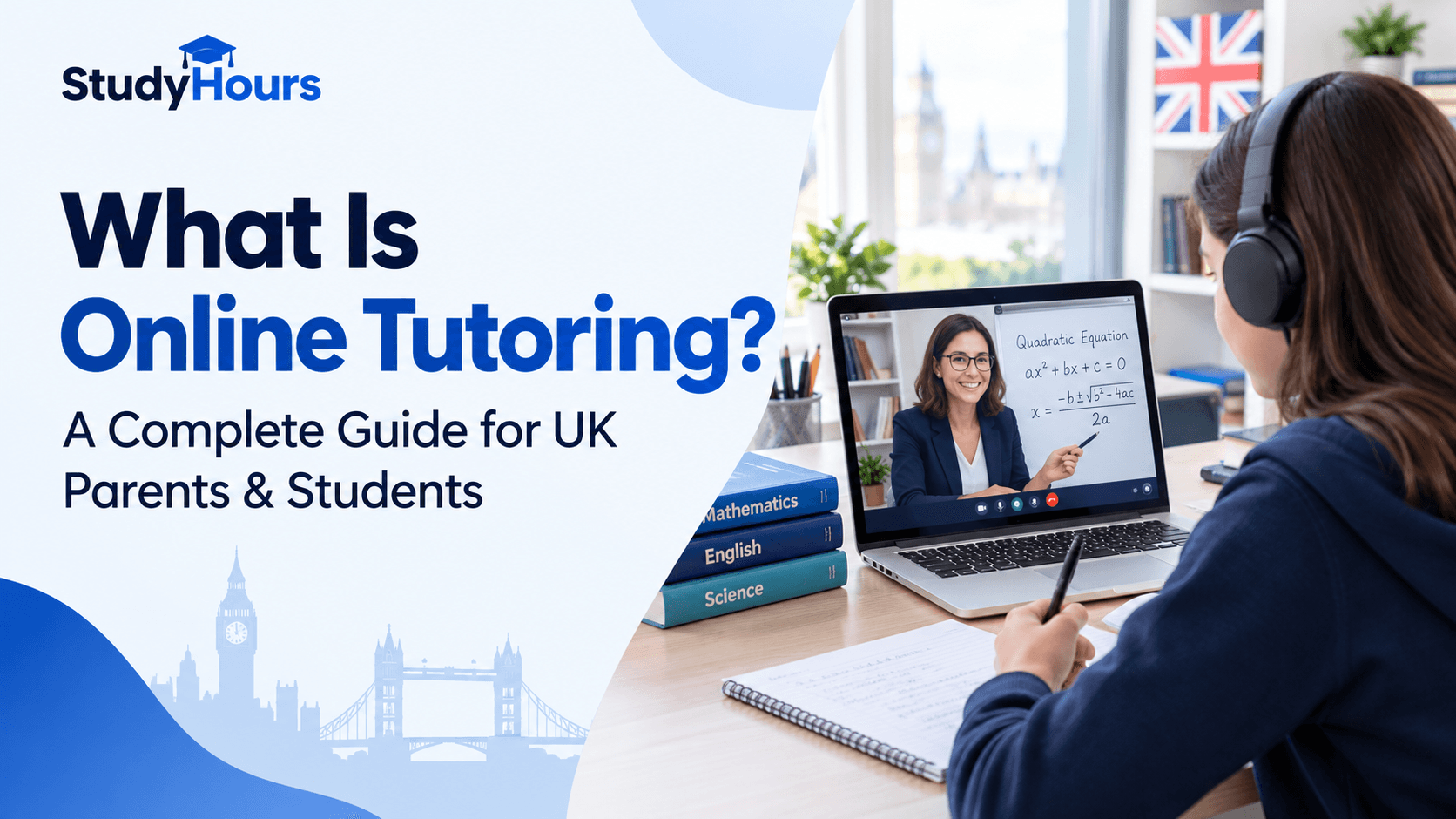
Online tutoring has become an increasingly accessible way for students to receive additional academic support outside the traditional classroom.
Whether a child needs help understanding a difficult subject, preparing for GCSE examinations, improving A-Level performance or developing better study habits, online lessons can provide a flexible way to work towards individual learning goals.
For parents in the UK, choosing the right tutoring option involves more than finding someone who knows a subject.
It also means understanding how online lessons work, what makes tutoring effective, how progress can be assessed and whether the teaching approach suits the student's needs.
Online tutoring uses digital technology to connect students with tutors through live lessons, virtual classrooms and other learning resources.
Depending on the service, students may receive one-to-one instruction, guided practice, feedback on their work and support with specific academic challenges.
This guide explains what online tutoring is, how it works in the UK, which students may benefit from it and what parents should consider when choosing an online tutor.
Families looking for a starting point can explore the subjects and support options offered through StudyHours online tutoring in the UK
What Is Online Tutoring?
Online tutoring is a form of additional education in which a student receives instruction from a tutor through an internet-connected device.
Lessons usually take place through video conferencing or a dedicated online learning platform.
Unlike a traditional classroom, where one teacher generally works with a group of students, online tutoring can provide more individual attention.
In one-to-one sessions, the tutor can focus on the student's current understanding, questions and learning priorities.
The exact format depends on the provider. Some services offer live lessons with a tutor, while others combine live teaching with recorded explanations, digital exercises, revision materials or independent study activities.
For example, a Year 10 student preparing for GCSE Mathematics might use online tutoring to revisit algebra, practise examination questions and understand mistakes in previous assessments.
An A-Level student could receive support with complex subject concepts, essay planning or examination technique.
Online tutoring can complement school education, but it does not automatically replace classroom teaching or independent study.
Its usefulness depends on the quality of instruction, the student's needs and how consistently the student applies what they learn.
Families exploring additional academic support can learn more about the subjects and tutoring options available through online tutoring in the UK.
How Does Online Tutoring Work?
Online tutoring generally follows a structured process, although the details vary between providers.
1. Identify the student's learning needs
The process often begins with identifying the subjects or skills where the student needs help.
Parents and students might consider:
Which subjects feel most challenging.
Whether particular topics are causing repeated mistakes.
Whether the student needs help with homework or examination preparation.
Which assessments or examinations are approaching.
Whether confidence, organisation or study habits are affecting progress.
A clear starting point helps the tutor focus on relevant learning goals rather than covering material without a defined purpose.
2. Match the student with a suitable tutor
The next step is finding a tutor with appropriate subject knowledge and experience teaching the student's age group, curriculum and academic level.
For UK students, curriculum familiarity can be particularly important. GCSE and A-Level courses may follow different examination-board specifications, so a tutor should understand the relevant course requirements and assessment approach.
Parents should also consider the tutor's communication style and ability to explain difficult ideas clearly.
A strong academic background alone does not guarantee that a tutor's teaching approach will suit every student.
3. Attend live online lessons
Lessons typically take place in a virtual classroom or through video conferencing.
Depending on the platform, students and tutors may use digital whiteboards, shared documents, diagrams, presentations, question sheets and other resources.
For example, during a Maths lesson, the tutor might demonstrate how to solve an equation on a digital whiteboard before asking the student to complete a similar problem independently.
In an English lesson, the tutor could review an essay structure, discuss textual evidence or help the student understand how to develop an analytical paragraph.
The most useful sessions involve active participation rather than simply watching the tutor explain information.
4. Practise and review the material
Learning does not end when a live lesson finishes.
Students may need to complete practice questions, revise key concepts, review feedback or apply a method independently.
These activities help them check whether they can use what they learned without immediate assistance.
A tutor may also use the next session to revisit previous topics and assess whether the student has retained the information.
5. Review progress and adjust the plan
As the student develops, their learning priorities may change.
A student who initially struggles with foundational concepts may eventually be ready for more challenging questions.
Another student may understand the subject but need to improve examination technique or time management.
Regular review helps ensure that tutoring remains relevant to the student's current needs.
What Subjects Can Students Study With an Online Tutor?
Online tutoring can cover a wide range of subjects and academic levels. The subjects available depend on the provider and the tutors it offers.
Mathematics
Mathematics tutoring can support students with number skills, algebra, geometry, statistics, problem-solving and examination preparation.
A tutor can help explain methods step by step, identify recurring errors and provide additional practice with challenging questions.
For GCSE and A-Level students, this may also involve learning how to show working clearly and apply mathematical methods to unfamiliar problems.
English Language and English Literature
English tutoring can focus on reading comprehension, grammar, vocabulary, writing structure, literary analysis and examination technique.
Students may benefit from discussing how to support an interpretation with evidence, develop analytical paragraphs or organise an essay in response to a specific question.
Science
Biology, Chemistry and Physics tutoring can help students understand scientific concepts, interpret diagrams, practise calculations and explain processes accurately.
Depending on the course, lessons may also cover practical methods, experimental variables, data interpretation and structured examination answers.
Computer Science
Computer Science tutoring can cover programming, algorithms, data representation, computational thinking and theoretical concepts.
Students may practise tracing code, explaining how an algorithm works, identifying errors and developing logical solutions to problems.
Other subjects and qualifications
Depending on the provider, online tutoring may also be available for humanities, languages, business subjects and other academic areas.
Students following GCSE, International GCSE, A-Level, IB or other qualifications should check that the tutor is familiar with their specific course and assessment requirements.
Who Can Benefit From Online Tutoring?
Online tutoring is not limited to students who are falling behind at school. It can serve different purposes depending on a student's abilities, goals and learning circumstances.
Primary school students
Younger students may benefit from additional support with reading, writing, number skills and foundational mathematical concepts.
Short, interactive sessions and age-appropriate activities can help maintain engagement.
Parents should consider the student's attention span, confidence using technology and need for adult supervision.
Secondary school students
Secondary school students often encounter more demanding subject content and increasing expectations for independent study.
Tutoring may help them consolidate classroom learning, revisit difficult topics, complete practice questions and develop effective study routines.
Students working towards GCSEs may also benefit from focused preparation that reflects their current specification and examination requirements.
GCSE students
GCSE courses require students to develop subject knowledge and apply it to different forms of assessment.
An online tutor may help a student identify learning gaps, review challenging topics, practise examination-style questions and understand feedback from mock exams.
The type of support should depend on the student's needs. Someone struggling with basic concepts may need to revisit foundational knowledge, while a student with strong subject understanding may benefit more from improving exam technique.
A-Level students
A-Level study often involves more complex concepts, detailed analysis and independent learning.
Tutoring can provide opportunities to clarify difficult material, practise structured responses and develop a deeper understanding of the subject.
Students preparing for university applications may also need to manage their time carefully alongside other academic commitments.
A realistic study plan can help them balance revision with schoolwork and personal responsibilities.
Students who want to extend their learning
Some students seek tutoring because they want to explore topics beyond their regular lessons, strengthen particular skills or prepare for more demanding academic work.
Additional support can provide opportunities to ask questions, work through challenging problems and receive feedback at an appropriate level.
However, tutoring should still be matched to the student's interests and goals rather than assuming that every student needs extra lessons.
What Are the Main Benefits of Online Tutoring?
The benefits of online tutoring depend on the student, the tutor and the quality of the learning experience. Several features may make it useful for families.
Personalised attention
One-to-one tutoring allows the lesson to focus on a student's particular questions and difficulties.
Instead of following a fixed classroom pace, the tutor can spend more time on a challenging concept or move forward when the student demonstrates understanding.
This flexibility can be valuable when a student needs additional explanation or would benefit from more demanding practice.
Flexible learning arrangements
Online lessons can reduce the need to travel to a tutoring centre or arrange transport to a tutor's home.
Families may be able to schedule sessions around school, extracurricular activities and other commitments, depending on the tutor's availability.
However, parents should still ensure that lesson times allow the student to concentrate and complete independent work between sessions.
Access to a wider choice of tutors
Online tutoring can make it easier to consider tutors who are not based nearby.
This can be useful when a student needs support in a specialist subject, a particular qualification or an examination-board specification.
Parents should check the tutor's credentials, teaching experience and suitability rather than selecting someone based solely on availability.
Immediate feedback
During a live lesson, a tutor can observe how a student approaches a problem and respond to misunderstandings.
For example, if a student repeatedly makes the same algebraic error, the tutor can identify the step where the confusion occurs and explain an alternative method.
Timely feedback can help students understand what needs to change before the same mistake becomes a persistent habit.
Development of independent study skills
Effective tutoring should help students become more capable of working independently.
A tutor can model problem-solving methods, explain how to approach difficult questions and encourage students to check their own work.
Over time, students can learn to recognise when they need to revisit a concept, how to use feedback and how to organise revision more effectively.
These skills can be useful beyond a single subject or examination.
Are There Any Disadvantages to Online Tutoring?
Online tutoring offers flexibility, but it is not automatically the best option for every student.
Screen time and concentration
Students who already spend considerable time using digital devices may find additional screen-based lessons tiring.
Parents can help by choosing suitable session lengths, encouraging breaks and ensuring that the student has a comfortable study space.
Technology requirements
Reliable internet access, an appropriate device and a suitable learning environment are important for live online lessons.
Technical difficulties can interrupt a session, so families should check the platform requirements before lessons begin.
Limited suitability for some learning activities
Most academic explanations and practice exercises can be adapted for online teaching, but some activities may be better suited to in-person environments.
Practical work, hands-on demonstrations and certain specialist activities may require resources that cannot be fully replicated through a screen.
Students should continue following their school's arrangements for practical assessments and other required activities.
The need for active participation
An online lesson is unlikely to be effective if a student simply watches without asking questions or attempting the work.
Tutors should encourage participation, check understanding and provide opportunities for independent problem-solving.
Parents can support this by asking students what they learned and whether they can explain a concept or complete a similar question themselves.
Online Tutoring vs Classroom Learning
Online tutoring and classroom learning serve different purposes, so they should not necessarily be treated as competing alternatives.
Classroom teaching provides a structured school environment where students learn alongside their peers, participate in group activities and follow the school's curriculum.
Online tutoring usually provides additional instruction outside that setting, often with more time devoted to an individual's questions and learning goals.
The main differences relate to purpose, class size, flexibility and the amount of individual attention available.
Classroom learning provides regular teaching, social interaction and a shared learning experience.
Online tutoring can provide focused practice, explanations of difficult concepts and additional feedback tailored to a student's needs.
Many students benefit from both. School lessons establish the main curriculum, while tutoring can provide further opportunities to review material or address particular weaknesses.
Parents choosing additional support should consider what the student needs rather than assuming one format is always more effective.
How to Choose the Right Online Tutor in the UK
Selecting an appropriate tutor requires consideration of academic expertise, teaching approach, communication and practical arrangements.
Check subject knowledge and curriculum experience
Ask whether the tutor has experience teaching the student's subject, age group and qualification.
For GCSE and A-Level students, familiarity with the relevant examination board and specification can be particularly useful.
Understand the teaching approach
A good tutor should be able to explain how they assess understanding, plan lessons and respond when a student struggles.
Parents can ask how sessions balance explanations, guided practice and independent questions.
Look for clear learning objectives
Tutoring should have a purpose. This might involve improving understanding of a particular topic, preparing for an assessment or developing a specific skill.
Clear objectives make it easier to review whether the sessions are addressing the student's needs.
Ask how progress is reviewed
Progress can be assessed through practice questions, topic checks, homework feedback and the student's ability to apply concepts independently.
Parents should look for meaningful evidence of learning rather than relying exclusively on the number of lessons completed.
Consider communication and compatibility
The tutor should communicate clearly, encourage questions and adapt explanations when necessary.
A student who feels comfortable asking for clarification may find it easier to identify misunderstandings and participate actively.
Review practical arrangements
Before committing, check lesson duration, scheduling, fees, cancellation arrangements, technology requirements and any available introductory session.
Parents should also understand how the provider handles safeguarding, privacy and communication between tutors, students and families.
Families looking for a starting point can explore the subjects and support options offered through StudyHours online tutoring in the UK.
How Can Parents Help Their Child Get the Most From Online Tutoring?
Parents can support effective tutoring by helping their child prepare for lessons and follow up on what they have learned.
Set clear goals
Discuss what the student wants to improve. Goals might include understanding a difficult topic, completing homework more independently or preparing for a particular examination.
Specific goals are easier to review than general expectations to improve grades.
Prepare a suitable learning environment
Choose a quiet space with a reliable internet connection, appropriate lighting and the materials needed for the lesson.
Reducing distractions can help the student participate more effectively.
Encourage independent practice
Students should have opportunities to apply what they learn without relying on the tutor for every step.
Depending on the subject, this might involve completing questions, reviewing notes, correcting mistakes or explaining a concept in their own words.
Review progress regularly
Ask the student which topics have become clearer and which still feel difficult.
Parents can also discuss progress with the tutor where appropriate, using feedback and practice work to identify the next priorities.
Keep expectations realistic
Tutoring is a learning process, and progress may vary between students and subjects.
Consistent attendance, active participation, suitable teaching and independent practice all contribute to the learning experience.
Avoid expecting immediate changes after a small number of sessions or assuming that tutoring guarantees a particular grade.
Frequently Asked Questions About Online Tutoring in the UK
How does online tutoring work in the UK?
Online tutoring connects students with tutors through live video lessons or digital learning platforms.
Sessions may include explanations, guided exercises, examination practice and feedback, depending on the student's goals and the provider's approach.
Is online tutoring effective for school students?
Online tutoring can be helpful when the teaching is appropriate to the student's needs and the student participates actively.
Its effectiveness depends on factors such as tutor quality, lesson structure, subject difficulty and independent practice.
How much does online tutoring cost in the UK?
The cost varies according to the subject, tutor experience, qualification level, lesson format and provider.
Specialist GCSE or A-Level support may be priced differently from primary-level tutoring.
Families should compare what is included in the fee, along with scheduling and cancellation arrangements, before choosing a service.
Is online tutoring suitable for GCSE and A-Level students?
It can be suitable for both. GCSE students may need help consolidating topics and practising exam questions, while A-Level students may benefit from support with advanced concepts and structured responses. The tutor should understand the student's course and current learning needs.
How often should a student have online tutoring?
There is no single schedule that suits everyone. Frequency should depend on the student's goals, current understanding, examination dates and capacity to complete independent work.
Regular sessions may be useful, but they should be balanced with schoolwork and personal commitments.
Can online tutoring help students prepare for examinations?
A tutor can help students review difficult topics, practise examination-style questions, understand feedback and develop revision strategies.
Students should also complete independent revision and follow the requirements of their own qualification.
What should parents look for in an online tutoring service?
Consider subject expertise, curriculum familiarity, teaching methods, communication, progress monitoring, scheduling, pricing and safeguarding arrangements.
The most suitable service is one that addresses the student's needs and supports independent learning.
Final Thoughts
Online tutoring offers UK students an additional way to receive academic support outside the classroom.
It can provide personalised explanations, flexible scheduling, subject-focused practice and opportunities to develop stronger study habits.
However, the quality of the learning experience matters more than the format alone.
Parents should look for tutors who understand the student's curriculum, explain concepts clearly, encourage participation and help the student become more independent.
Start by identifying the areas where your child needs support, set realistic learning goals and review progress regularly.
With a suitable tutor and consistent independent practice, online tutoring can become a useful part of a student's wider learning plan.
Published by StudyHours Global Editorial Board