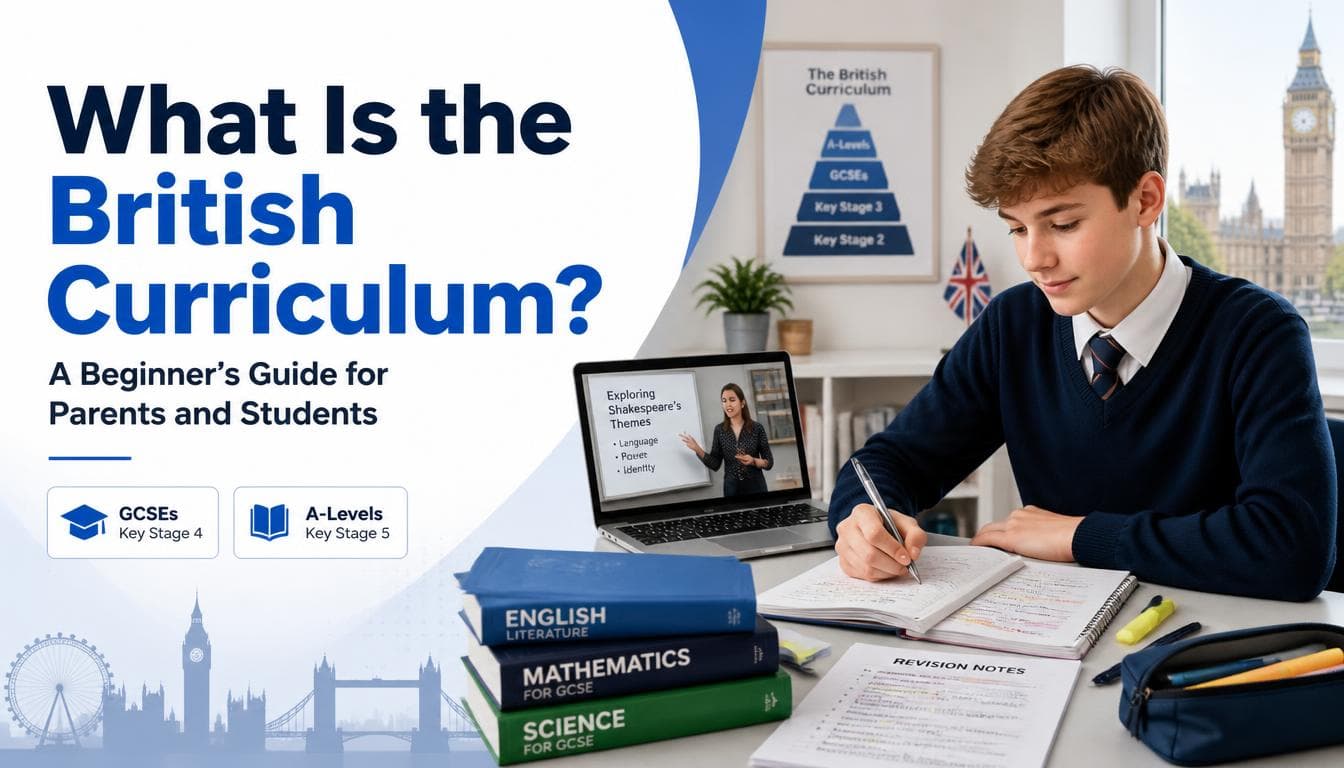
Choosing the right school curriculum is an important decision for parents.
With several education systems available in the UAE, families often want to understand how each curriculum works, what students learn, and how school qualifications prepare them for university.
The British curriculum is one of the education pathways available to students in the UAE and other countries.
It provides a structured approach to learning, with students progressing through different educational stages before taking qualifications such as GCSEs, IGCSEs, and A-Levels, depending on their school and programme.
However, understanding the British curriculum involves more than knowing the names of these qualifications.
Parents should also understand the school stages, subject choices, assessment methods, and the skills students are expected to develop.
This guide explains the British curriculum, how it is organised, which subjects students study, how examinations work, and what families should consider when choosing a British curriculum school.
What Is the British Curriculum?
The British curriculum generally refers to an educational approach based on the schooling system used in the United Kingdom, particularly England.
International schools often adapt elements of this system to meet their local requirements.
In England, the National Curriculum establishes learning requirements for many state-funded schools.
However, international schools offering a British-style education may follow different programmes, examination boards, and school arrangements.
The curriculum typically emphasises structured subject learning, progression between year groups, and the development of academic knowledge and skills.
Students usually study a broad range of subjects during their earlier school years.
As they progress into secondary education, they may begin specialising in selected subjects, particularly when preparing for GCSE, IGCSE, or A-Level qualifications.
The exact structure depends on the school, the examination board, and the qualifications it offers.
What Makes the British Curriculum Different?
The British curriculum is known for its structured progression through school stages and its use of subject-specific qualifications in secondary education.
Some common features include:
Structured learning stages: Students progress through year groups and educational stages.
Broad subject coverage: Younger students generally study a range of academic and practical subjects.
Increasing subject specialisation: Students usually have more opportunities to select subjects as they progress through secondary school.
Formal qualifications: GCSEs, IGCSEs, and A-Levels are commonly offered by British curriculum schools, depending on the programme.
Emphasis on subject knowledge: Students develop knowledge and skills appropriate to each subject.
Assessment and examination preparation: Students may complete school assessments, coursework where applicable, practical assessments, and formal examinations.
These features can vary between schools, so parents should always review the specific programme offered by their chosen school.
How Does the British Curriculum Work?
The British curriculum is commonly organised into educational stages that correspond to students' ages and school years. In England, these stages are known as Key Stages.
International schools may use similar terminology, but their year-group arrangements and curricula can differ.
Understanding these stages helps parents identify what children typically study at different points in their education.
Understanding the Key Stages of the British Curriculum
Early Years Foundation Stage (EYFS)
The Early Years Foundation Stage covers early childhood education in England, generally from birth to age five.
For school-aged children, the Reception year is particularly relevant. Learning at this stage focuses on communication, language, physical development, personal and social development, early mathematics, literacy, and understanding the world.
Children often learn through a combination of guided activities, play, exploration, and structured classroom experiences.
The aim is to establish foundational skills that support the transition into primary education.
International schools may use their own early years frameworks or adaptations, so parents should check how each school organises this stage.
Key Stage 1: Years 1 and 2
Key Stage 1 generally covers Years 1 and 2 in England, when children are approximately five to seven years old.
Students develop foundational skills in English, mathematics, science, and other areas of learning.
English lessons support reading, writing, spelling, grammar, and communication.
Mathematics introduces number skills, calculations, shapes, measurements, and basic problem-solving.
Students also begin developing confidence in expressing ideas, following instructions, and working independently.
Parents can support learning during these years by encouraging reading, practising basic mathematics, and helping children develop consistent routines.
Key Stage 2: Years 3 to 6
Key Stage 2 generally covers Years 3 to 6, when students are approximately seven to eleven years old.
The curriculum becomes more detailed as children develop their reading, writing, mathematics, scientific understanding, and problem-solving skills.
Students may study subjects such as:
English
Mathematics
Science
History
Geography
Computing
Art and design
Design and technology
Physical education
Languages, where offered
The specific subjects and teaching arrangements depend on the school.
During this stage, students increasingly need to apply what they learn rather than simply remember facts. They may also begin preparing for the transition to secondary education.
Key Stage 3: Years 7 to 9
Key Stage 3 generally covers Years 7 to 9 in England, when students are approximately eleven to fourteen years old.
This stage provides a broad secondary education before students begin the main GCSE examination years.
Students commonly study English, mathematics, science, humanities, languages, computing, and other subjects offered by their school.
The work becomes more demanding as students learn to explain ideas in greater detail, solve more complex problems, and manage different subject requirements.
This is also a useful time for students to identify their academic strengths and areas that need improvement.
A strong foundation during Key Stage 3 can make the transition to GCSE or IGCSE study more manageable.
Key Stage 4: Years 10 and 11
Key Stage 4 generally covers Years 10 and 11 in England, when students are approximately fourteen to sixteen years old.
Many British curriculum schools use these years to prepare students for GCSE or IGCSE qualifications.
Students usually study a combination of required subjects and selected options, depending on their school and qualification programme.
English, mathematics, and science are commonly central to the programme, although exact requirements differ between schools and examination routes.
Students need to understand their subject specifications, practise relevant question types, and develop effective revision habits.
Some qualifications include coursework, practical assessments, or other components, while others rely more heavily on examinations.
The assessment structure depends on the subject and awarding organisation.
Key Stage 5: Years 12 and 13
Key Stage 5 generally covers Years 12 and 13, when students are approximately sixteen to eighteen years old.
Many students at this stage study A-Levels or other senior secondary qualifications offered by their school.
Compared with earlier school years, students often focus on fewer subjects in greater depth.
For example, a student interested in engineering may choose subjects that meet the entry requirements of relevant university courses.
A student considering medicine may need to research specific subject prerequisites before selecting their A-Level combination.
University entry requirements vary, so students should check the requirements of their intended institutions and programmes before making final decisions.
What Subjects Do Students Study in the British Curriculum?
The subjects available depend on the student's age, school, and qualification programme.
Younger students usually study a broad range of subjects. Older students may have more opportunities to specialise.
English
English develops reading comprehension, writing, grammar, vocabulary, and communication skills.
At secondary level, students may study English Language, English Literature, or related qualifications depending on the school's programme.
Students benefit from regular reading, structured writing practice, and feedback on how they communicate ideas.
Mathematics
Mathematics covers topics such as number, algebra, geometry, statistics, and problem-solving.
As students progress, the subject becomes more complex and may require them to combine several mathematical methods within a single problem.
Regular practice helps students recognise question patterns, understand mathematical relationships, and explain their working accurately.
Science
Science education introduces students to scientific concepts, evidence, investigation, and the natural world.
At earlier stages, students may study science as a broad subject. At GCSE or IGCSE level, they may take combined science or separate qualifications in biology, chemistry, and physics, depending on the school and examination board.
The available options and assessment requirements vary.
Humanities
Humanities subjects may include history, geography, and related areas.
These subjects help students interpret evidence, understand societies and environments, evaluate information, and communicate reasoned explanations.
Languages
Schools may offer modern foreign languages and other language subjects.
Availability varies by school and qualification programme, so families should check which languages are offered and when students can select them.
Computing and Other Subjects
Computing, art and design, design and technology, business, economics, physical education, and other subjects may also be available.
Older students often have more choice, although subject combinations may be restricted by timetable arrangements or entry requirements.
What Are GCSEs and IGCSEs?
GCSE stands for General Certificate of Secondary Education. These qualifications are commonly taken by students in England at around ages sixteen, usually at the end of Year 11.
IGCSE stands for International General Certificate of Secondary Education.
It is an international qualification offered by various awarding organisations and used by many international schools.
Both qualifications cover individual subjects and assess students against defined subject specifications.
However, GCSE and IGCSE are not identical in every respect. Their syllabuses, assessment structures, examination formats, and available subjects depend on the awarding organisation and qualification.
Why Are GCSEs and IGCSEs Important?
These qualifications help students demonstrate their knowledge and skills at the end of secondary education.
Their results may influence:
Eligibility for particular A-Level subjects
Progression into further education
Subject choices in senior secondary school
Applications to some educational programmes
Longer-term academic planning
The exact requirements depend on the school and the next stage of education.
Students should review their school's subject-entry requirements before selecting GCSE or IGCSE options.
What Are A-Levels?
A-Levels, or Advanced Level qualifications, are commonly studied during Years 12 and 13.
They allow students to concentrate on a smaller selection of subjects in greater depth than during the earlier secondary years.
For example, a student considering a university course in economics may explore mathematics and economics requirements, while someone interested in biological sciences may investigate the prerequisites for biology and chemistry.
These are examples rather than universal requirements. University courses differ, so students should research their intended destinations before choosing subjects.
How Do A-Levels Support University Applications?
Universities may use A-Level grades and subject choices when deciding whether applicants meet course-entry requirements.
Some degree programmes require particular subjects, while others accept a broader range of combinations.
Students should therefore investigate entry requirements early and speak with their school's academic advisers before finalising their choices.
How Are Students Assessed in the British Curriculum?
Assessment methods vary according to the student's age, school, subject, and qualification.
Younger students may be assessed through classroom activities, written work, projects, teacher observations, and tests.
In secondary education, students may complete regular school assessments and prepare for external examinations.
At GCSE, IGCSE, and A-Level, the assessment structure depends on the awarding organisation and the individual subject.
Some qualifications are assessed mainly through examinations. Others may include practical assessments or coursework where applicable.
Why Is Regular Assessment Important?
Assessment helps teachers and students understand what has been learned and where further work is needed.
For example, a student may understand mathematical concepts during lessons but struggle to apply them to unfamiliar examination questions.
Regular practice can reveal this gap and help the student improve before a formal assessment.
Students should use feedback to identify recurring mistakes, review difficult concepts, and develop more effective study strategies.
Is the British Curriculum Suitable for Students in the UAE?
The British curriculum is one of the educational pathways available through international schools in the UAE.
It may suit families who want their children to follow a British-style educational programme or who are considering further education in the UK or other countries that recognise relevant qualifications.
However, the suitability of the curriculum depends on the student and the family.
Parents should consider the child's learning preferences, academic strengths, language needs, future plans, and the quality of the schools available.
What Should Parents Consider When Choosing a British Curriculum School?
School quality: Review teaching quality, facilities, student support, and the school's academic environment.
Curriculum and qualifications: Confirm whether the school offers GCSE, IGCSE, A-Level, or alternative qualifications.
Subject availability: Check that the school offers the subjects the student may need for future study.
Examination support: Ask how the school prepares students for assessments and monitors progress.
University pathways: Research whether the school's qualifications align with the entry requirements of the student's intended universities.
Student wellbeing: Consider workload, extracurricular activities, pastoral care, and the overall learning environment.
A school's suitability cannot be judged by its curriculum label alone. Families should evaluate the complete educational experience.
How Can Parents Support Children Following the British Curriculum?
Parents can support their children's education by helping them build consistent habits and encouraging them to take responsibility for their learning.
Establish a Realistic Study Routine
A regular schedule can help students balance schoolwork, revision, extracurricular activities, and rest.
The routine should reflect the child's age and workload. Younger students may need shorter sessions with breaks, while older students may need a more structured plan for several subjects.
Encourage Independent Learning
As students progress through school, they need to become more independent in organising assignments, reviewing lessons, and preparing for examinations.
Parents can encourage children to set goals, track progress, and reflect on what they need to improve.
Address Learning Gaps Early
If a student repeatedly struggles with a concept, it is useful to identify the cause rather than simply assign more practice.
The problem may involve a missing foundation, misunderstanding instructions, insufficient practice, or difficulty applying knowledge under time pressure.
Speaking with teachers and reviewing recent assessments can help families decide what support is needed.
Provide Support During Examination Years
GCSE, IGCSE, and A-Level preparation can require students to manage several subjects and deadlines simultaneously.
Parents can help by encouraging a realistic revision plan, providing a suitable study environment, and supporting healthy routines.
Students should also leave enough time to review mistakes and practise the types of questions they will encounter in their assessments.
How Can Online Tutoring Support British Curriculum Students?
Some students benefit from additional academic support beyond regular classroom lessons.
Online tutoring can provide opportunities to review difficult concepts, practise subject-specific questions, and receive individual feedback.
The most appropriate approach depends on the student's needs, current performance, and academic goals.
For example, a student preparing for GCSE Mathematics may need help understanding algebra or geometry, while an A-Level student may require more advanced problem-solving practice.
What Are the Benefits of Personalised Tutoring?
Individual attention: Lessons can focus on the student's particular questions and areas of difficulty.
Flexible learning: Online sessions can often be arranged around school and other commitments.
Targeted practice: Students can spend additional time on challenging topics rather than following a single pace for everyone.
Exam preparation: Tutors can help students understand question formats, review mistakes, and practise managing time.
Progress monitoring: Regular feedback can help students and parents understand which skills are improving and which still need attention.
Families looking for additional support can explore online British curriculum tutoring in the UAE to understand how personalised lessons can complement classroom learning.
When choosing a tutor, parents should check subject knowledge, familiarity with the student's qualification and examination board, teaching approach, and the way progress is reviewed.
Frequently Asked Questions About the British Curriculum
1. What Is the British Curriculum in Simple Words?
The British curriculum generally refers to a structured educational approach based on the UK school system, particularly England. International schools may adapt it to their own programmes and local requirements.
2. At What Age Do Students Start GCSEs?
Students in England typically begin studying their GCSE subjects in Year 10, at around age fourteen, and take examinations at the end of Year 11, at around age sixteen. International schools may use different arrangements.
3. What Is the Difference Between GCSE and IGCSE?
GCSE and IGCSE are related but distinct qualifications. Their syllabuses and assessment arrangements depend on the awarding organisation and subject. Students should check the specifications offered by their school.
4. What Comes After GCSE or IGCSE?
Many students progress to A-Levels or other senior secondary qualifications.
The available pathways depend on the school, the student's results, and the entry requirements of the chosen programme.
5. Is the British Curriculum Only Available in the UK?
No. Many international schools offer British-style education outside the UK, including in the UAE.
These schools may adapt the curriculum and school structure to meet local requirements.
6. Is the British Curriculum Good for Students Planning to Study Abroad?
It can be a suitable option for some students, but suitability depends on the intended university, course requirements, qualifications, and the student's academic goals.
Families should verify admission requirements with their target institutions.
7. Can Students Receive Online Tutoring for GCSE and A-Level Subjects?
Yes. Online tutoring can provide additional subject support and examination preparation.
Families should choose a tutor who understands the relevant syllabus and qualification requirements.
8. How Can Students Improve Their Performance in British Curriculum Exams?
Students can improve preparation by understanding the syllabus, revising consistently, practising appropriate questions, reviewing mistakes, and seeking clarification when concepts remain difficult.
Conclusion
The British curriculum provides a structured approach to school education, with students progressing through different stages before taking qualifications such as GCSEs, IGCSEs, and A-Levels, depending on their school's programme.
Understanding these stages helps parents make informed decisions about school choices, subject options, examination preparation, and future academic pathways.
For families in the UAE, the best choice depends on the individual student's needs and the quality of the school, not simply on the curriculum name.
Regular study habits, a clear understanding of subject requirements, and timely academic support can help students develop confidence as they progress through school.
For families who need additional subject guidance, personalised online tutoring may complement classroom teaching and help students work towards their academic goals.
Published by StudyHours Global Editorial Board