Choosing the right school curriculum is an important decision for parents. With different education systems available in the UAE, families often want to understand how each curriculum works, which qualifications students can earn, and how their education may influence future academic opportunities.
The Cambridge curriculum is a popular international education pathway offered by schools in many countries.
It provides structured learning programmes for different age groups, from primary education to advanced secondary qualifications.
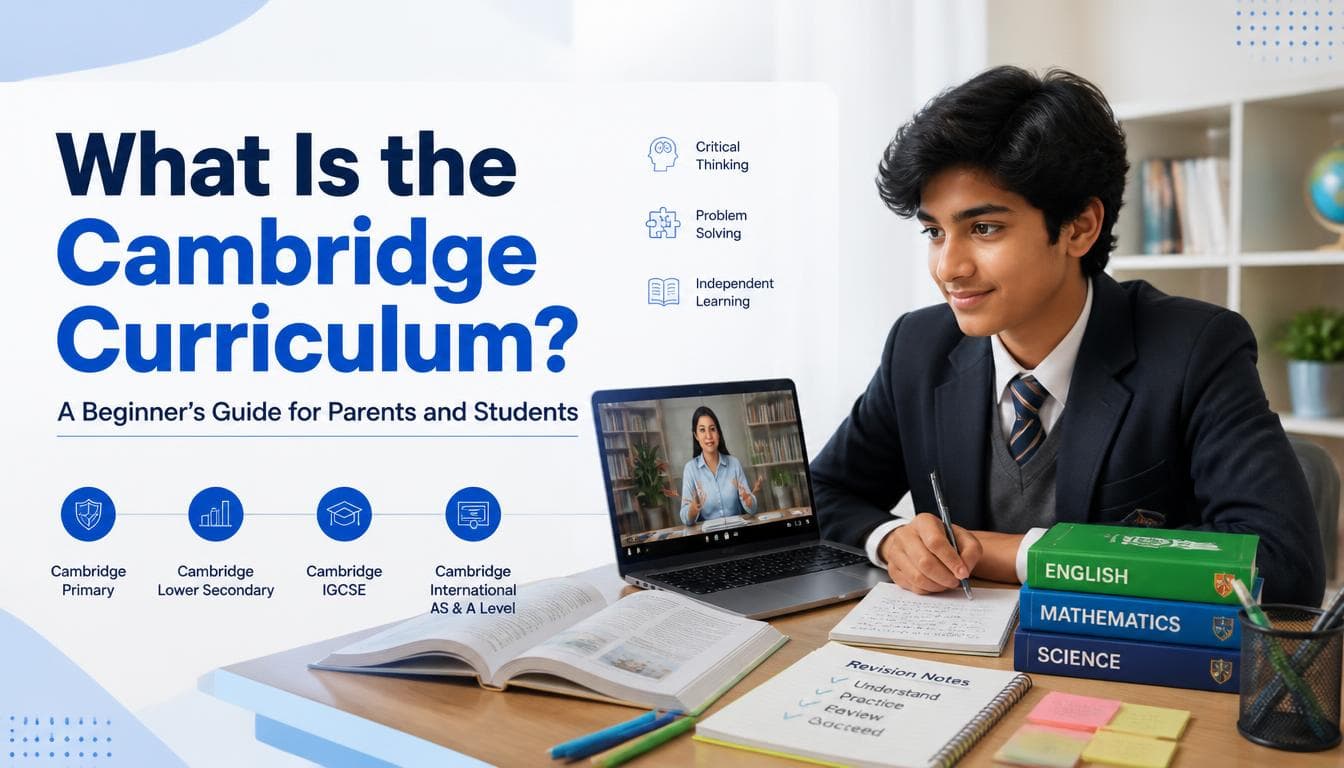
Students following a Cambridge pathway may study Cambridge Primary, Cambridge Lower Secondary, Cambridge IGCSE, Cambridge O Level, Cambridge International AS Level, or Cambridge International A Level, depending on their school and educational stage.
However, understanding the Cambridge curriculum involves more than knowing the names of these qualifications.
Parents should also understand how students progress through the programme, which subjects are available, how assessments work, and how to choose suitable academic pathways.
This guide explains the Cambridge curriculum in simple terms and highlights what families in the UAE should know before choosing a Cambridge education pathway.
What Is the Cambridge Curriculum?
The Cambridge curriculum refers to educational programmes and qualifications developed by Cambridge International Education, part of Cambridge University Press & Assessment.
These programmes are designed for schools serving students in different countries and educational settings.
Schools can offer Cambridge programmes at different stages, depending on their educational provision and the qualifications they choose to provide.
The Cambridge pathway includes programmes for younger learners and qualifications for secondary and advanced secondary students.
Some schools offer Cambridge Primary and Lower Secondary, while others focus mainly on qualifications such as IGCSE, O Level, and International A Level.
This means that not every Cambridge school offers every stage or qualification.
What Makes the Cambridge Curriculum Different?
The Cambridge pathway has several features that distinguish it from other international education programmes.
Internationally used qualifications: Cambridge qualifications are offered through schools in many countries.
Subject-specific learning: Students study individual subjects with defined learning objectives and assessment requirements.
Different educational stages: Schools can offer programmes for younger learners as well as qualifications for secondary and advanced secondary education.
Subject choice: At secondary level, students may have opportunities to select subjects based on their interests, strengths, and future plans.
Structured assessment: Assessment methods depend on the programme and qualification. Many Cambridge secondary qualifications include formal examinations, while some subjects may have additional assessment components.
Flexible school implementation: Schools select programmes and subjects that fit their educational arrangements, within the requirements of the qualifications they offer.
These features make it important for parents to check the exact Cambridge programmes available at a particular school.
How Does the Cambridge Curriculum Work?
The Cambridge pathway can cover several stages of education, from primary school through advanced secondary study.
Students do not necessarily follow every stage. Their pathway depends on the school they attend and the qualifications available to them.
Cambridge Primary
Cambridge Primary is designed for younger learners, typically covering ages five to eleven.
The programme helps students develop foundational knowledge and skills in subjects such as English, mathematics, and science, with additional subjects available through participating schools.
At this stage, students build reading, writing, numeracy, communication, and problem-solving skills.
Learning activities are designed to help children understand concepts, ask questions, and apply their knowledge to different situations.
Parents can support this development by encouraging reading, practising basic mathematics, and maintaining consistent learning routines at home.
Cambridge Lower Secondary
Cambridge Lower Secondary is generally designed for learners aged eleven to fourteen.
It builds on the foundations established during primary education and prepares students for further secondary study.
Depending on the school, subjects may include English, mathematics, science, and other areas of learning.
Students begin working with more complex concepts and develop stronger analytical, research, and problem-solving skills.
This stage can help students prepare for qualifications such as Cambridge IGCSE or Cambridge O Level, although the pathway and timing vary between schools.
Cambridge IGCSE
Cambridge IGCSE is an international qualification commonly taken by students aged fourteen to sixteen.
It allows students to study a selection of individual subjects, such as mathematics, English, biology, chemistry, physics, business studies, economics, geography, and history, depending on the school's offerings.
Each subject has its own syllabus and assessment requirements.
Students need to understand the content and skills required for each subject rather than rely only on memorising information.
Cambridge IGCSE qualifications can help students prepare for further study, including Cambridge International AS and A Levels.
Cambridge O Level
Cambridge O Level is another international qualification offered by Cambridge International.
It covers individual subjects and is used by schools in various educational settings.
Cambridge O Level and Cambridge IGCSE have similarities, but they are separate qualifications with differences that can include syllabus content, assessment arrangements, and subject availability.
Students and parents should review the specific qualifications offered by their school before deciding which pathway is appropriate.
Cambridge International AS and A Level
Cambridge International AS and A Level qualifications are designed for advanced secondary study.
Students typically study these qualifications during the later years of secondary education, often around ages sixteen to nineteen, depending on the school and programme.
They usually choose a smaller number of subjects and study them in greater depth.
For example, students interested in science, engineering, business, or humanities may select subjects that align with their academic strengths and potential university plans.
The best subject combination depends on the student's goals and the entry requirements of the universities or courses they may apply to.
What Subjects Are Available in the Cambridge Curriculum?
The subjects available depend on the educational stage, school, and qualification.
English
English develops reading comprehension, writing, vocabulary, grammar, and communication skills.
At higher levels, students may study English Language, English Literature, or other English qualifications offered by their school.
Regular reading and writing practice can help students express ideas clearly and develop stronger analytical skills.
Mathematics
Mathematics covers topics such as numbers, algebra, geometry, statistics, and problem-solving.
As students progress, they encounter more complex mathematical concepts and learn to apply different methods to unfamiliar questions.
Consistent practice is important because students need to understand the reasoning behind mathematical procedures, not simply memorise formulas.
Science
Science subjects may include biology, chemistry, and physics, depending on the stage and qualification.
Younger students develop general scientific understanding, while older students may study separate sciences or combined science pathways.
Science learning often involves explaining concepts, interpreting data, applying scientific principles, and understanding practical investigations where relevant.
Business and Economics
Some secondary programmes offer business studies and economics.
Business studies may introduce areas such as business operations, marketing, finance, and decision-making.
Economics explores topics such as markets, resource allocation, economic growth, and the behaviour of individuals and organisations.
These subjects may be useful for students considering business-related or social science pathways, although university requirements vary.
Humanities
Humanities subjects may include history, geography, and related areas.
They help students interpret information, evaluate evidence, understand societies and environments, and develop reasoned explanations.
Languages and Other Subjects
Depending on the school and qualification, students may also have access to languages, computer science, information technology, art and design, and other subjects.
Parents should check the school's subject list before making decisions, particularly when a student has a specific university course or career pathway in mind.
What Is the Difference Between Cambridge IGCSE, O Level, and A Level?
These qualifications serve different purposes within secondary and advanced secondary education.
Cambridge IGCSE: An international secondary qualification commonly taken around ages fourteen to sixteen.
Cambridge O Level: A separate international secondary qualification offered in a range of subjects.
Cambridge International AS Level: An advanced secondary qualification that can form part of an A-Level pathway or be taken as a qualification in its own right, depending on the subject and programme.
Cambridge International A Level: An advanced qualification that allows students to study selected subjects in greater depth.
IGCSE and O Level qualifications are generally associated with an earlier stage of secondary education, while AS and A Levels are intended for more advanced study.
The qualifications are not interchangeable in every context. Schools, universities, and other institutions may have specific requirements, so students should confirm that their chosen qualifications meet their future needs.
How Are Cambridge Students Assessed?
Assessment methods vary by programme, subject, and qualification.
Younger learners may complete classroom activities, written assignments, progress checks, and other assessments designed to help teachers understand their development.
At secondary and advanced secondary levels, students may complete formal examinations and, where applicable, practical assessments or coursework.
The precise assessment structure depends on the individual syllabus.
Why Is Understanding the Syllabus Important?
Each Cambridge qualification has defined learning objectives and assessment requirements.
Students who understand their syllabus can identify which topics they need to study and what skills they must demonstrate.
For example, knowing a scientific definition may not be enough if an examination question requires the student to explain a process, interpret data, or apply a principle to an unfamiliar situation.
Understanding the syllabus helps students plan revision more effectively and focus on the knowledge and skills required for their subjects.
How Can Students Prepare for Cambridge Examinations?
Students can improve their preparation by following a consistent study routine.
Useful strategies include:
Reviewing lessons regularly.
Identifying difficult topics early.
Practising questions relevant to the qualification.
Using past papers when appropriate.
Reviewing mark schemes and examiner feedback where available.
Keeping track of repeated mistakes.
Asking teachers for clarification when concepts remain difficult.
Students should also understand the examination format for each subject because question styles and assessment arrangements can differ.
Is the Cambridge Curriculum Suitable for Students in the UAE?
Cambridge qualifications are offered by schools in different countries, including the UAE.
For families considering a Cambridge education, suitability depends on the student's learning needs, academic interests, and future plans.
Some students prefer a programme that offers subject-specific qualifications and opportunities to select subjects during secondary education. Others may have different needs or prefer another educational pathway.
Parents should evaluate the school's quality and the programme it provides rather than assume that one curriculum is automatically the best choice for every student.
What Should Parents Consider?
School provision: Confirm which Cambridge programmes and qualifications the school offers.
Subject availability: Check whether the subjects the student may need are available.
Teaching and support: Review the school's approach to teaching, assessment, and academic guidance.
Examination preparation: Ask how students are prepared for formal assessments and how progress is monitored.
University requirements: Research the qualifications and subjects required by the universities or courses the student may eventually consider.
Student wellbeing: Consider the learning environment, workload, extracurricular opportunities, and pastoral support.
A well-informed decision should take account of the student's individual needs and the opportunities available at the school.
How Can Parents Support Cambridge Students at Home?
Parents can help students develop effective learning habits by encouraging consistency, independence, and confidence.
Build a Regular Study Routine
A realistic study timetable helps students balance homework, revision, extracurricular activities, and rest.
The routine should reflect the student's age and workload. Younger learners may benefit from shorter sessions, while students preparing for IGCSE or A-Level examinations may need a more structured revision plan.
Encourage Understanding Rather Than Memorisation
Memorisation can be useful, but students also need to understand concepts and apply them to different questions.
Parents can encourage children to explain what they have learned in their own words, demonstrate how they solved a problem, or describe why a particular answer is correct.
These activities can reveal misunderstandings that may otherwise go unnoticed.
Review Progress Regularly
Parents can discuss feedback from teachers, review assessment results, and help students identify subjects that require additional attention.
The goal is to identify useful next steps rather than focus only on grades.
When students understand their strengths and weaknesses, they can plan their learning more effectively.
Seek Additional Academic Support When Needed
Some students need extra help with particular concepts, examination techniques, or subject-specific practice.
Online tutoring can provide personalised lessons that focus on the student's current learning needs.
Families looking for additional support can explore online Cambridge tutoring in the UAE.
When choosing a tutor, parents should check their subject expertise and familiarity with the student's specific Cambridge syllabus and qualification.
Conclusion
The Cambridge curriculum provides an international educational pathway with programmes and qualifications for different stages of learning.
Students may begin with Cambridge Primary or Lower Secondary, continue to qualifications such as Cambridge IGCSE or O Level, and later progress to Cambridge International AS and A Levels, depending on their school's provision.
For parents in the UAE, understanding these options can help them evaluate schools, plan subject choices, and support their children's academic development.
The most suitable pathway depends on the individual student, the school, and future education goals. By reviewing qualification requirements, encouraging consistent study habits, and seeking support when needed, families can help students approach their education with greater confidence.
Frequently Asked Questions About the Cambridge Curriculum
1. What Is the Cambridge Curriculum in Simple Words?
The Cambridge curriculum is a collection of international education programmes and qualifications offered by Cambridge International Education. It covers different stages of learning, from primary education to advanced secondary qualifications.
2. Is the Cambridge Curriculum the Same as the British Curriculum?
Not exactly. Cambridge International offers its own programmes and qualifications, while the term British curriculum can refer to educational approaches based on the UK school system. Some British curriculum schools offer Cambridge qualifications, but the terms do not mean precisely the same thing.
3. What Is Cambridge IGCSE?
Cambridge IGCSE is an international secondary qualification commonly taken by students aged fourteen to sixteen. Students study individual subjects and complete assessments according to each subject's syllabus.
4. Is Cambridge O Level Different from Cambridge IGCSE?
Yes. They are separate qualifications, although both are used for secondary education. Their syllabuses, assessments, and available subjects may differ.
5. What Comes After Cambridge IGCSE?
Many students progress to Cambridge International AS and A Levels or another suitable senior secondary programme. The available options depend on the school, the student's results, and the requirements of the next programme.
6. Can Students Choose Their Cambridge Subjects?
Subject choice depends on the educational stage and the school's offerings. Older students usually have more opportunities to select individual subjects, but school requirements and future academic goals should guide their decisions.
7. Is the Cambridge Curriculum Available in the UAE?
Yes. Schools in the UAE offer Cambridge programmes and qualifications, although the stages, subjects, and qualifications available vary between schools.
8. How Can Students Improve Their Cambridge Exam Results?
Students can improve by understanding the syllabus, revising regularly, practising appropriate questions, analysing mistakes, and asking for help when they struggle with particular concepts.
Published by StudyHours Global Editorial Board