Choosing the right educational pathway is an important decision for parents and students.
With different international curricula available, understanding how each programme works can help families make informed choices about their children's education and future opportunities.
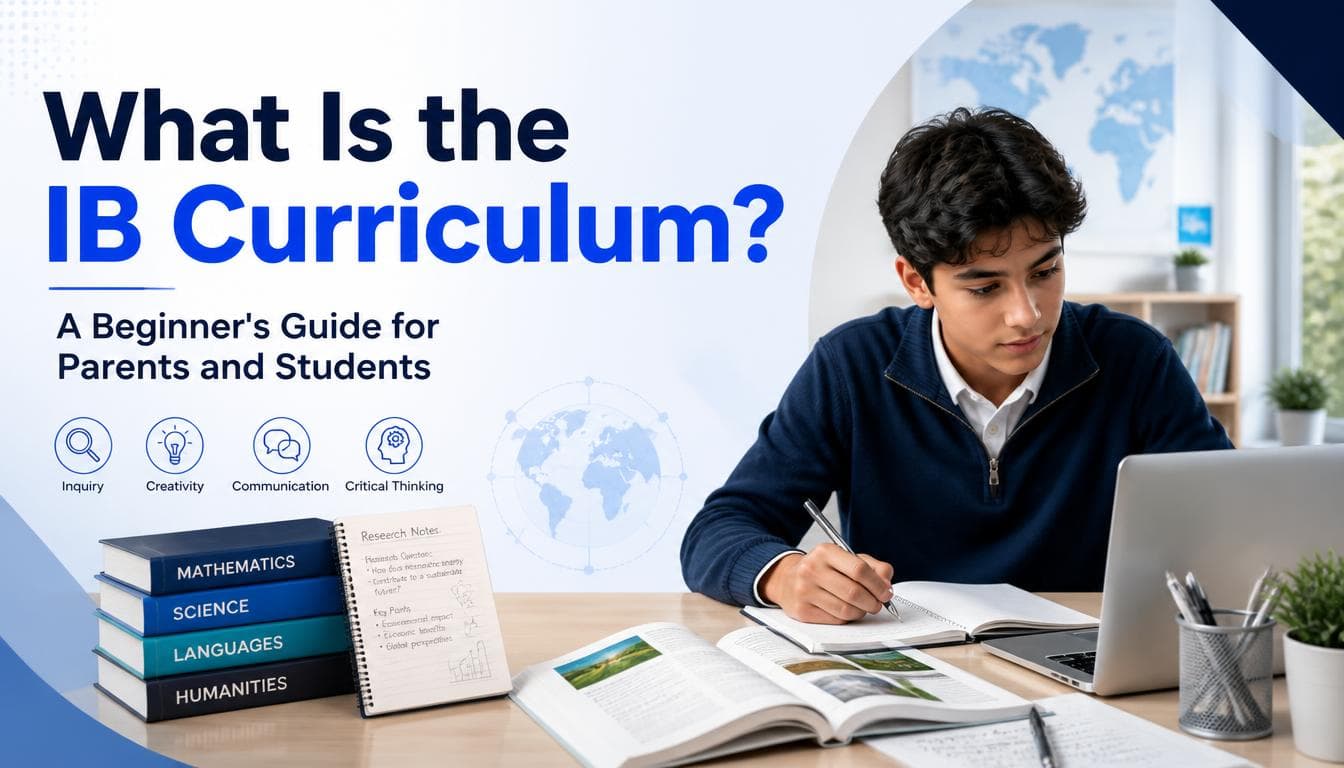
The International Baccalaureate (IB) curriculum is an internationally recognised educational framework designed to develop subject knowledge, critical thinking, independent learning and an understanding of different perspectives.
Rather than focusing only on memorising information, IB programmes encourage students to ask questions, investigate ideas, apply their knowledge and reflect on what they learn.
The IB offers four educational programmes: the Primary Years Programme (PYP), Middle Years Programme (MYP), Diploma Programme (DP) and Career-related Programme (CP).
Each programme serves a different stage or educational purpose, with its own structure and learning expectations.
For families in Riyadh and across Saudi Arabia, understanding the IB curriculum can be especially useful when comparing international schools, planning subject choices or preparing for the transition to a new educational stage.
In this guide, we explain what the IB curriculum is, how its programmes differ, which subjects students may study, how assessment works and how parents can support their children's academic progress.
Families exploring this option can learn more about online IB tutoring in Riyadh through StudyHours.
What Is the International Baccalaureate Curriculum?
The International Baccalaureate is an educational organisation that develops programmes intended to help students become knowledgeable, thoughtful and engaged learners.
The IB curriculum combines academic study with skills such as research, communication, collaboration, critical thinking and reflection.
Students are encouraged to understand not only what they are learning but also how knowledge can be used in different situations.
For example, a student studying environmental issues might learn scientific concepts, analyse relevant information, consider social and economic factors, and explain how different communities are affected. This approach helps connect classroom learning with real-world questions.
The IB framework also places importance on international-mindedness.
Students explore different viewpoints, consider cultural contexts and learn to engage respectfully with people whose experiences may differ from their own.
However, the IB is not one single syllabus followed identically by every student. The organisation offers four programmes, and the subjects, projects and assessment methods depend on the programme, age group and school.
What Are the Main Features of the IB Curriculum?
Several features distinguish the IB approach to education.
Conceptual understanding: Students are encouraged to understand the ideas behind a topic rather than simply memorising facts or procedures.
Inquiry-based learning: Students investigate questions, explore evidence and develop explanations through guided learning.
Critical thinking: Learners practise evaluating information, comparing viewpoints and supporting conclusions with relevant evidence.
Independent research: Depending on the programme, students may complete projects, investigations or extended pieces of academic work.
Reflection: Students consider their progress, identify areas for improvement and evaluate their learning experiences.
International-mindedness: Learning encourages awareness of different cultures, perspectives and global issues.
These features are implemented differently across the four IB programmes.
Younger students may learn through guided inquiry and classroom projects, while older students may complete subject-specific investigations, formal examinations and independent research.
What Are the Four IB Programmes?
The IB offers four programmes designed for different educational stages and pathways. Understanding these programmes helps parents identify which one may be relevant to their child.
1. Primary Years Programme (PYP)
The Primary Years Programme is designed for children aged approximately 3 to 12.
The PYP focuses on developing curiosity, foundational academic skills and an interest in learning.
Students explore concepts through inquiry and make connections between subjects instead of treating every topic as completely separate.
Learning may involve reading, writing, Mathematics, Science, the arts, social studies and other areas, depending on the school's programme.
For example, a classroom project about communities could include reading related texts, writing descriptions, examining maps, collecting information and discussing how people contribute to society.
The goal is to help students develop a strong foundation while learning to ask questions, investigate ideas and communicate their understanding.
What should parents know about the PYP?
Parents should look beyond individual test results and consider the child's overall development.
Reading habits, communication, curiosity, problem-solving and the ability to explain ideas are all useful indicators of learning progress.
Children may still need direct instruction and repeated practice in foundational skills.
Inquiry-based learning does not mean that students are expected to discover every concept independently.
2. Middle Years Programme (MYP)
The Middle Years Programme is designed for students aged approximately 11 to 16.
The MYP encourages students to connect subject knowledge with real-world situations while developing independent learning, research and analytical skills.
The programme includes eight subject groups:
Language and literature
Language acquisition
Individuals and societies
Sciences
Mathematics
Arts
Physical and health education
Design
Schools organise their teaching around the MYP framework and the subjects they offer.
Students may complete projects, investigations, presentations, written assignments and other assessment tasks.
They are encouraged to explain their reasoning, use evidence and consider how ideas relate to wider contexts.
The MYP also includes projects. The Personal Project is a significant component in the final year of the programme, where students explore an interest, set goals and develop an outcome supported by a process of investigation and reflection.
What challenges might MYP students experience?
Students may find it difficult to balance several subjects, meet assignment deadlines or understand how assessment criteria apply to their work.
They may also need to adjust to tasks that require explanation and evaluation rather than short factual answers.
A practical approach is to break larger assignments into smaller steps, clarify the assessment requirements and review feedback after each task.
3. Diploma Programme (DP)
The Diploma Programme is designed for students aged approximately 16 to 19.
It is often the IB programme families consider when discussing university preparation and advanced secondary education.
The DP combines six subject groups with three core components: Theory of Knowledge (TOK), the Extended Essay (EE), and Creativity, Activity, Service (CAS).
Students generally study six subjects, choosing a combination based on their interests, school availability and future plans.
They normally take three subjects at Higher Level (HL) and three at Standard Level (SL), although the permitted combination and requirements should be confirmed with the school.
The DP encourages students to develop subject expertise while also learning to research independently, evaluate information, manage deadlines and reflect on their experiences.
What makes the DP demanding?
Students need to manage several subjects alongside coursework, internal assessment components and the programme core.
Their workload may include revision, laboratory reports, essays, research projects and other assignments.
The challenge is not only the amount of work. Students must also understand different assessment criteria and apply suitable methods to different subjects.
A planned study routine can help students divide larger tasks into manageable stages and avoid leaving important work until the last minute.
4. Career-related Programme (CP)
The Career-related Programme is designed for students aged approximately 16 to 19 who want to combine academic learning with career-related education.
The CP brings together a career-related study, at least two Diploma Programme courses and the CP core.
The career-related component depends on the pathway and the options available through the school.
The programme also develops skills such as communication, reflection, personal development and preparation for future learning or employment.
The CP can be relevant for students who want a more career-focused educational experience while continuing to study selected IB subjects.
Parents should discuss the available pathways with the school to understand the career-related study, course choices and progression opportunities offered.
How Does the IB Curriculum Work?
Although each IB programme has its own structure, the broader approach combines subject learning with the development of transferable skills.
Students learn concepts, practise relevant skills and apply their understanding through activities, assignments, investigations and assessments appropriate to their programme.
Learning Through Inquiry
Inquiry-based learning encourages students to investigate questions and explore how ideas connect.
A teacher may introduce a question, provide relevant resources and guide students through the process of finding and evaluating information.
Students then use their understanding to develop an explanation, complete a task or communicate a conclusion.
Inquiry does not replace structured teaching. Teachers still explain concepts, demonstrate methods and provide feedback.
The difference is that students are also encouraged to explore questions and take an active role in their learning.
Connecting Knowledge Across Subjects
The IB encourages students to recognise connections between different areas of knowledge.
For example, a topic related to energy may involve scientific principles, mathematical calculations, economic considerations and environmental questions.
Making these connections can help students understand why a concept matters beyond the classroom.
However, the depth of interdisciplinary learning depends on the programme and the task.
Students should still develop the subject-specific knowledge needed to answer questions accurately.
Developing Approaches to Learning
IB programmes place importance on skills that support learning across subjects.
These include:
Thinking skills: Analysing information, solving problems and evaluating arguments.
Communication skills: Explaining ideas clearly through speaking, writing and other forms of communication.
Research skills: Finding information, evaluating sources and using evidence appropriately.
Self-management skills: Organising time, planning tasks and managing deadlines.
Social skills: Collaborating with others, listening to different viewpoints and contributing constructively.
Students develop these skills gradually through classroom activities, assignments and reflection.
For parents, one useful way to support this process is to encourage children to explain how they approached a problem, rather than focusing only on whether the final answer was correct.
What Subjects Do IB Students Study?
The subjects students study depend on their programme and school.
PYP students experience a broad, connected curriculum. MYP students study across eight subject groups.
DP students select subjects from six subject groups, while CP students combine career-related study with selected DP courses.
The Diploma Programme subject groups are particularly important for families exploring the IB pathway for older students.
Group 1: Studies in Language and Literature
This group develops students' ability to understand, interpret and analyse texts.
Depending on the course, students may explore literary works, non-literary texts, language choices, context and the ways authors communicate meaning.
Students develop reading comprehension, analytical writing and the ability to support interpretations with evidence.
Group 2: Language Acquisition
Language acquisition courses help students develop proficiency in an additional language.
The level and course depend on the student's previous experience and the school's available options.
Learning may involve listening, reading, writing, speaking and understanding cultural contexts. Students often need regular practice to develop vocabulary, grammatical accuracy and confidence in communication.
Group 3: Individuals and Societies
This group includes subjects such as Economics, Business Management, Geography, History, Global Politics and Psychology, depending on course availability.
Students learn to interpret information, analyse evidence, evaluate arguments and understand social, historical, political or economic issues.
Success often requires more than remembering facts. Students may need to explain relationships, compare perspectives and support conclusions with relevant examples.
Group 4: Sciences
Science subjects may include Biology, Chemistry, Physics, Computer Science, Design Technology and other available courses.
Students develop scientific knowledge and learn to interpret data, evaluate evidence and apply concepts to problems.
Practical investigations and subject-specific assessment tasks may also form part of their learning.
Students benefit from combining content revision with regular practice in explaining processes, interpreting results and answering questions in the required format.
Group 5: Mathematics
The DP includes two main Mathematics courses: Analysis and Approaches (AA) and Applications and Interpretation (AI).
Both courses involve mathematical reasoning, but they differ in their emphasis and approach.
Analysis and Approaches places greater emphasis on mathematical theory, algebraic methods, functions and related areas of mathematics.
Applications and Interpretation gives greater emphasis to mathematical modelling, applications, interpretation and the use of technology.
Both courses are available at HL and SL, subject to the relevant course and school arrangements.
Students should consider their strengths, interests, future study plans and the requirements of potential university courses before choosing a Mathematics pathway.
Group 6: The Arts
The arts group includes courses such as Visual Arts, Music, Theatre, Film and Dance, depending on availability.
Students may explore creative processes, develop practical skills, analyse artistic work and communicate ideas through different forms of expression.
Some students may be permitted to take an additional subject from another group instead of an arts subject.
The available options and diploma requirements should be checked with the school.
What Is the Difference Between HL and SL Subjects?
In the Diploma Programme, Higher Level (HL) and Standard Level (SL) indicate different levels of subject study.
HL courses generally involve greater breadth or depth of content and more recommended teaching hours than SL courses.
Both levels require students to demonstrate their understanding according to the relevant subject's assessment objectives and grade descriptors.
Students typically take three HL subjects and three SL subjects, although they should confirm their exact programme requirements with their school.
How Should Students Choose HL and SL Subjects?
Subject selection should consider several factors.
Academic strengths: Students should consider which subjects they understand well and where they are prepared to manage a more demanding workload.
Personal interests: Interest in a subject can help sustain motivation when assignments become challenging.
University requirements: Some university courses specify required subjects or levels. Students should check the requirements of the institutions and courses they may apply to.
School availability: Not every school offers every subject or combination.
Workload balance: Students should consider the combined demands of their subjects, assessments and other commitments.
Choosing subjects solely because they appear easier or because friends have selected them may not be the best long-term strategy.
Students should speak with school counsellors and subject teachers before finalising their choices.
How Are IB Students Assessed?
Assessment methods vary across IB programmes and subjects. Depending on the course, students may complete written examinations, oral assessments, projects, investigations, portfolios or other coursework.
The purpose is to evaluate how well students meet the learning objectives and assessment criteria for their subjects.
School-Based Assessment
Teachers assess student work throughout the learning process.
This may include class assignments, presentations, practical activities, projects and other tasks.
Feedback can help students identify misunderstandings and improve their work before completing later assessments.
Students should read feedback carefully and use it to make specific improvements.
Examinations and External Assessment
Many DP courses include written examinations at the end of the programme.
Some coursework and other assessment components may also be externally assessed, depending on the subject.
Students should check the assessment structure for each course rather than assuming all subjects use the same format.
Preparing effectively means understanding the content, practising relevant question types and learning how to present answers clearly.
Internal Assessment and Coursework
Some IB subjects include internally assessed components, investigations or coursework.
The format depends on the subject. A task may require students to develop a research question, collect or analyse information, explain a method, evaluate results or communicate findings.
Students should understand the relevant assessment criteria before beginning the task and keep track of deadlines throughout the process.
Any guidance received from teachers or other academic support providers should help students develop their own understanding and produce their own work in line with school and IB academic-integrity requirements.
What Are TOK, the Extended Essay and CAS?
The DP core consists of three components that complement students' subject studies.
Theory of Knowledge (TOK)
Theory of Knowledge encourages students to think critically about knowledge itself.
Students explore questions about how people develop knowledge, how evidence is interpreted and how assumptions can influence conclusions.
The course encourages students to consider different perspectives and build reasoned arguments.
For example, students might explore how the methods used to establish knowledge differ between scientific investigation, history and the arts.
TOK requires students to explain their reasoning and support their ideas with relevant examples.
Extended Essay (EE)
The Extended Essay is an independent research project that allows students to investigate a topic connected to an approved subject area.
The final essay is up to 4,000 words under the standard DP requirements. Students develop a focused research question, investigate relevant sources or evidence and present a structured argument.
The process requires planning, research, analysis, academic writing and appropriate referencing.
Students should begin by choosing a topic that genuinely interests them and narrowing it to a manageable research question.
Regular progress reviews can help prevent the project from becoming overwhelming near the deadline.
Creativity, Activity, Service (CAS)
CAS encourages students to engage in creative activities, physical activity and service experiences.
The component is intended to support personal development, reflection and engagement beyond academic study.
Students document and reflect on their experiences in accordance with their school's CAS arrangements.
CAS is a required part of the DP core, but it does not contribute points to the final diploma score.
Students should consult their school's guidance to understand the applicable completion requirements.
What Are the Benefits of the IB Curriculum?
The IB curriculum offers an educational approach that combines academic study with broader learning skills.
Whether it is suitable for an individual student depends on their interests, learning preferences, school environment and future plans.
Development of Critical Thinking
Students are encouraged to evaluate information, consider evidence and support their conclusions.
These skills can help them approach unfamiliar questions and make reasoned decisions.
Independent Learning
Projects, investigations and coursework encourage students to plan tasks, manage deadlines and take responsibility for their progress.
Students may need guidance when developing these skills, especially during transitions to more demanding programmes.
Research and Communication
IB students may be required to investigate topics, analyse sources, write structured responses and present ideas.
These activities help students practise research and communication skills that can be useful in further education.
Broader Perspectives
The curriculum encourages students to consider different viewpoints and understand how cultural, social and global contexts influence issues.
This can help students develop a more thoughtful approach to discussions and problem-solving.
Preparation for Further Study
The IB DP combines subject learning with independent research, coursework and assessment preparation.
These experiences can help students become familiar with academic expectations encountered in higher education.
However, university entry requirements vary by institution, course and country, so students should confirm specific requirements rather than assuming that completing an IB programme guarantees admission.
What Challenges Might IB Students Face?
The IB curriculum can be rewarding, but students may find certain aspects challenging.
Managing Multiple Deadlines
Students may have homework, tests, projects and coursework due across several subjects.
Without a clear plan, it can be difficult to decide which task needs attention first.
A weekly planner, a list of upcoming deadlines and regular progress checks can help students manage their workload more effectively.
Understanding Assessment Criteria
Students may know the subject content but struggle to understand what a question expects them to explain, analyse or evaluate.
Reading the command terms in a question and reviewing the relevant assessment criteria can help clarify what a strong response should include.
Balancing Memorisation and Application
Memorising definitions or formulas is useful in many subjects, but it is rarely sufficient on its own.
Students also need to practise applying their knowledge to different questions and explaining their reasoning.
A balanced revision routine should include content review, active recall and practice questions.
Completing Research and Coursework
Longer assignments can feel overwhelming when students do not know where to begin.
Breaking the task into stages—choosing a topic, planning research, organising evidence, drafting and reviewing—makes the process more manageable.
Students should also ask teachers for clarification when instructions or assessment expectations are unclear.
How Can Parents Support Children Studying the IB Curriculum?
Parents can help students develop effective learning habits without taking over their academic responsibilities.
Establish a Consistent Study Routine
Encourage your child to set aside regular time for homework, revision and assignment planning.
The routine should reflect their age, workload and other commitments. It should also leave room for rest, physical activity and personal interests.
Encourage Questions and Discussion
Ask your child to explain what they learned and which ideas they found difficult.
Talking through a concept can help reveal misunderstandings that may not be obvious from a completed worksheet.
Encourage questions rather than expecting students to understand every topic immediately.
Review Progress, Not Just Grades
Grades provide useful information, but they do not always show why a student is struggling.
Look for patterns in teacher feedback, incomplete tasks, repeated mistakes and confidence levels.
A student may need help with subject knowledge, time management, written communication or exam technique.
Identifying the specific problem makes it easier to choose an appropriate response.
Communicate With the School
Teachers and school counsellors can explain subject requirements, assessment expectations and upcoming deadlines.
Parents should seek clarification when their child is struggling consistently or when they are unsure how to support a particular assignment.
Consider Additional Academic Support When Needed
Some students benefit from individual explanations, structured revision or guided practice outside regular classroom lessons.
Additional support should be aligned with the student's actual programme, subjects, level and school requirements.
Families exploring this option can learn more about online IB tutoring in Riyadh through StudyHours.
The most useful support focuses on improving understanding and helping students develop the skills to complete their own academic work confidently.
Is the IB Curriculum Suitable for Every Student?
The IB curriculum can suit students who enjoy exploring ideas, making connections between subjects and developing independent learning skills. However, no curriculum is the best choice for every learner.
Before choosing an IB school or programme, parents should consider:
The student's learning preferences and academic interests.
The subjects and programme offered by the school.
The teaching approach and learning support available.
The workload associated with the intended programme.
The student's future educational goals.
The requirements of potential universities or other destinations after school.
Families should also understand that the experience of studying the IB can differ between schools.
The subjects offered, timetable, teaching practices and support arrangements may vary.
A conversation with the school can help parents understand how the programme is implemented and whether it meets their child's needs.
Conclusion
The International Baccalaureate curriculum offers a structured approach to education that combines academic learning with inquiry, critical thinking, research and reflection.
Its four programmes—the PYP, MYP, DP and CP—serve different educational stages and purposes.
Understanding their differences helps parents identify the pathway that best matches their child's learning needs and future goals.
For students, success involves more than memorising information. Developing consistent study habits, managing deadlines, practising subject-specific skills and responding to feedback can make learning more manageable.
Parents can support this process by staying informed about school requirements, encouraging independent learning and seeking clarification when difficulties arise.
With the right approach, students can build greater confidence in their subjects and become more effective learners throughout their IB education.
Frequently Asked Questions About the IB Curriculum
What does IB stand for in education?
IB stands for International Baccalaureate. It is an educational organisation that offers four programmes: the Primary Years Programme, Middle Years Programme, Diploma Programme and Career-related Programme.
What are the four IB programmes?
The four programmes are the PYP, MYP, DP and CP. The PYP is intended for younger learners, the MYP for middle-years students, and the DP and CP for older students.
Each programme has its own curriculum structure and learning expectations.
Is the IB curriculum the same as the IB Diploma Programme?
No. The IB curriculum refers more broadly to the educational programmes offered by the International Baccalaureate.
The Diploma Programme is one of those programmes and is designed for students aged approximately 16 to 19.
How many subjects do IB Diploma students study?
DP students generally study six subjects alongside the three core components: Theory of Knowledge, the Extended Essay and CAS.
The exact subject combination depends on the student's choices, school availability and programme requirements.
What is the difference between IB HL and SL?
Higher Level and Standard Level are two levels of study within the DP. HL courses generally involve greater depth or breadth and more recommended teaching hours than SL courses.
Students should consider their interests, abilities and future study requirements when choosing their subjects.
Is the IB curriculum difficult?
The level of challenge depends on the programme, subjects, student and school.
Students may need to manage multiple assignments, understand assessment criteria and develop independent study skills. Regular revision, planning and early clarification of difficult concepts can help.
Does the IB curriculum prepare students for university?
The IB can help students develop subject knowledge, research skills, critical thinking and independent learning.
University admission requirements vary, however, so students should check the entry requirements of their intended institutions and courses.
Can students receive additional help with IB subjects?
Yes. Students may seek additional academic support when they need help understanding concepts, practising questions or organising revision.
Any support should match the student's programme and subject requirements and encourage independent learning.
Can students in Riyadh study the IB curriculum?
IB programmes are offered by authorised IB World Schools. Families in Riyadh should check individual schools to confirm which IB programme they offer, the relevant age group, available subjects and admission requirements.
Published by StudyHours Global Editorial Board