GCSEs are an important stage of secondary education in the United Kingdom. They help students demonstrate what they have learned, prepare for further education and develop the qualifications needed for many future career pathways.
However, parents and students often have questions about when GCSE courses begin, the age at which students take their exams, how mock exams fit into the school year and when results are released.
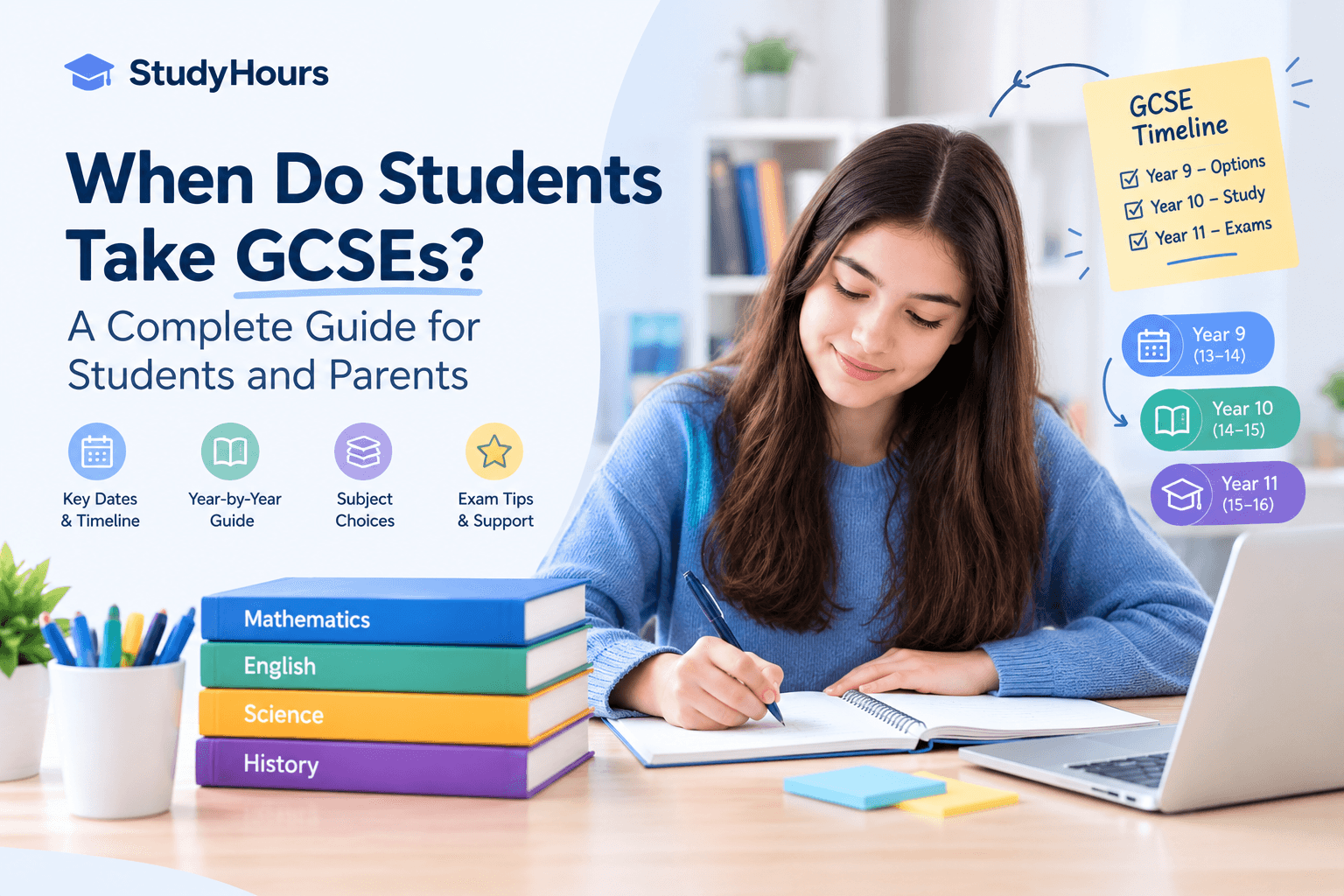
In England, most students take their GCSE examinations at the end of Year 11, usually when they are 15 or 16 years old.
However, preparation often starts much earlier, and the exact timetable depends on the school, subject, examination board and qualification being studied.
Education arrangements also differ across the UK, so it is important to understand which rules apply to your location.
This guide explains when students typically take GCSEs, what happens during each secondary school year, how the examination calendar works and how families can prepare for this important stage.
Understanding when students take GCSEs is an important step for parents and learners planning their secondary education.
From choosing subjects in Year 9 to preparing for final examinations in Year 11, students benefit from consistent learning and effective revision strategies.
StudyHours online GCSE tutoring offers personalised one-to-one academic support to help students strengthen subject knowledge, understand challenging concepts and prepare for their GCSE examinations with greater confidence.
At What Age Do Students Take GCSEs?
Most students in England take their GCSE examinations when they are 15 or 16 years old.
This is because GCSE courses are generally completed at the end of Year 11.
The age at which a student takes an examination depends on their date of birth, school year placement and the qualifications they are studying.
Students in the same class may therefore be different ages during the examination period.
Students develop at different rates, and some may need additional time to understand particular topics before moving on to more advanced material.
Access to online GCSE tutors can help learners revisit difficult concepts, reinforce classroom lessons and build confidence as they progress towards their GCSE examinations.
For example, a student who turns 16 in September may already be 16 when the main GCSE examinations begin the following summer.
Another student whose birthday falls in July may still be 15 during some examinations.
Typical GCSE age by school year
Year 7: Usually ages 11–12. Students begin secondary school and establish the foundations for later study.
Year 8: Usually ages 12–13. Students build knowledge across core and optional subjects.
Year 9: Usually ages 13–14. Many schools ask students to select their GCSE options during this year.
Year 10: Usually ages 14–15. Students study their GCSE courses in greater depth.
Year 11: Usually ages 15–16. Students complete their courses, revise and sit most GCSE examinations.
These ages are typical rather than universal. Individual circumstances, school policies and different education systems can affect the timeline.
When Do GCSE Courses Start?
GCSE courses commonly begin in Year 10, but preparation can start earlier.
Many schools introduce students to GCSE subject choices in Year 9. During this year, students may select optional subjects such as History, Geography, a modern foreign language, Art, Computer Science, Design and Technology or a vocational qualification. The options available vary between schools.
Starting GCSE preparation early can help students identify knowledge gaps before the workload becomes more demanding in Years 10 and 11.
Regular revision, clear learning goals and targeted practice can make the transition easier. Personalised GCSE tutoring can provide additional subject guidance for students who need help strengthening their foundations before their final examination year.
Some schools begin teaching parts of their GCSE courses in Year 9, particularly where a subject requires substantial practical work, extended content or additional preparation.
Other schools use Year 9 primarily to strengthen foundational knowledge before formal GCSE teaching begins.
It is important to distinguish between starting a GCSE course and sitting the final GCSE examination.
A student might begin learning GCSE content in Year 9 but not take the final examination until the end of Year 11.
Why schools may start GCSE content early
Schools decide how to organise their curriculum according to subject requirements, available teaching time and their chosen examination specifications.
Starting earlier can give students more time to cover the syllabus, practise examination techniques and complete required assessments.
However, starting GCSE material early does not automatically mean a student will achieve a higher grade.Consistent learning, effective feedback, subject understanding and regular practice are also important.
Parents should ask their child's school when each GCSE subject officially begins and whether any formal assessments take place before Year 11.
What Happens in Year 9?
Year 9 is often a transition year because students begin thinking more seriously about the subjects they want to study for GCSE.
Although students are not usually sitting their main GCSE examinations at this stage, decisions made during Year 9 can influence their workload and future educational options.
Choosing GCSE subjects
Schools generally provide information about optional subjects, course content and assessment methods.
Students may attend options evenings, speak to teachers and receive guidance about subjects that match their interests and strengths.
When choosing subjects, students should consider:
Which subjects they enjoy and feel motivated to study.
Their performance and confidence in different areas.
Whether a subject is required for a future course or career.
The balance of examinations, coursework and practical assessment.
The subjects actually offered by their school.
Students should avoid choosing a subject solely because friends are taking it or because they believe it will be easy.
GCSE courses require sustained effort, and genuine interest can help maintain motivation.
Building strong foundations
Year 9 is also a useful time to identify gaps in Maths, English and Science. Weak foundational knowledge can make later GCSE topics more difficult, particularly when new concepts build on earlier learning.
For example, a student who struggles with fractions, percentages or algebra may find GCSE Maths increasingly challenging if those skills remain unresolved.
Similarly, difficulties with reading comprehension or scientific vocabulary can affect performance across several subjects.
Addressing these issues early can make the transition to Year 10 more manageable.
What Happens in Year 10?
Year 10 is typically the first full year of formal GCSE study. Students begin working through the content specified by their examination boards and gradually develop the knowledge and skills required for their final assessments.
The workload may feel different from earlier years because lessons become more focused on specific examination requirements.
Learning the GCSE specification
Each GCSE subject follows a specification published by an examination board, such as AQA, Pearson Edexcel, OCR or another approved provider.
The specification identifies the content and skills students are expected to demonstrate.
Students should know which examination board their school uses for each subject. Different boards may organise content differently or use different assessment structures, even where the subject title is the same.
For example, two students studying GCSE Biology may cover broadly similar scientific principles but encounter differences in topic organisation, practical requirements or question styles.
Developing examination skills
Year 10 is a good time to learn how to answer GCSE-style questions. Students need to understand not only the subject content but also how marks are awarded.
Useful skills include:
Showing working clearly in mathematical calculations.
Explaining scientific processes using accurate terminology.
Supporting English Literature interpretations with relevant textual evidence.
Structuring extended answers in History and Geography.
Checking answers against the command words in a question.
Students should use teacher feedback to understand why an answer received a particular mark and what would improve it.
Starting revision early
Revision does not need to involve hours of studying every evening. Short, regular sessions can help students remember material and identify areas requiring more attention.
Creating summary notes, testing recall without looking at a textbook and revisiting older topics are useful approaches.
Students can also keep a list of questions they find difficult and ask teachers to explain them.
What Happens in Year 11?
Year 11 is usually the most intensive year of GCSE study. Students complete remaining course content, revise previously studied topics, take mock examinations and prepare for the final examination period.
The year can feel demanding because students must manage several subjects at once. A clear plan helps them avoid leaving every topic until the final weeks.
Completing the syllabus
Teachers aim to complete the required subject content before the final examinations.
The timing varies by subject and school, so some classes may finish new material earlier than others.
Students should check which topics remain to be covered and make sure they understand the content already taught.
If a topic is confusing, it is better to seek help before revision becomes more intensive.
Taking mock examinations
Many schools organise GCSE mock exams during Year 11. These often take place in the autumn term, although schools may also schedule another examination period later in the year.
Mock exams help students experience examination conditions, practise managing time and identify gaps in their knowledge.
They can also help teachers understand which topics need further attention.
A mock grade is not necessarily the grade a student will receive in the final GCSE examination.
It reflects performance at a particular point in time and may be affected by how much content has been covered.
Students should use mock results as feedback rather than as a fixed prediction of their future performance.
Preparing for final examinations
As the summer examination period approaches, students should focus on reviewing the specification, practising past-paper questions and improving weaker areas.
A useful revision plan includes every subject, realistic study sessions, regular breaks and time for reviewing mistakes.
Students should not spend all their revision time on favourite subjects while neglecting areas they find difficult.
When Do GCSE Exams Take Place?
In England, the main GCSE examination period usually takes place during May and June at the end of Year 11.
However, there is no single examination date for every GCSE subject. Each paper has its own scheduled date and time, and examination timetables are published by the relevant awarding organisations.
Some qualifications include practical assessments, speaking tests, coursework or other non-exam components.
These may take place earlier in the academic year, depending on the subject and examination board.
Why examination dates vary
GCSE subjects have different assessment requirements. English, Maths and Science may involve multiple written papers, while other subjects can include practical or internally assessed components.
Examination boards coordinate timetables across many subjects and schools. Students should therefore rely on their school's official timetable and the relevant examination board rather than assuming that all examinations occur in the same week.
How students should prepare for the exam period
Once the timetable is available, students can create a revision schedule based on the order of their examinations.
A practical approach is to:
Write down every examination date and time.
Identify the subjects with the earliest papers.
Allocate revision sessions to topics that need the most attention.
Schedule timed practice papers.
Leave time to review mistakes and revisit difficult concepts.
Protect sleep and allow for breaks between study sessions.
Students should also check practical details, including their examination venue, arrival time, required stationery and any school instructions.
When Are GCSE Results Released?
GCSE results in England are normally released in August, following the summer examination period.
The precise date changes from year to year and should be confirmed through official announcements and the student's school.
Students generally receive their results through their school or examination centre. Schools explain how and when results can be collected and what support is available for students considering their next steps.
Results day can be exciting, stressful or a mixture of both. Students should remember that a set of grades is important, but it does not determine every future opportunity.
What happens if a student does not achieve the expected grade?
The next step depends on the subject, the grade achieved and the requirements of the student's intended course or training pathway.
Some students may be able to resit a subject, take an alternative qualification or discuss other routes into further education. Schools and colleges can explain the options available locally.
Students who are disappointed with their results should speak to a teacher, school adviser or college admissions team before making decisions. They may have more options than they initially realise.
Do GCSE Dates Differ Across the UK?
Yes. Although GCSEs are widely associated with secondary education across the UK, education policy and qualification arrangements differ between England, Wales, Northern Ireland and Scotland.
England
In England, students commonly take GCSE examinations at the end of Year 11, usually at ages 15–16. GCSEs are graded numerically from 9 to 1 in the reformed grading system.
Wales
Wales has its own education and qualification arrangements. GCSEs are available, but qualifications, specifications and grading arrangements may differ from those in England. Students should check guidance from their school and the relevant awarding body.
Northern Ireland
Northern Ireland offers GCSE qualifications, but the available specifications and grading arrangements depend on the awarding organisation.
Schools can explain which qualifications apply to their students and how grades are reported.
Scotland
Scotland follows a different qualification system. Students typically study National Qualifications, including National 5s, Highers and Advanced Highers, rather than following the same GCSE structure used in England.
For families moving between countries or comparing qualifications, it is important to check how a particular qualification is recognised rather than assuming that school years and examination stages are identical.
Can Students Take GCSEs Earlier or Later Than Year 11?
Yes, in some circumstances. Although Year 11 is the usual examination year, students may take particular GCSE examinations earlier or later depending on their school and individual circumstances.
Some schools enter students for certain subjects before the end of Year 11. This is a school-specific decision and should not be assumed to be available everywhere.
Other students may take GCSEs later because they are resitting a subject, have changed schools, are following a different learning pathway or need additional preparation time.
Early GCSE entries
Early entry may be considered where a school believes a student is ready and the subject's assessment structure makes it appropriate.
However, taking an examination early can reduce the time available to study and practise.
Students and parents should discuss the academic implications with the school before making decisions about early entry.
GCSE resits
Students may have opportunities to resit GCSE examinations if they need to improve a grade or meet a course requirement.
The arrangements depend on the subject, examination series and applicable rules.
In England, GCSE English Language and Maths are particularly important for many post-16 pathways, and students who do not achieve the required standard may be expected to continue studying these subjects.
The precise requirements depend on the student's circumstances and the applicable education rules.
Students should check resit dates, entry arrangements and fees with their school, college or examination centre.
How Can Parents Help Their Children Prepare for GCSEs?
Parents can help by encouraging a manageable study routine, discussing progress and communicating with teachers when a child experiences difficulties.
If a student continues to struggle despite regular revision, additional individual guidance may be worth considering.
StudyHours GCSE tutoring is an option for families exploring personalised subject support to complement classroom learning and independent revision.
Create a realistic study routine
Help your child set aside regular study time while keeping the timetable manageable.
A useful routine should allow for schoolwork, revision, hobbies, exercise, meals and sufficient sleep.
Avoid filling every free hour with revision. A schedule that is too demanding can become difficult to maintain and may increase stress.
Encourage independent learning
Rather than simply asking whether your child has revised, encourage them to explain what they have learned or demonstrate how they would answer a question.
Questions such as "What was the most difficult topic today?" or "Can you explain how you solved that problem?" can help identify where further support is needed.
Communicate with teachers
If your child repeatedly struggles with a subject, contact their teacher to understand the specific difficulty.
It may involve missing foundational knowledge, misunderstanding exam questions, weak revision methods or anxiety during assessments.
A clear understanding of the problem makes it easier to decide what support would be most useful.
Recognise progress
Improvement is not always reflected immediately in a mock grade. A student may become more confident with a topic, make fewer calculation errors or improve their answer structure before their overall result changes.
Recognising these smaller improvements can help students remain motivated throughout the GCSE period.
How Can Students Make the Most of the Time Before GCSE Exams?
The months leading up to GCSE examinations provide an opportunity to strengthen subject knowledge and improve examination technique.
Students should begin by checking the specification for each subject and identifying which topics they understand confidently, which require revision and which they find difficult.
Use active recall
Active recall means trying to remember information without immediately looking at the answer.
Students can use flashcards, short quizzes or blank-page summaries to test their knowledge.
This method helps identify what has genuinely been remembered rather than what merely looks familiar when reading a textbook.
Practise with examination questions
Past papers and exam-style questions help students understand how knowledge is assessed.
Students should review the mark scheme after attempting a question and identify why marks were awarded or missed.
For extended responses, they should practise using the command words in the question and structuring answers clearly.
Review mistakes systematically
Keeping an error log can be useful. Students can record the topic, the mistake they made and the correct approach.
For example, a Maths error log might show that a student repeatedly forgets to include units, misreads negative signs or struggles to rearrange equations. Targeted practice can then focus on those specific issues.
Ask for help when needed
Students should not wait until the final week to seek help with a difficult topic.
Teachers, school revision sessions and appropriate learning support can help clarify misunderstandings.
For students who need more personalised academic guidance, StudyHours online GCSE tutoring provides a relevant starting point for exploring subject-specific learning support.
Conclusion
Most students in England take their GCSE examinations at the end of Year 11, usually at ages 15–16.
However, GCSE preparation starts much earlier, with Year 9 often involving subject choices and foundational learning, followed by more intensive course study in Year 10 and Year 11.
Understanding the timeline helps students organise their learning, prepare for mock examinations, use revision time effectively and plan their next steps after results day.
Parents can contribute by encouraging steady progress, maintaining open communication with teachers and helping their children approach examinations with confidence.
Every student follows a slightly different journey. The most useful approach is to understand the requirements of each subject, seek help with difficult topics early and build consistent study habits throughout secondary school.
For families exploring additional academic support, visit StudyHours GCSE online tutoring to learn more about personalised learning support for GCSE subjects.
Frequently Asked Questions About GCSE Timing
What year do students take GCSEs?
Most students in England take their main GCSE examinations in Year 11. Some courses begin in Year 9 or Year 10, and individual examination arrangements may vary.
Are GCSEs taken at age 16?
Usually, yes. Students commonly sit GCSE examinations at ages 15–16, depending on their birthdays and school year placement.
Do GCSEs start in Year 9 or Year 10?
This depends on the school and subject. Some schools begin GCSE content in Year 9, while others start formal courses in Year 10. The main examinations usually take place at the end of Year 11.
When do GCSE exams usually start?
The main GCSE examination period in England generally begins in May and continues into June. Students should use the official timetable for their examination year.
When do GCSE results come out?
GCSE results are normally released in August in England. The exact date varies, so students should confirm it with their school or official examination-board announcements.
Can students take GCSEs in Year 10?
Some students may be entered for particular GCSE examinations in Year 10, depending on their school and subject. This is not the standard arrangement for all GCSE subjects.
What happens if a student fails GCSE Maths or English?
The next steps depend on the grade, the student's age and their intended education or training pathway.
Many students continue studying Maths or English after Year 11 if they have not achieved the required grade. Their school or college can explain the relevant options.
Are GCSEs the same in England, Wales and Northern Ireland?
Not entirely. The qualifications, specifications and grading arrangements can differ.
Students should check the rules that apply in their country and with their awarding organisation.
Does Scotland have GCSEs?
Scotland generally follows a different qualification system, including National 5s, Highers and Advanced Highers.
GCSEs are not the standard qualification pathway in Scottish secondary schools.
How early should students start revising for GCSEs?
There is no single ideal starting date. Students benefit from reviewing material throughout their courses rather than leaving all revision until the final weeks. Regular practice in Year 10 and Year 11 can make the examination period more manageable.
Published by StudyHours Global Editorial Board