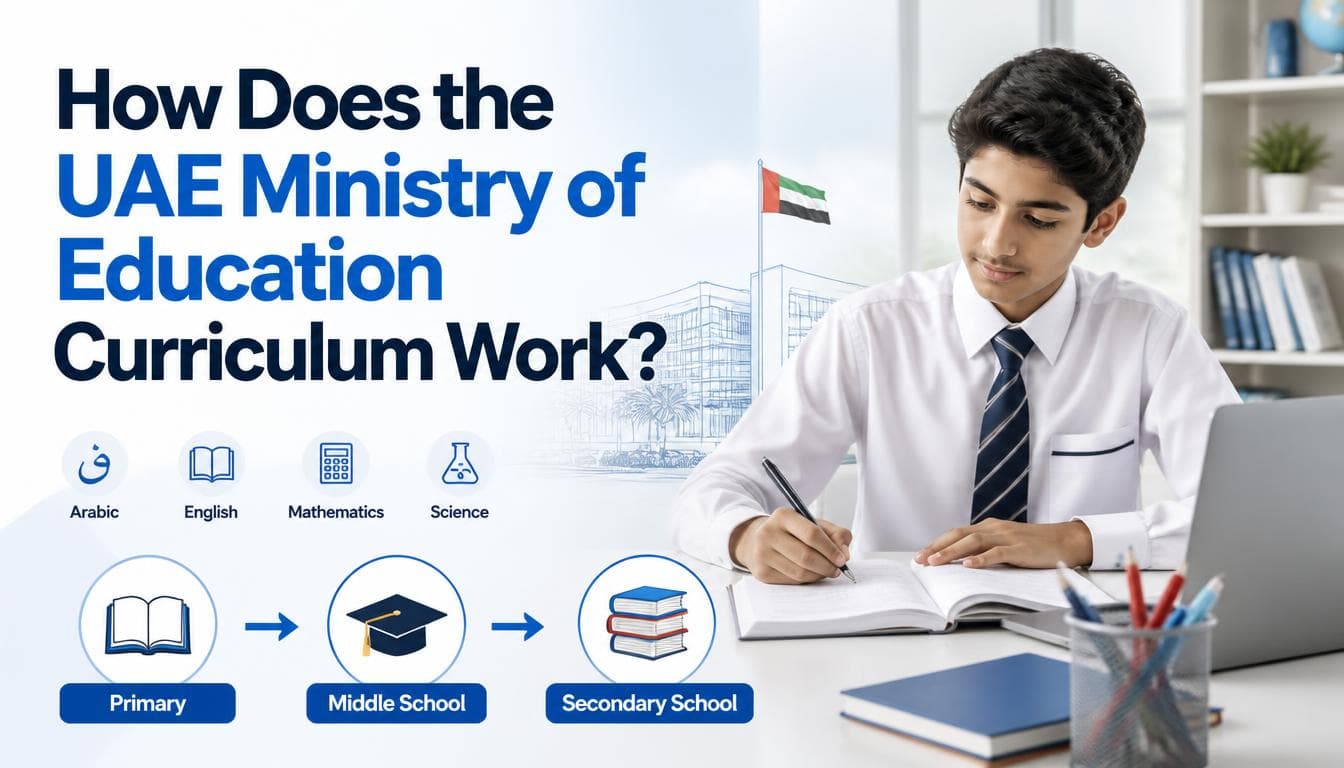
Understanding how the UAE Ministry of Education (MOE) curriculum works can help parents support their children's education more effectively.
From choosing appropriate learning resources to preparing for school assessments, knowing how the curriculum is organised makes it easier to recognise what students are expected to learn and where they may need additional support.
The UAE MOE curriculum provides a framework for teaching and learning in schools that follow the Ministry's educational programme.
It outlines subjects, learning expectations and study requirements, while assessment policies help schools monitor students' academic progress.
Although the curriculum follows an organised structure, the exact subjects, study plans and assessment arrangements can vary according to a student's grade, educational stage and the applicable academic-year guidance.
In this guide, we explain how the UAE Ministry of Education curriculum works, how learning develops across school stages, how students are assessed and how parents can help children build confidence in their studies.
What Is the UAE Ministry of Education Curriculum?
The UAE Ministry of Education curriculum is the national curriculum framework used by public schools and private schools that implement the Ministry's programme.
It establishes the academic direction for students, including the subjects they study, the knowledge they develop and the skills they are expected to build as they progress through school.
The curriculum aims to support academic development alongside cultural understanding, responsible citizenship and personal growth.
Students study core academic subjects while developing skills such as communication, reasoning, problem-solving and independent learning.
It is important to understand that not every school in the UAE follows the MOE curriculum.
Many private schools offer other educational programmes, including British, American, Indian and International Baccalaureate pathways.
Parents should therefore confirm which curriculum their child's school follows before selecting learning materials or additional academic support.
How Is the UAE MOE Curriculum Organised?
The Ministry curriculum is organised around educational stages and grade-level learning expectations. As students move through school, the complexity of their subjects and the depth of their knowledge generally increase.
The curriculum is supported by official study plans that explain the requirements for the relevant academic year.
These plans help schools organise teaching and learning in accordance with the Ministry's approved framework.
1. Early Learning and Foundational Skills
In the early years of education, students begin developing the basic skills needed for future learning.
Depending on the student's grade and school programme, learning may focus on areas such as:
Recognising letters, sounds and words.
Developing reading comprehension.
Building early writing and communication skills.
Understanding numbers and basic mathematical operations.
Exploring the world through observation and simple scientific activities.
Learning about personal responsibility, values and relationships.
These foundations are important because later topics build on earlier knowledge. A student who finds reading difficult, for example, may also struggle to understand word problems in Mathematics or follow written instructions in Science.
Parents can help by encouraging regular reading, discussing schoolwork and providing opportunities to practise foundational skills without making learning feel like a constant test.
2. Developing Subject Knowledge
As students progress through school, learning becomes more structured and subject-specific.
Students build on their earlier knowledge in Mathematics, languages, Science and other curriculum subjects.
They are also expected to explain ideas more clearly, make connections between concepts and apply what they have learned to different questions.
For example, Mathematics may progress from basic number operations to more advanced areas such as algebra, geometry, functions and other grade-appropriate concepts.
Science learning may develop from observation and basic scientific ideas towards more detailed study of biological, chemical and physical processes.
Language learning also becomes more demanding. Students may need to analyse texts, understand grammar, organise written responses and communicate their ideas with greater accuracy.
The exact topics and expectations depend on the student's grade and the applicable study plan.
3. Preparing for Senior School and Future Study
In the later school years, students generally encounter more advanced academic content and may have to make decisions about subjects or educational pathways.
For students following the MOE curriculum in Cycle 3, the Ministry's study-plan guidance includes arrangements for educational streams, subject choices and progression between streams.
The applicable details should be checked against the current academic-year guidance.
At this stage, students may need to strengthen their understanding of advanced Mathematics, Sciences, languages and other subjects relevant to their chosen pathway.
They also benefit from developing independent study habits, time management, research skills and the ability to evaluate their own work.
Planning ahead can help students understand how their current subjects relate to further education, although university admission requirements should always be confirmed directly with the relevant institution.
What Subjects Do Students Study in the UAE MOE Curriculum?
The subjects a student studies depend on their grade, school programme and the approved study plan.
Common areas of learning include languages, Mathematics, Science and subjects related to UAE society, values and culture.
Arabic Language
Arabic is an important part of the UAE's educational and cultural context.
Students develop language skills appropriate to their grade, which may include reading comprehension, vocabulary, grammar, writing and interpreting different types of texts.
As learning becomes more advanced, students may be expected to explain ideas, analyse passages and produce organised written responses.
Parents can support Arabic learning by encouraging regular reading, discussing unfamiliar words and helping children practise writing in manageable stages.
English Language
English learning develops students' reading, writing, listening and communication skills.
Students may work on vocabulary, grammar, comprehension, sentence construction and longer written responses.
As they progress, they are expected to understand more complex texts and communicate ideas with greater clarity.
Regular reading and writing practice can help students become more confident. Rather than memorising rules alone, students should practise applying grammar and vocabulary in context.
Mathematics
Mathematics develops logical thinking, numerical understanding and problem-solving skills.
Depending on the grade, students may study number operations, fractions, percentages, measurement, geometry, algebra, statistics and other topics.
Mathematical concepts often build on one another. If a student has difficulty with fractions, for example, they may later find percentages, ratios or algebraic expressions more challenging.
A useful learning strategy is to identify the first concept the student does not fully understand and revisit it before moving to more advanced questions.
Science
Science helps students understand the natural world through concepts, evidence, observation and investigation.
The content becomes more specialised as students progress through school. Depending on their grade and study pathway, students may encounter topics related to Biology, Chemistry, Physics and broader scientific principles.
Effective Science learning involves more than memorising definitions. Students should understand how processes work, interpret information, explain relationships and apply concepts to unfamiliar examples.
Islamic Education
Islamic Education is included in the curriculum for students to whom the subject applies under the relevant school and Ministry requirements.
Learning may cover areas such as Islamic beliefs, values, practices, texts and ethical principles, depending on the grade and approved syllabus.
Students benefit from understanding the meaning of what they study rather than relying entirely on memorisation. They should also practise answering questions clearly and using appropriate examples where required.
Social Studies and Other Curriculum Subjects
Social Studies and other subjects help students understand society, culture, history, geography, citizenship and related areas of knowledge.
The curriculum may also include Moral Education and other subjects or electives according to the relevant study plan.
These subjects develop understanding beyond core academic skills. Students may need to explain ideas, interpret information, consider different perspectives and connect classroom learning with real-world situations.
Parents should consult their child's school timetable and current study plan for the precise list of required subjects.
How Does the Curriculum Change as Students Progress?
The curriculum is designed to help students develop knowledge and skills over time.
Although the exact expectations differ by grade and subject, learning generally moves from foundational understanding towards more complex application.
From Remembering to Understanding
At the beginning of a topic, students may need to learn vocabulary, definitions, rules or basic facts.
As their understanding develops, they should be able to explain these ideas in their own words and recognise how different concepts are connected.
For example, learning a mathematical formula is only one step. Students also need to understand what the formula represents and when it should be used.
From Understanding to Application
Students are increasingly expected to apply their knowledge to questions, activities and problems.
In Mathematics, this might mean using a familiar method to solve a word problem. In Science, it could involve explaining a result or applying a principle to a new situation.
Practising different question types helps students recognise which concepts are relevant and choose appropriate methods independently.
From Application to Independent Thinking
More advanced learning may require students to analyse information, compare ideas, justify answers and evaluate evidence.
These skills are particularly important when questions require written explanations rather than short factual responses.
Students can develop them by explaining how they reached an answer, identifying evidence to support their reasoning and reviewing alternative approaches when a solution is incorrect.
How Are Students Assessed Under the UAE MOE Curriculum?
Assessment helps schools understand what students have learned and identify areas where further teaching or practice may be needed.
The Ministry's assessment guidance for the 2026–2027 academic year describes an assessment framework that includes school-based and centralised assessments, alongside different assessment approaches.
The precise arrangements depend on the applicable policy, educational stage and grade.
Diagnostic Assessment
Diagnostic assessments help identify a student's existing knowledge and possible learning gaps.
They can provide useful information about areas that need attention before a new topic is introduced or as part of a broader learning review.
For parents, the results can help clarify whether a child needs to revisit foundational concepts or is ready for more challenging work.
A diagnostic result should be considered alongside classroom performance, teacher feedback and the student's progress over time.
Formative Assessment
Formative assessment takes place during the learning process.
Teachers may use classwork, questions, discussions, short tasks, homework or other activities to check whether students understand a topic.
The purpose is not simply to assign a mark. It is also to identify misunderstandings early enough for teachers and students to address them.
Students can make better use of formative feedback by correcting mistakes, asking questions and practising the specific skills they have not yet mastered.
Summative Assessment
Summative assessments evaluate learning at a particular point, such as the end of a unit or another assessment period.
Depending on the applicable school and Ministry requirements, these assessments may include formal examinations, written tasks, projects or other approved methods.
Preparing for summative assessment involves reviewing the relevant material, practising suitable questions and understanding the instructions students may encounter.
However, students should not assume that every grade or subject follows the same assessment format.
Families should check school communications and current Ministry guidance for the requirements that apply to their child.
How Should Parents Interpret Assessment Results?
A mark provides useful information, but it does not always explain why a student is struggling.
For example, a student may understand a Science concept but lose marks because they misread the question.
Another student may remember a mathematical method but struggle to apply it independently.
Parents should look for patterns in the feedback, including:
Topics the student consistently finds difficult.
Repeated calculation or grammar errors.
Problems understanding written instructions.
Difficulty explaining answers.
Weak revision habits or incomplete homework.
Signs that the student understands concepts but needs more practice.
Discussing these patterns with the teacher can help families decide which areas deserve attention first.
What Is the Role of Study Plans in the MOE Curriculum?
A study plan provides guidance on the subjects and learning requirements that apply during a particular academic year.
It helps schools organise teaching and implement the approved curriculum.
For parents, it provides a reference point for understanding what their child is expected to study.
The Ministry publishes study-plan guidance for relevant school stages and programmes.
These documents may include information about subjects, streams or other requirements that apply to particular groups of students.
Because educational arrangements can change, families should use the official guidance for the correct academic year rather than relying only on older notes, online summaries or advice intended for a different grade.
Why Should Parents Check the Current Study Plan?
Checking the current study plan can help parents:
Understand the subjects relevant to their child's grade.
Follow school communications about curriculum requirements.
Identify topics that may need additional revision.
Avoid using learning materials designed for a different syllabus.
Understand applicable subject or stream arrangements in later grades.
The Ministry's official website is the most appropriate starting point for current study-plan information.
Parents should also contact their child's school when they need clarification about how the guidance applies to an individual student.
How Can Parents Help Children Follow the MOE Curriculum?
Parents do not need to teach every subject themselves to support academic progress. Consistent routines, communication and encouragement can make a meaningful difference.
1. Understand the Child's Current Learning Priorities
Ask your child which subjects feel manageable and which ones seem difficult.
Look at recent classwork, homework and teacher feedback to identify specific topics that need attention.
Try to avoid treating every low mark as evidence that the student needs to repeat an entire subject. Often, a smaller number of missing skills are responsible for a wider pattern of difficulty.
2. Establish a Manageable Study Routine
A consistent routine can help students balance homework, revision, rest and other activities.
The routine should reflect the child's age, workload and concentration needs. Younger students may benefit from shorter study periods, while older students may need longer sessions for revision and complex assignments.
Include time for reviewing previous learning rather than focusing exclusively on upcoming tests.
3. Encourage Active Revision
Simply rereading notes can create a sense of familiarity without showing whether the student can recall or apply the information.
Encourage your child to explain concepts aloud, answer practice questions, create summaries or solve problems without immediately checking the answer.
After completing a task, review mistakes and identify the reason for each one. This turns revision into a process of improvement rather than repetition alone.
4. Communicate With Teachers
Teachers can provide valuable insight into a student's classroom participation, progress and areas for improvement.
If your child repeatedly struggles with a subject, ask which topics should be prioritised and what type of practice would be most useful.
This can also help parents understand whether the difficulty is related to subject knowledge, language comprehension, organisation or assessment technique.
5. Choose Learning Resources That Match the Curriculum
Not every workbook, video or online course will match the requirements of the UAE MOE curriculum.
Before using additional materials, check that the content is appropriate for the student's grade, subject and current learning objectives.
Resources from a different curriculum may still explain a useful concept, but the terminology, topic sequence and assessment expectations may differ.
When Might a Student Need Additional Academic Support?
Some students progress comfortably with classroom teaching and regular independent revision. Others may need extra explanation or guided practice to understand particular concepts.
Additional support may be useful when a student:
Repeatedly struggles with the same topic.
Has difficulty completing homework independently.
Understands explanations in class but cannot apply them to questions.
Needs to strengthen foundational skills before moving to advanced material.
Lacks confidence in a particular subject.
Wants structured revision before an important assessment.
The aim should be to identify the underlying difficulty and help the student become more independent over time.
How Can Online Tutoring Support MOE Curriculum Learning?
Online tutoring can provide individual attention for students who need more time to understand a topic or practise a particular skill.
A tutor can review the student's current learning needs, explain difficult concepts step by step, work through examples and provide targeted practice.
Progress can then be reviewed so future sessions focus on the areas that need the most attention.
For example, a student struggling with Mathematics may need to revisit fractions before moving to more advanced algebra.
A student finding Arabic writing difficult may benefit from structured practice in grammar, vocabulary and written expression.
The tutoring plan should be matched to the student's actual grade, school requirements and current learning priorities.
Families exploring additional support can learn more about online UAE MOE curriculum tutors at StudyHours.
Common Mistakes Parents Should Avoid
Supporting a child's education is easier when parents focus on practical, consistent steps rather than trying to control every part of the learning process.
Assuming Every UAE School Follows the Same Curriculum
Schools in the UAE may follow different educational programmes. A school that uses the British, American or IB curriculum does not necessarily follow the same subject sequence or assessment arrangements as a school implementing the MOE curriculum.
Confirming the school's curriculum helps families choose relevant study resources.
Focusing Only on Marks
Marks matter, but they do not always reveal the full picture of a student's understanding.
Reviewing the errors behind a result can help identify whether the student needs conceptual explanation, more practice or improved examination technique.
Leaving Revision Until the Last Minute
Last-minute revision can make it difficult for students to identify and address learning gaps.
Short, regular review sessions give students more opportunities to revisit concepts and practise applying them.
Using Outdated Curriculum Information
Study plans, assessment arrangements and subject requirements may change.
Parents should check current Ministry guidance and school communications rather than assuming that a previous year's requirements remain unchanged.
Comparing Students Without Considering Their Needs
Students develop at different rates and may find different subjects challenging.
A more useful approach is to compare a child's current performance with their previous work, identify realistic goals and recognise progress in specific skills.
Conclusion
The UAE Ministry of Education curriculum provides a structured framework for learning, with subject knowledge and skills developing as students progress through school.
Understanding the curriculum's organisation, the purpose of assessment and the role of current study plans helps parents support their children's education more confidently.
The most effective approach combines regular study habits, communication with teachers, appropriate learning resources and early attention to specific learning gaps.
When a student needs additional help, targeted support can make difficult concepts easier to understand and give them more opportunities to practise independently.
By focusing on the student's actual needs and checking current school requirements, families can build a more informed and manageable approach to learning under the UAE MOE curriculum.
Frequently Asked Questions
How does the UAE MOE curriculum work?
The UAE MOE curriculum provides a framework for teaching and learning in schools that implement the Ministry's programme.
It outlines subject requirements and learning expectations, while approved study plans and assessment policies guide how the curriculum is implemented during the relevant academic year.
Does every school in the UAE follow the MOE curriculum?
No. Public schools and certain private schools implement the Ministry curriculum, while many other private schools follow programmes such as British, American, Indian or IB. Parents should confirm the curriculum used by their child's school.
What subjects are included in the UAE MOE curriculum?
Subjects depend on the student's grade and applicable study plan. Common learning areas include Arabic, English, Mathematics, Science, Islamic Education, Social Studies and Moral Education, alongside other subjects or electives where required.
How are students assessed in MOE schools?
Assessment arrangements depend on the applicable Ministry policy, grade and subject. They may include diagnostic, formative, school-based, centralised, summative or project-based approaches.
Families should consult current Ministry guidance and school communications for specific requirements.
Can parents use British or American curriculum resources to help an MOE student?
Some resources may help explain general concepts, but they may not match the student's exact syllabus, terminology or assessment expectations. Parents should prioritise materials appropriate to the child's grade and curriculum.
How can parents tell if their child needs extra support?
Repeated difficulties with the same topics, incomplete homework, low confidence or problems applying classroom knowledge may indicate that additional support could help.
Teacher feedback and a review of the student's work can help identify the underlying issue.
Can online tutoring support students following the UAE MOE curriculum?
Yes. Online tutoring can provide individual explanations, guided practice and revision tailored to a student's learning needs.
The tutor should understand the student's grade and curriculum and align sessions with the school's current learning requirements.
Where can parents find the latest UAE MOE curriculum information?
Parents can consult the UAE Ministry of Education's official website and their child's school for current study plans, assessment policies and subject requirements.
They should check that any guidance applies to the correct academic year and educational stage.
Published by StudyHours Global Editorial Board