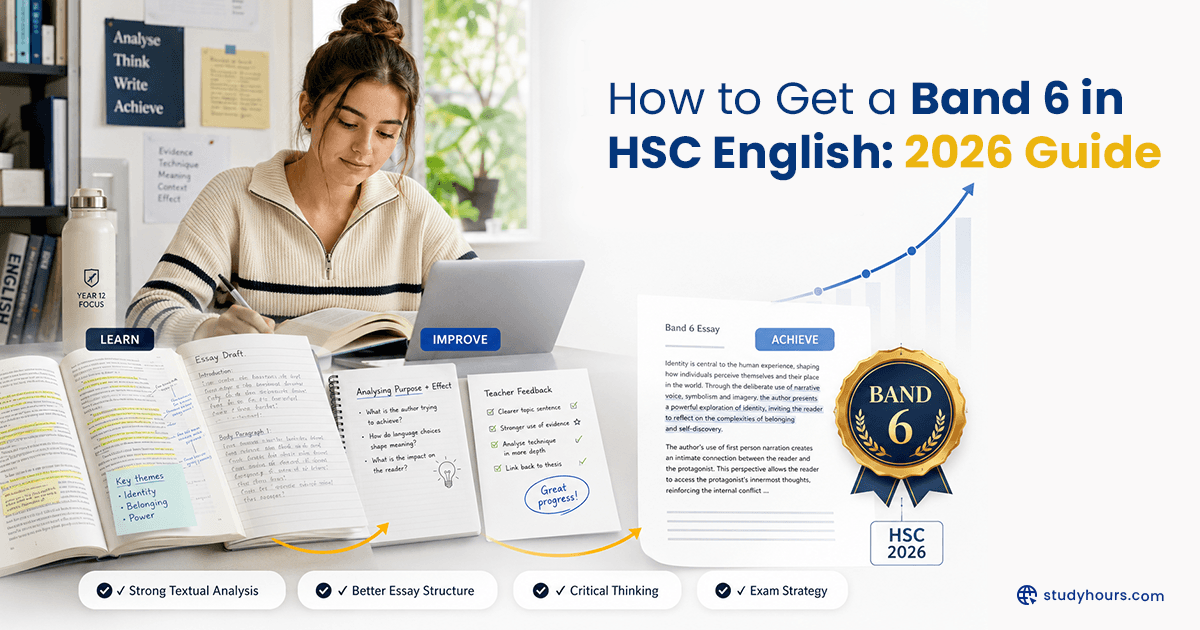
Getting a Band 6 in HSC English is not simply about writing long essays or memorising sophisticated vocabulary.
A strong HSC English response needs to demonstrate that you understand the prescribed text, answer the question directly, develop a clear argument and analyse how the composer creates meaning.
For many students, the biggest challenge is knowing how to turn their ideas into a structured response under exam conditions.
The good news is that these skills can be developed.
Whether you are studying HSC English Advanced, English Standard or another HSC English course, the fundamentals remain important: understand your text, know your syllabus, practise responding to different questions, use relevant textual evidence and explain the effect of the techniques you identify.
If you're looking for broader academic support alongside HSC preparation, StudyHours' online tutoring in Australia provides curriculum-focused tutoring for Australian students, including NSW HSC pathways.
This guide explains practical strategies you can use in 2026 to improve your HSC English preparation and work towards a Band 6.
Important: The exact requirements and prescribed texts depend on your HSC English course and cohort. Always use the NESA syllabus and assessment information that applies to you.
What Is Band 6 in HSC English?
A Band 6 is the highest performance band reported for an HSC course.
However, achieving a Band 6 is not about hitting a simple percentage threshold in every assessment task.
NESA describes performance bands in terms of what students know, understand and can do. Your HSC result reflects your overall performance in the course and examination rather than one isolated essay or assessment task.
For English, this means you need to demonstrate strong skills in areas such as:
Understanding and responding to texts
Developing an argument
Analysing language and textual features
Using evidence effectively
Organising ideas logically
Adapting your response to the question
Communicating clearly and effectively
A Band 6 response should therefore do more than identify techniques.
It should explain how and why textual choices create meaning and connect those choices to the question and your overall argument.
How to Get a Band 6 in HSC English
There is no single formula for achieving a Band 6.
However, the following strategies can significantly improve the quality of your preparation.
1. Know Your HSC English Syllabus
Before spending hours memorising quotes, make sure you understand your course.
Your syllabus tells you what you are expected to learn and the kinds of skills you need to demonstrate.
Read the relevant NESA syllabus carefully and identify:
Your prescribed texts
Module requirements
Key concepts
Learning outcomes
Assessment expectations
Examination requirements
If you are studying English Advanced, for example, your preparation should be built around the specific modules and texts prescribed for your cohort.
Why does this matter?
Students sometimes prepare generic essays without considering the actual syllabus.
That can become a problem when an exam question asks you to approach the text from a different perspective.
Instead of memorising one essay, aim to understand the text well enough to construct an argument for different questions.
2. Read Your Prescribed Texts Closely
One of the most important HSC English study tips is also one of the most obvious:
Know your text.
Don't rely entirely on online summaries, study guides or someone else's interpretation.
Read the prescribed text yourself.
As you read, record:
Important scenes
Character development
Major ideas
Relationships
Conflicts
Symbols
Language choices
Structural features
Context
Recurring motifs
Significant quotations
Your notes should help you understand why a particular moment matters, not just what happened.
Instead of writing:
"The character uses metaphor."
Write:
"The metaphor presents the character's changing perception of responsibility, reinforcing the text's broader exploration of identity."
The second approach gives you something you can actually use in an analytical essay.
3. Understand the Difference Between Technique and Analysis
This is one of the biggest differences between an average response and a high-level response.
Simply identifying a technique is not enough.
Basic analysis:
The composer uses repetition.
Stronger analysis:
The repetition reinforces the character's uncertainty and draws attention to the tension between their stated beliefs and actions.
Even stronger analysis:
Through repeated references to uncertainty, the composer positions the audience to recognise the character's internal conflict, revealing how their public certainty contrasts with their private doubts.
The key question is:
So what?
Whenever you identify a technique, ask:
What technique is being used?
What does it emphasise?
How does it create meaning?
Why has the composer used it?
How does it relate to the question?
What does it reveal about the text's broader ideas?
That is where analysis becomes much more sophisticated.
4. Build a Flexible Quote Bank
Memorising quotations can be useful, but don't create a huge list of quotes without understanding them.
Instead, develop a flexible quote bank organised by themes, characters, ideas or textual concepts.
For each quotation, record:
Quote | Technique | Meaning | Possible Themes | Context |
Key quotation | Technique | What it reveals | Related ideas | Relevant context |
Aim to understand several possible interpretations of your strongest quotations.
Don't memorise entire essays
This is important.
A memorised essay may work for a question that closely matches your preparation.
But if the question is unexpected, you may struggle to adapt it.
Instead, memorise:
Key quotations
Core arguments
Important textual moments
Techniques
Contextual ideas
Flexible topic sentences
Then construct your argument around the actual question.
5. Learn How to Answer the Question
You can know your text extremely well and still lose marks if you don't answer the question
Before writing, identify the important words in the question.
For example, suppose the question asks:
"How does the text represent the conflict between individual identity and social expectations?"
Your essay should focus on:
How the text represents the conflict
Individual identity
Social expectations
The relationship between those concepts
Don't simply write everything you know about the text.
Use the question as your roadmap
Your introduction should establish your argument in direct response to the question.
Your body paragraphs should continue developing that argument.
Your conclusion should return to the central idea.
A useful test is:
Could a reader tell exactly what question I am answering from my essay?
If not, your argument may need to be more focused.
6. Write Strong Thesis Statements
Your thesis is the central argument of your essay.
A weak thesis simply repeats the question.
Weak:
The text shows how identity is affected by society.
Stronger:
Through the tension between individual desire and social expectation, the text demonstrates that identity is shaped not only by personal choices but also by the pressures imposed by the surrounding social environment.
The second thesis makes a clear argument that can be developed throughout the essay.
A strong thesis should:
Directly answer the question
Present an interpretation
Establish your main argument
Give your essay direction
Be flexible enough to accommodate your paragraphs
Avoid trying to sound sophisticated simply by using complicated vocabulary.
Clear thinking is more valuable than complicated wording.
7. Structure Your Body Paragraphs Around Ideas
A strong HSC English paragraph should develop an argument rather than become a list of techniques.
A useful structure is:
Point
Introduce the main idea of the paragraph.
Evidence
Use a relevant quotation or textual example.
Analysis
Explain how the textual choice creates meaning.
Connection
Connect the analysis back to the question and your broader argument.
You can think of it as:
Argument → Evidence → Technique → Effect → Meaning → Question
For example:
The composer presents isolation as a consequence of social exclusion. This is reinforced through the recurring imagery of separation, which positions the character physically and emotionally outside the community.
The imagery therefore transforms isolation from a temporary experience into a broader representation of the consequences of rejecting social expectations.
Notice that the paragraph isn't simply:
Technique → Quote → Technique → Quote
It develops an idea.
8. Analyse the Composer's Choices
High-level English responses consistently focus on the composer's deliberate choices.
Instead of writing:
The character is lonely.
Ask:
How does the composer make the audience understand the character's loneliness?
Then consider:
Language
Imagery
Symbolism
Structure
Characterisation
Tone
Narrative perspective
Setting
Dialogue
Form
Visual elements, where relevant
Your analysis should explain the relationship between the textual choice and the meaning it creates.
A useful sentence pattern
Through [textual choice], the composer [verb] the idea of [concept], positioning the audience to [effect/interpretation].
Don't use this mechanically in every paragraph.
Use it as a starting point for developing your own analytical voice.
9. Practise Writing Under Time Pressure
Writing a strong essay at home is different from writing one in an examination.
During the HSC, you have limited time to:
Read the question
Plan your response
Recall evidence
Develop an argument
Write paragraphs
Check your work
This is why timed practice matters.
Start by writing individual paragraphs under time constraints.
Then progress to:
Timed introductions
Timed body paragraphs
Complete essays
Full examination sections
Full examination practice
After each practice session, review your work.
Don't simply ask:
"What mark did I get?"
Also ask:
Did I answer the question?
Was my thesis clear?
Did every paragraph develop an argument?
Was my evidence relevant?
Did I analyse rather than describe?
Did I explain the effect of techniques?
Did I finish within the time?
Where did I lose clarity?
Students who are preparing for several senior subjects can also use StudyHours' Australian ATAR tutoring and strategy support to complement subject-level preparation. The programme covers HSC among the major Australian senior-secondary pathways and focuses on exam technique, study strategy and ATAR planning.
10. Get Feedback and Rewrite Your Essays
Writing an essay once isn't enough.
One of the most effective ways to improve is to rewrite.
Ask your teacher, tutor or another qualified person to identify:
Weak arguments
Unsupported claims
Repetitive analysis
Poor paragraph structure
Irrelevant evidence
Weak expression
Areas where you need more detailed analysis
Then rewrite the weakest section.
Why rewriting works
Your first essay shows what you can currently produce.
Your second version shows whether you can apply feedback.
That process helps you turn feedback into an actual skill.
How to Write a Band 6 HSC English Introduction
Your introduction should be concise and purposeful.
It should generally establish:
Your interpretation of the question
Your thesis
Your main arguments
The text and composer
The direction of your response
Avoid writing a huge introduction filled with historical background that does not directly answer the question.
A useful introduction structure
Context → Text → Argument → Main ideas
For example:
Through its exploration of individual identity and social expectation, [Text] by [Composer] examines the tension between personal autonomy and the pressures imposed by society.
By representing characters whose choices are shaped by competing personal and social values, the composer demonstrates that identity is continually negotiated between individual desire and external expectation.
The exact wording should always be adapted to the question and your prescribed text.
How to Write a Band 6 HSC English Body Paragraph
Your body paragraphs should build your thesis.
A practical structure is:
Topic sentence
Make a clear argument.
Evidence
Introduce a relevant quotation or example.
Technique
Identify the relevant textual choice.
Analysis
Explain how it creates meaning.
Development
Explore the deeper implication.
Link
Connect the paragraph to the question and thesis.
The strongest paragraphs don't treat analysis as an afterthought.
The analysis should be the largest and most important part of the paragraph.
How to Write a Strong HSC English Conclusion
Your conclusion should not simply repeat your introduction word for word.
Instead:
Reinforce your central argument
Bring your ideas together
Address the significance of your interpretation
Return to the question
Keep it concise.
The conclusion is not the place to introduce a completely new argument.
How to Improve Your HSC English Vocabulary
You do not need to use extremely complicated words to achieve a Band 6.
In fact, using sophisticated vocabulary incorrectly can make your writing less clear.
Focus on precise analytical verbs.
Instead of repeatedly writing:
shows
try:
reveals
establishes
challenges
reinforces
critiques
exposes
constructs
positions
represents
foregrounds
contrasts
emphasises
interrogates
destabilises
But remember:
Precision is more important than complexity.
A simple sentence that clearly communicates an insightful idea is stronger than an unnecessarily complicated sentence that says very little.
How to Improve HSC English Essay Writing
If your essays are currently receiving lower marks than you want, don't try to improve everything at once.
Identify your biggest weakness.
If your analysis is weak:
Practice explaining the meaning and effect of individual quotations.
If your structure is weak:
Plan essays before writing them.
If your evidence is weak:
Build a smaller but more useful quote bank.
If your expression is weak:
Read high-quality writing and practise rewriting unclear sentences.
If you don't answer the question:
Spend more time analysing the wording of the question before writing.
If you run out of time:
Complete regular timed writing practice.
Common HSC English Mistakes to Avoid
Memorising Entire Essays
A memorised essay may not answer an unfamiliar question effectively.
Technique Spotting
Listing techniques without explaining their significance does not demonstrate deep analysis.
Overusing Quotes
You don't need a quotation in every sentence. Choose evidence that genuinely supports your argument.
Retelling the Story
Summary tells the marker what happened. Analysis explains why it matters.
Ignoring the Question
Everything in your essay should contribute to answering the question.
Using Complicated Vocabulary for Its Own Sake
Clear, precise writing is better than artificial sophistication.
Writing Huge Introductions
Your introduction should establish your argument rather than consume valuable examination time.
Not Practising Timed Responses
An excellent untimed essay does not automatically translate into an excellent examination response.
HSC English Study Timetable Example
A balanced weekly study schedule might look like this:
Day | Focus | Activity |
Monday | Text study | Analyse one key scene |
Tuesday | Quotes | Review and categorise quotations |
Wednesday | Analysis | Write two analytical paragraphs |
Thursday | Essay planning | Plan responses to practice questions |
Friday | Expression | Improve vocabulary and sentence structure |
Saturday | Exam practice | Write a timed response |
Sunday | Review | Analyse mistakes and rewrite a weak section |
You can adjust this timetable depending on your other HSC subjects and assessment deadlines.
The goal is regular, focused practice, not studying English for hours every day.
How Can HSC English Tutoring Help You Get a Band 6?
Some students benefit from personalized feedback because English improvement can be difficult to manage independently.
For students looking for online HSC tutoring in Australia, StudyHours provides Australian curriculum-focused tutoring and identifies HSC as one of its dedicated senior-secondary pathways.
A good HSC English tutor can help you:
Analyse prescribed texts
Develop stronger thesis statements
Improve essay structure
Strengthen textual analysis
Identify gaps in your understanding
Practise unseen questions
Improve examination technique
Receive personalised essay feedback
Develop a realistic study plan
The purpose of tutoring should not be to give you a memorised Band 6 essay.
Instead, it should help you develop the skills to respond independently to different questions.
How Long Does It Take to Get a Band 6 in HSC English?
There is no fixed amount of time required.
It depends on:
Your current English skills
Your understanding of the prescribed texts
Your writing ability
Your analytical skills
Your previous assessment results
How consistently you practise
The quality of feedback you receive
A student who is already performing strongly may need to focus on refining analysis and exam technique.
Another student may need to spend more time developing foundational writing and comprehension skills.
The important thing is to measure progress against your own weaknesses.
Can You Get a Band 6 Without Memorising Lots of Quotes?
Yes, but you still need strong knowledge of your prescribed texts.
The goal shouldn't be to memorise hundreds of quotations.
Instead, learn a manageable selection of highly useful quotations and textual examples that can support different arguments.
For each quote, know:
Who says it
What is happening
Which technique is used
What it reveals
What broader idea it connects to
How you could use it in different questions
This makes your evidence more flexible.
Conclusion
Getting a Band 6 in HSC English isn't about writing the longest essay, using the fanciest vocabulary or memorising the most quotations.
It is about demonstrating that you understand the text and can communicate an insightful interpretation in response to the question.
Focus on the fundamentals:
Know your syllabus.
Understand your prescribed texts.
Build a flexible quote bank.
Develop clear thesis statements.
Analyse techniques rather than simply identifying them.
Connect every paragraph to the question.
Practise under timed conditions.
Learn from feedback.
Rewrite your weaker responses.
Develop your own analytical voice.
Most importantly, don't judge your potential by one assessment result.
If your feedback tells you that your analysis is descriptive, work on analysis.
If your arguments lack focus, practise thesis writing.
If you run out of time, practise under timed conditions.
If you struggle to remember evidence, build a smaller and more useful quote bank.
Good HSC English results come from deliberate practice, not last-minute memorisation.
With a clear study strategy and consistent effort, you can build the skills needed to produce stronger HSC English responses and work towards a Band 6.
Frequently Asked Questions About Getting a Band 6 in HSC English
1. What is the best way to get a Band 6 in HSC English?
Focus on understanding your prescribed texts, answering questions directly, developing a clear thesis, analysing textual choices, using relevant evidence and completing regular timed practice.
2. Is a Band 6 in HSC English hard to achieve?
A Band 6 represents a high level of performance, so it requires consistent preparation. However, strong analytical writing, text knowledge and examination technique can be developed through deliberate practice.
3. How many quotes should I memorise for HSC English?
There is no official number you need to memorise. A smaller collection of versatile quotations that you understand deeply is generally more useful than a huge list that you cannot analyse effectively.
4. Do I need sophisticated vocabulary for a Band 6?
No. Sophisticated vocabulary can help when used accurately, but clear and precise expression is more important than using unnecessarily complicated words.
5. Should I memorise a Band 6 essay?
It is better to understand your arguments, evidence and texts than to memorise an entire essay. Examination questions can require you to adapt your response to a particular focus.
6. How often should I practise HSC English essays?
There is no universal number. Regular practice is more important than writing full essays every day. Combine paragraph practice, essay planning, timed responses and full essays.
7. How can I improve my HSC English essay?
Identify your weakest area first. This could be thesis development, evidence, analysis, structure, expression or time management. Then practise that specific skill and use teacher or tutor feedback to improve.
8. Can tutoring help me achieve a Band 6?
Tutoring can provide personalised explanations, feedback and targeted practice. However, no tutor can guarantee a particular HSC result.
9. Is HSC English Advanced harder than English Standard?
The courses have different syllabus requirements, content and expectations. Students should compare the relevant NESA course documentation rather than assuming one course is simply "harder".
10. What should I do if I keep getting low marks in English?
Don't just write more essays. Find out why you are losing marks. Review teacher feedback, identify recurring weaknesses and practise those specific skills.
Published by StudyHours Global Editorial Board