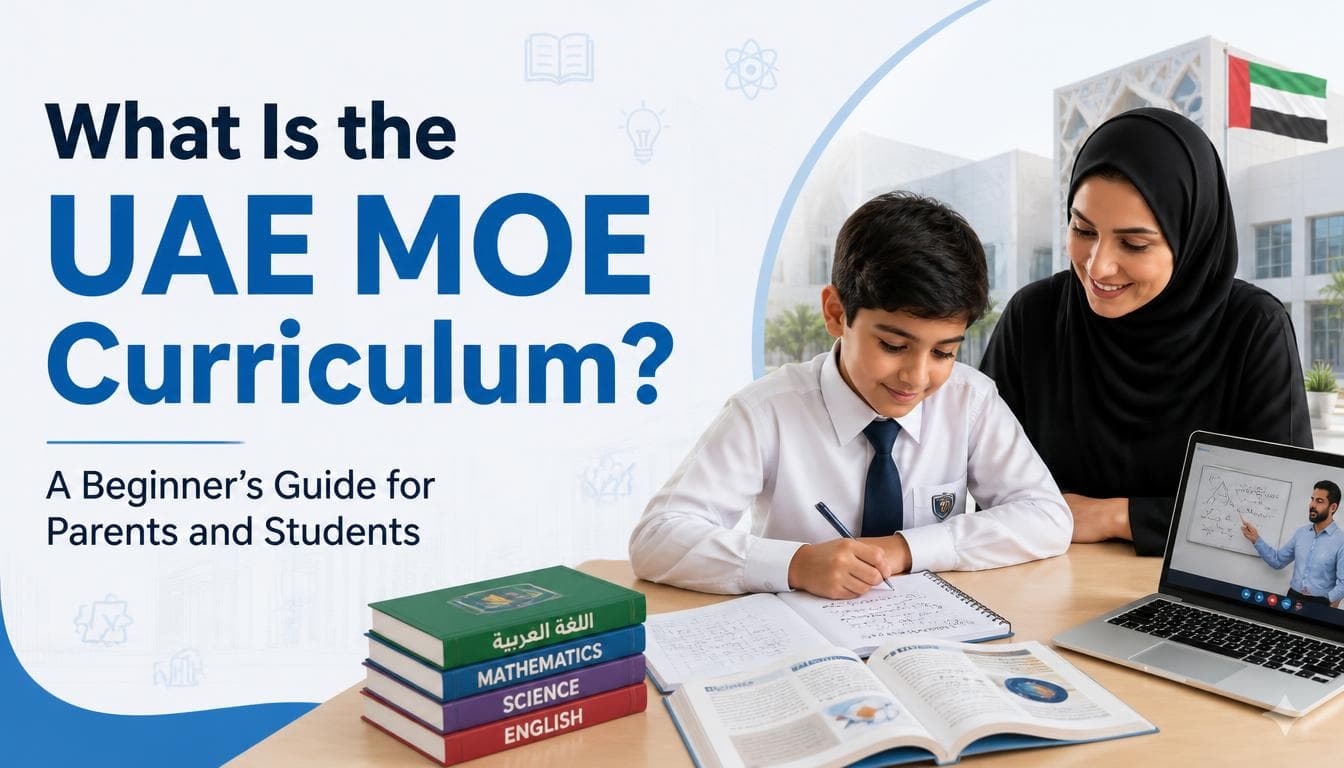
Choosing the right curriculum is an important decision for parents. In the United Arab Emirates (UAE), students can follow different educational pathways depending on their school, family preferences, and future academic goals.
One of these pathways is the UAE Ministry of Education (MOE) curriculum, which is commonly associated with the UAE national education system.
Parents who are unfamiliar with this curriculum may have questions about the subjects students study, how school grades are organised, how assessments work, and what qualifications students can pursue after completing secondary education.
The UAE MOE curriculum provides a structured approach to learning that includes academic subjects, language development, national identity, and the development of skills students need for further education and everyday life.
The exact subjects, learning requirements, and assessment arrangements depend on the student's grade and the applicable Ministry guidelines.
This beginner's guide explains what the UAE MOE curriculum is, how it works, which subjects students may study, and how parents can support their children's academic progress.
What Is the UAE MOE Curriculum?
MOE stands for the Ministry of Education. The UAE Ministry of Education is responsible for developing educational policies and curriculum frameworks for schools that follow the Ministry's programmes.
The UAE MOE curriculum, also known as the UAE national curriculum, provides a framework for teaching and learning across different educational stages.
It covers academic subjects alongside learning objectives related to the country's language, culture, values, and educational priorities.
The Ministry curriculum is implemented in public schools and in private schools that follow the UAE Ministry of Education programme.
The curriculum is designed to support students as they develop foundational knowledge, strengthen subject understanding, and prepare for further education.
However, the UAE MOE curriculum should not be confused with every curriculum available in the UAE.
Many private schools follow international programmes, including British, American, and International Baccalaureate pathways.
Parents should confirm which curriculum their child's school follows before choosing learning resources or additional academic support.
What Are the Main Features of the UAE MOE Curriculum?
Several features help parents understand the purpose of the UAE national curriculum.
Structured learning: Students progress through different grades and educational stages, with learning expectations developing over time.
Core academic subjects: Students study subjects such as Arabic, English, mathematics, and science, according to the applicable programme and grade.
UAE national identity: The curriculum includes learning connected to the country's language, culture, heritage, and values.
Moral and social development: Students may study areas that develop ethical understanding, personal responsibility, and awareness of their communities.
Progress assessment: Schools use assessment methods to evaluate student understanding and identify areas requiring further attention.
Preparation for further education: Students develop the academic knowledge and skills needed to progress through school and consider future educational opportunities.
The precise requirements can change as the Ministry updates its study plans and educational policies.
Parents should consult their school and the official Ministry guidance for the requirements that apply to their child's grade.
Who Follows the UAE MOE Curriculum?
The UAE MOE curriculum is followed by students attending public schools and private schools that implement the Ministry curriculum.
It can serve students from different family backgrounds, including Emirati families and expatriate families whose children attend schools following the UAE national programme.
A student's eligibility, admission arrangements, and language requirements depend on the school and the applicable rules.
Is the UAE MOE Curriculum the Same in Every School?
Not necessarily in every practical detail.
Schools implementing the Ministry curriculum must follow the applicable curriculum and education requirements. However, school arrangements, teaching approaches, available support, and other operational details may differ.
Students may also experience different learning needs depending on their grade, previous education, language proficiency, and academic strengths.
For this reason, parents should check the school's current subject list, assessment arrangements, and study plan rather than assume that every school operates identically.
How Is the UAE MOE School System Organised?
The UAE school system covers education from the early years through Grade 12.
The Ministry organises its study plans around educational stages, with requirements that can differ according to the student's grade and programme.
The cycle structure is commonly used when discussing the UAE MOE curriculum.
Cycle 1: Building Foundational Skills
The early school years focus on developing the basic knowledge and skills students need for later learning.
Students build their reading, writing, numeracy, communication, and problem-solving abilities.
They also begin developing an understanding of science, their surroundings, and their communities.
Arabic language learning is an important part of the UAE educational context. Students also develop skills in other subjects according to the curriculum and grade.
During these years, children benefit from consistent routines, regular reading, guided practice, and encouragement to ask questions.
Parents can support learning by reviewing schoolwork, practising foundational skills, and communicating with teachers when a child experiences persistent difficulty.
Cycle 2: Developing Subject Knowledge
As students progress through school, the curriculum becomes more demanding.
They build on their foundational knowledge and encounter more complex concepts in mathematics, science, languages, and other subjects.
Students are increasingly expected to explain their reasoning, apply concepts to unfamiliar questions, organise assignments, and take greater responsibility for their learning.
This stage is also an opportunity for parents to monitor progress and identify subjects where additional practice may be helpful.
For example, a student who struggles with fractions or basic algebra may find later mathematics topics more difficult if those gaps remain unresolved.
Addressing learning difficulties early can help students approach more advanced work with greater confidence.
Cycle 3: Preparing for Senior Secondary Education
The later years of school involve more advanced subject content and preparation for the next stage of education.
Students develop deeper subject knowledge, prepare for school assessments, and consider their future academic options.
Depending on the applicable programme, students may study different subject combinations or educational streams aligned with their interests and future plans.
The Ministry's official study plan for the 2026–2027 academic year includes guidance for Cycle 3, including general and advanced streams, elective subjects, and procedures for moving between streams.
Parents should consult the latest official guidance and their school before making decisions about subject selection.
Students approaching the end of secondary school should also research university entry requirements early, particularly if they have a specific degree or career pathway in mind.
What Subjects Are Taught in the UAE MOE Curriculum?
The subjects students study depend on their grade, educational programme, and applicable Ministry requirements.
The following subjects are commonly associated with the UAE MOE curriculum.
Arabic Language
Arabic is an important subject within the UAE national education system.
Students develop reading comprehension, writing, vocabulary, grammar, and communication skills.
As they progress, they may work with more complex texts and develop stronger analytical and written-expression abilities.
Students who find Arabic challenging may need support with particular areas, such as reading fluency, sentence construction, grammar rules, or written composition.
Regular reading and writing practice can help students strengthen their understanding over time.
English Language
English lessons help students develop reading, writing, grammar, vocabulary, comprehension, and communication skills.
These abilities can support learning across subjects because students frequently need to understand written instructions, explain their answers, and communicate ideas clearly.
Students who struggle with English may benefit from identifying whether their main difficulty involves vocabulary, reading comprehension, grammar, or written expression.
Targeted practice can then focus on the specific skills that need improvement.
Mathematics
Mathematics develops logical reasoning, numerical understanding, and problem-solving skills.
Depending on their grade, students may study number operations, fractions, decimals, percentages, algebra, geometry, measurement, statistics, and other mathematical topics.
As the curriculum progresses, students are expected to apply concepts to more complex problems.
A student may understand a formula but still struggle to recognise when or how to use it. Working through different question types can help build that ability.
Science
Science helps students understand the natural world through scientific concepts, observation, investigation, and evidence.
The content becomes more advanced as students progress through school.
Depending on the grade and programme, students may encounter topics relating to biology, chemistry, physics, environmental science, and scientific investigation.
Students can strengthen their understanding by learning key concepts, practising relevant questions, interpreting information, and explaining scientific processes in their own words.
Islamic Education
Islamic Education is part of the curriculum for students to whom the relevant subject requirements apply.
The subject may cover religious knowledge, values, ethical behaviour, and other content specified in the applicable programme.
Students should use the learning materials and assessment guidance provided by their school to understand the expectations for their grade.
Social Studies
Social Studies can help students develop an understanding of society, history, geography, citizenship, and the UAE's cultural and national context.
Students may need to remember key information while also explaining relationships, interpreting material, and connecting what they learn to real-world situations.
Creating concise revision notes and practising written explanations can help students prepare for assessments.
Moral Education
Moral Education focuses on developing values, personal responsibility, ethical understanding, and awareness of the wider community, according to the applicable programme.
Students may be expected to reflect on situations, explain their reasoning, and demonstrate their understanding of relevant concepts.
Parents can reinforce this learning through everyday discussions about responsibility, respect, cooperation, and decision-making.
Important: Subject requirements and arrangements can vary by grade and programme. Families should refer to the school's current timetable and the relevant Ministry study plan for the definitive list of subjects.
How Are Students Assessed Under the UAE MOE Curriculum?
Assessment helps schools understand students' progress and determine whether they have developed the knowledge and skills expected at their stage of education.
The exact assessment methods depend on the grade, subject, programme, and current Ministry requirements.
Students may complete classroom assessments, assignments, tests, term examinations, practical activities, or other forms of evaluation where applicable.
Why Is Regular Assessment Important?
Assessments can help identify areas where students are performing well and topics that need further attention.
For example, a student may achieve good results in classroom activities but struggle when asked to solve unfamiliar mathematics problems independently.
This may indicate that the student understands the basic procedure but needs more practice applying it.
Similarly, a student who loses marks in written answers may need to improve how they organise explanations or interpret question instructions.
Understanding the reasons behind assessment results helps students plan their next steps.
How Can Students Improve Their Assessment Results?
Students can adopt several practical strategies.
Review lessons regularly: Revisiting classroom material helps reinforce concepts before assessments.
Identify difficult topics: Students should recognise areas they do not fully understand instead of repeatedly revising material they already know.
Practise relevant questions: Working through questions helps students apply knowledge and identify common mistakes.
Use teacher feedback: Feedback can show where answers need clearer explanations, more accurate calculations, or stronger subject knowledge.
Plan revision in advance: A realistic timetable helps students avoid leaving all their preparation until the last few days.
Ask questions early: Students should seek clarification when a topic remains confusing.
These habits can help students develop a more organised and confident approach to learning.
How Is the UAE MOE Curriculum Different from International Curricula?
The UAE has a diverse educational environment, and families may need to compare the national curriculum with international programmes when choosing a school.
The most appropriate option depends on the student's needs, family preferences, school quality, and future academic plans.
UAE MOE Curriculum vs British Curriculum
The UAE MOE curriculum follows the Ministry's national educational framework.
British curriculum schools generally use programmes based on the British education system, although the exact structure and qualifications depend on the school. Students may progress towards GCSEs, IGCSEs, or A-Levels.
The two pathways differ in their programme structures, subject requirements, and qualifications.
Parents comparing them should review the actual school programmes rather than rely only on the curriculum name.
UAE MOE Curriculum vs American Curriculum
American curriculum schools generally organise learning around an American-style programme, with arrangements varying by school and state or accreditation framework.
Students may earn school credits and a high school diploma, and some schools offer Advanced Placement courses or other additional qualifications.
The UAE MOE curriculum follows the applicable Ministry programme instead.
Families should compare subject choices, teaching approaches, graduation requirements, assessment methods, and future education pathways before deciding which school is appropriate.
Which Curriculum Is Better for Students?
There is no single curriculum that is automatically best for every student.
The UAE MOE curriculum may be appropriate for families who want their children to follow the national education programme.
An international curriculum may suit other students depending on their educational preferences and future plans.
Parents should consider the child's learning needs, language strengths, school environment, and potential university requirements when evaluating the available options.
How Can Parents Support Children Following the UAE MOE Curriculum?
Parents play an important role in helping children develop consistent study habits and confidence in their learning.
Support does not need to involve long hours of supervision. Small, regular actions can help students organise their work and recognise when they need assistance.
Establish a Realistic Study Routine
A regular study schedule can help students balance homework, revision, extracurricular activities, and rest.
Younger children may benefit from shorter study sessions, while older students may need more structured plans covering several subjects.
The routine should be realistic and flexible enough to accommodate school commitments.
Encourage Independent Learning
As children progress through school, they need to become more responsible for completing assignments, reviewing lessons, and preparing for assessments.
Parents can encourage this by helping children set manageable goals and review their progress.
Rather than immediately providing answers, ask children to explain how they approached a problem and where they became confused.
This encourages them to think independently and recognise what they need to practise.
Identify Learning Gaps Early
A student who repeatedly struggles with a subject may have missed an important foundational concept.
For example, difficulties with fractions can affect later algebra, while weak reading comprehension can make it harder to understand questions in several subjects.
Parents can review teacher feedback, discuss difficulties with their children, and speak with teachers when a problem continues.
Identifying the underlying issue can make additional practice more effective.
Maintain Communication with Teachers
Teachers can provide valuable information about a student's classroom performance, understanding, and areas for improvement.
Regular communication can help parents understand whether a child needs more practice, a different learning approach, or additional academic support.
Working together makes it easier to create a consistent plan for the student's progress.
How Can Online Tutoring Support UAE MOE Students?
Some students need additional support beyond regular classroom lessons. They may find a particular subject difficult, need help revising for assessments, or benefit from having concepts explained at a different pace.
Online tutoring can provide individual attention and opportunities for focused practice.
Personalised Subject Support
One-to-one tutoring allows lessons to focus on the student's current learning needs.
For example, a student struggling with mathematics may need to revisit foundational concepts before moving to more advanced questions.
Another student may understand the lesson but need help applying knowledge to assessment-style questions.
A personalised approach can focus on these specific difficulties.
Support Across Different Subjects
Students may need help with Arabic, English, mathematics, science, or other subjects included in their programme.
Support should be matched to the student's grade and the requirements of their school rather than based on a generic international curriculum.
This helps ensure that lessons address relevant concepts and learning objectives.
Preparation for School Assessments
Tutors can help students organise revision, practise appropriate questions, and review mistakes.
They can also help students understand difficult concepts and develop strategies for answering questions clearly.
The aim is to strengthen understanding and independent learning, rather than simply complete homework on the student's behalf.
Choosing Suitable Academic Support
Before choosing a tutor, parents should consider the tutor's subject knowledge, experience with the relevant curriculum, teaching approach, and ability to explain concepts clearly.
Families looking for additional support can explore online UAE MOE curriculum tutoring to learn about tutoring options for students following the UAE national curriculum.
The most useful support is aligned with the student's actual grade, subject requirements, and learning goals.
Conclusion
The UAE MOE curriculum provides a structured educational pathway for students attending schools that implement the Ministry's national programme.
It covers academic learning alongside subjects and educational objectives connected to the UAE's language, culture, and national context.
As students progress through school, they develop foundational skills, strengthen their subject knowledge, and prepare for further education.
For parents, understanding the curriculum is an important first step towards making informed educational decisions.
Checking the school's current requirements, encouraging consistent study habits, and addressing learning difficulties early can help children approach their schoolwork with greater confidence.
When students need additional help, personalised academic support can complement classroom teaching by focusing on the subjects and concepts they find most challenging.
Frequently Asked Questions About the UAE MOE Curriculum
1. What Does MOE Mean in the UAE?
MOE stands for the Ministry of Education. The UAE Ministry of Education oversees educational policies and curriculum frameworks for schools and programmes under its responsibility.
2. What Is the UAE MOE Curriculum?
The UAE MOE curriculum is the national education programme implemented in public schools and private schools that follow the Ministry curriculum.
It includes academic subjects and learning objectives aligned with the applicable Ministry requirements.
3. Which Students Follow the UAE MOE Curriculum?
Students attending UAE public schools and private schools that implement the Ministry curriculum follow the relevant programme. Parents should confirm the curriculum used by their child's school.
4. What Subjects Are Included in the UAE MOE Curriculum?
Depending on the grade and programme, subjects may include Arabic, English, mathematics, science, Islamic Education, Social Studies, and Moral Education. The precise requirements should be confirmed with the school.
5. Does Every Private School in the UAE Follow the MOE Curriculum?
No. Many private schools follow other programmes, including British, American, and International Baccalaureate curricula.
Some private schools implement the UAE Ministry curriculum. Parents should check which programme a school offers.
6. How Is Student Progress Assessed?
Assessment methods vary by grade, subject, and applicable requirements.
They may include school-based assessments, assignments, tests, examinations, or other evaluation methods.
7. How Can Parents Help Children Who Struggle with the UAE MOE Curriculum?
Parents can review teacher feedback, encourage regular study, identify difficult topics, and communicate with teachers.
Additional subject support may also help students address learning gaps.
8. Can Students Receive Online Tutoring for UAE MOE Subjects?
Yes. Online tutoring can provide additional help with relevant subjects and assessment preparation.
Parents should choose support that matches the student's grade, school curriculum, and specific learning needs.
Published by StudyHours Global Editorial Board