Understanding matter is one of the very first and most essential topics in chemistry. If you're studying lower secondary sciences, O-Level chemistry, or getting ready for higher-level science subjects, the Kinetic Particle Theory (KPT) gives us the base for lots of chemistry ideas.
The kinetic particle theory really helps explain why substances are solids, liquids, and gases. It also helps us understand changes of state, diffusion, pressure, and so much more that we see in our daily lives. By knowing how particles act, students can really grasp a wide variety of chemistry subjects more easily.
In this guide, we'll look into the kinetic particle theory, its key points, the four states of matter, and some properties of solids, liquids, and gases.
What Is the Kinetic Particle Theory?
According to this theory, the Kinetic Particle Theory (KPT) is a scientific model that explains the physical properties and behaviour of matter based on the movement of tiny particles.
consists of extremely small particles such as atoms, molecules, or ions. These particles are always moving and possess kinetic energy. The arrangement, movement, and energy of these particles determine whether a substance exists as a solid, liquid, gas, or plasma.
The kinetic particle theory allows scientists and students to understand how substances behave under different conditions, including changes in temperature and pressure.
For example, when ice melts into water, the particles gain energy and move quite freely. When water boils into steam, the particles gain even more energy and spread further apart. These changes may be explained using the kinetic particle theory itself.
Why Is the Kinetic Particle Theory Important in Chemistry?
The kinetic particle theory forms the basis of many Chemistry topics taught in Singapore schools.
Students use this theory to explain:
Changes of State
The kinetic particle theory explains how substances change from one state of matter to another when they gain or lose heat energy. When a solid is heated, its particles gain kinetic energy and vibrate more vigorously until they break free from their fixed positions and become a liquid. Further heating causes the particles to move even faster, allowing them to escape into the air as a gas. When heat is removed, the reverse process occurs, causing gases to condense into liquids and liquids to freeze into solids.
Diffusion
Diffusion is the movement of particles from a region of higher concentration to a region of lower concentration. The kinetic particle theory explains diffusion by showing that particles are constantly moving in random directions. As a result, they naturally spread out over time until they are evenly distributed. Diffusion occurs fastest in gases because gas particles move rapidly and have large spaces between them.
Expansion and Contraction
When substances are heated, their particles gain kinetic energy and move faster. The increased movement causes particles to move slightly further apart, leading to expansion. When substances are cooled, particles lose kinetic energy and move more slowly, causing them to come closer together. This results in contraction. The particles themselves do not expand or shrink; only the spaces between them change.
Gas Pressure
Gas pressure is caused by gas particles colliding with the walls of a container. According to the kinetic particle theory, gas particles move continuously and randomly in all directions. Every collision with the container walls exerts a small force. The combined effect of billions of collisions creates pressure. When the temperature increases, particles move faster and collide more frequently, leading to higher gas pressure.
Heating and Cooling Processes
The kinetic particle theory explains how substances respond to changes in temperature. During heating, particles absorb energy and move faster, increasing their kinetic energy. During cooling, particles lose energy and move more slowly. These changes in particle movement affect the physical state and properties of substances. Understanding heating and cooling processes helps students explain melting, boiling, freezing, and condensation.
Physical Properties of Substances
The physical properties of solids, liquids, and gases can be explained through the arrangement and movement of particles. Solids have fixed shapes because their particles are closely packed and held together by strong forces of attraction. Liquids can flow and take the shape of their container because their particles can move past one another. Gases have no fixed shape or volume because their particles are far apart and move freely. The kinetic particle theory helps explain these differences by examining how particles behave in each state of matter.
Without understanding particle behaviour, many Chemistry concepts become difficult to explain. This is why kinetic particle theory is introduced early and revisited throughout secondary school Chemistry.
What Are the Main Points of Kinetic Theory?
The kinetic particle theory is based on several important ideas about matter and particles.
All Matter Is Made of Tiny Particles
Every substance consists of very small particles that cannot be seen with the naked eye. These particles may be atoms, molecules, or ions, depending on the substance.
Even though particles are tiny, they make up everything around us, including water, air, metals, and living things.
Particles Are Constantly Moving
Particles are never completely still. They are always moving.
In solids, particles vibrate around fixed positions.
In liquids, particles move around one another.
In gases, particles move rapidly and randomly in all directions.
The higher the temperature, the faster the particles move.
There Are Spaces Between Particles
Particles are separated by spaces.
The amount of space depends on the state of matter. Solids have very little space between particles, while gases have large spaces.
This explains why gases can be compressed but solids cannot.
Particles Attract One Another
Forces of attraction exist between particles.
These forces are strongest in solids, weaker in liquids, and weakest in gases.
The strength of these forces affects the physical properties of substances.
Temperature Affects Particle Movement
When a substance is heated, particles gain kinetic energy and move faster.
When a substance is cooled, particles lose kinetic energy and move more slowly.
This principle explains melting, boiling, freezing, and condensation.
What Are the Four States of Matter?
Matter can exist in four main states depending on the arrangement and energy of its particles.
Solid
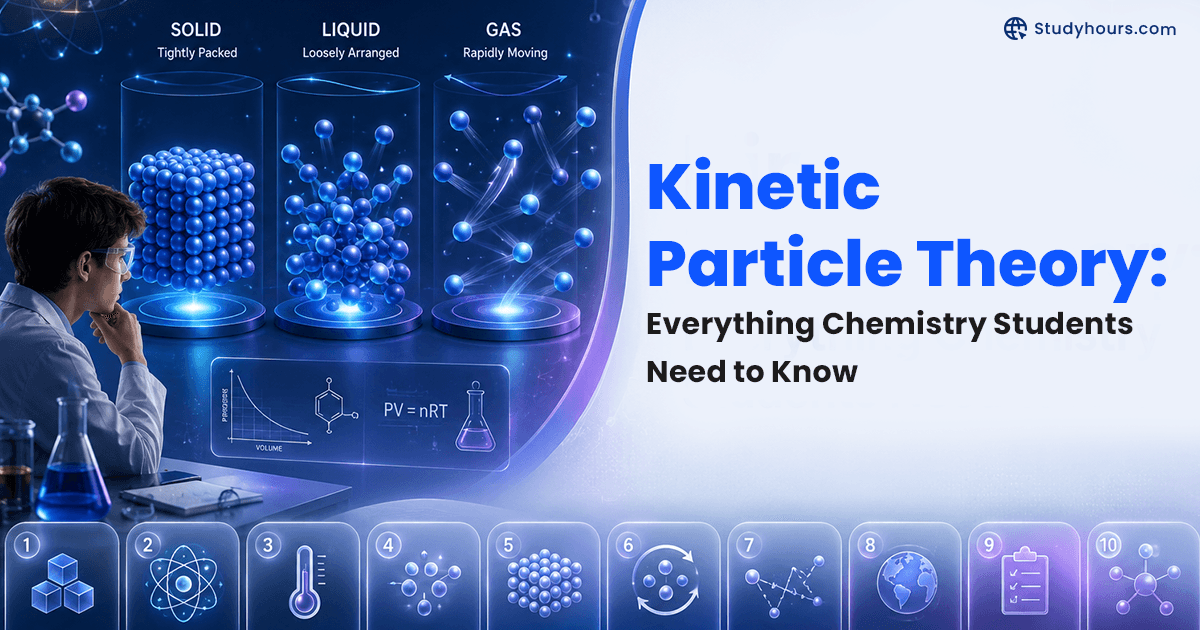
In a solid, particles are packed closely together in a fixed arrangement.
The particles cannot move from place to place. They only vibrate around fixed positions.
Because of this arrangement, solids have a definite shape and a definite volume.
Examples include:
- Ice
- Wood
- Iron
- Salt
The strong forces of attraction between particles keep solids rigid and difficult to compress.
Liquid
In a liquid, particles are close together but are not fixed in place.
The particles can move and slide past one another.
Liquids have a definite volume but do not have a definite shape. Instead, they take the shape of their container.
Examples include:
- Water
- Milk
- Cooking oil
- Alcohol
The forces of attraction are weaker than those found in solids, allowing particles to move more freely.
Gas
In a gas, particles are far apart and move rapidly in random directions.
Gases have neither a definite shape nor a definite volume. They expand to fill any container.
Examples include:
- Oxygen
- Nitrogen
- Carbon dioxide
- Water vapour
The forces of attraction between particles are very weak, allowing particles to move freely.
This explains why gases are highly compressible.
Plasma
Plasma is often called the fourth state of matter.
It forms when gases are heated to extremely high temperatures. At these temperatures, electrons separate from atoms, creating charged particles.
Plasma is commonly found in:
- The Sun
- Stars
- Lightning
- Fluorescent lamps
Although plasma is not usually studied in detail at lower secondary levels, it is important in advanced science and physics.
Summary of the Properties of Solids, Liquids, and Gases
Understanding the differences between solids, liquids, and gases is an essential part of Chemistry.
Shape
Solids have a fixed shape because their particles remain in fixed positions.
Liquids do not have a fixed shape. They take the shape of their container.
Gases have no fixed shape and spread throughout the entire container.
Volume
Solids have a fixed volume.
Liquids also have a fixed volume.
Gases do not have a fixed volume because they expand to fill available space.
Particle Arrangement
Solid particles are tightly packed in a regular arrangement.
Liquid particles are close together but arranged randomly.
Gas particles are far apart and arranged randomly.
Particle Movement
Solid particles vibrate in fixed positions.
Liquid particles move around each other.
Gas particles move rapidly and randomly in all directions.
Compressibility
Solids are almost impossible to compress.
Liquids are very difficult to compress.
Gases can be compressed easily because of the large spaces between particles.
Forces of Attraction
Solids have the strongest forces of attraction.
Liquids have moderate forces of attraction.
Gases have very weak forces of attraction.
How Kinetic Particle Theory Explains Changes of State
Changes of state occur when particles gain or lose energy.
When a solid is heated, particles gain kinetic energy and vibrate more strongly. Eventually, they overcome some attractive forces and melt into a liquid.
When a liquid is heated further, particles gain enough energy to escape the liquid and become a gas. This process is called boiling or evaporation.
When a gas cools, particles lose energy and move more slowly. They come closer together and condense into a liquid.
Further cooling causes particles to lose even more energy, leading to freezing and the formation of a solid.
The kinetic particle theory explains all these changes through particle movement and energy transfer.
Common Student Mistakes When Learning Kinetic Particle Theory
Many students understand the basic concepts but make mistakes during exams.
One common mistake is confusing particle movement with particle arrangement. Students should remember that particles in solids still move by vibrating.
Another mistake is forgetting that particles themselves do not expand when heated. Instead, the spaces between particles increase.
Students also sometimes believe that particles disappear during melting or boiling. In reality, the particles remain the same—only their arrangement and movement change.
Understanding these details can help students answer structured and multiple-choice questions more accurately.
Take Study Hours to Begin Your Chemistry Tuition Journey
A strong understanding of the kinetic particle theory is essential for success in Chemistry. It forms the foundation for many topics that students will encounter throughout secondary school and beyond.
At Study Hours, students receive structured guidance that helps them build strong Chemistry fundamentals. Lessons focus on clear explanations, exam-focused learning, and regular practice to strengthen understanding and confidence. Whether students need help with kinetic particle theory, chemical bonding, acids and bases, or other Chemistry topics, expert support can make learning more effective.
Take Study Hours to begin your Chemistry tuition journey and build a strong foundation for future success in Chemistry.
Get Personalized Help
Match with an expert tutor for your exact curriculum and goals.
FAQ
How does the Kinetic Particle Theory explain diffusion?
Diffusion occurs because particles are constantly moving. They spread from an area of high concentration to an area of low concentration until they are evenly distributed.
Why does diffusion happen faster in gases than in liquids?
Gas particles move much faster and have more space between them compared to liquid particles, allowing them to spread more quickly.
How does the theory explain gas pressure?
Gas pressure is caused by gas particles colliding with the walls of a container. More frequent and forceful collisions result in higher pressure.
Why do substances expand when heated?
When heated, particles move faster and further apart, causing the substance to occupy more space and expand.
What is kinetic energy in the Kinetic Particle Theory?
Kinetic energy is the energy that particles possess due to their motion. Faster-moving particles have greater kinetic energy.
How does the Kinetic Particle Theory explain melting?
When a solid is heated, its particles gain energy and vibrate more vigorously. Eventually, they overcome some attractive forces and begin moving freely, causing the solid to melt into a liquid.
How does the Kinetic Particle Theory explain boiling?
As a liquid is heated, its particles gain enough energy to overcome attractive forces completely and escape into the gaseous state.
What is the difference between particle movement in solids and gases?
In solids, particles only vibrate about fixed positions. In gases, particles move rapidly and randomly in all directions.
What are some common exam questions on Kinetic Particle Theory?
Students are often asked to:
- Compare particle arrangements in solids, liquids, and gases.
- Explain diffusion using particle movement.
- Describe changes of state using the theory.
- Explain expansion, contraction, and gas pressure.
- Interpret particle diagrams and identify states of matter.
Why do students find Kinetic Particle Theory difficult?
Many students struggle to visualise particles because they are too small to see. Using particle diagrams and real-life examples can make the concepts easier to understand.
Is the Kinetic Particle Theory tested in school examinations?
Yes. The Kinetic Particle Theory is a fundamental Chemistry topic and frequently appears in school exams, practical assessments, and national examinations such as O-Level and IGCSE Chemistry.
What is the best way to revise Kinetic Particle Theory?
The best revision methods include:
- Drawing particle diagrams.
- Practising exam-style questions.
- Memorising the properties of solids, liquids, and gases.
- Understanding how particle movement changes during heating and cooling processes.
- Applying the theory to real-world examples.
Final Thoughts
The Kinetic Particle Theory is one of the most important concepts in Chemistry because it explains how matter behaves at the particle level. By understanding how particles are arranged, how they move, and how they respond to changes in temperature, students can better understand many Chemistry topics, including states of matter, diffusion, expansion, and changes of state.
For students in Singapore, mastering the kinetic particle theory is essential for success in lower secondary science and O-Level Chemistry. Rather than memorising definitions, students should focus on understanding how particle behaviour explains everyday observations. This deeper understanding makes it easier to answer structured questions and apply concepts in examinations.
With regular practice and a strong grasp of particle behaviour, students can build a solid foundation for future Chemistry learning and perform with greater confidence in school assessments and national examinations.
Published by StudyHours Global Editorial Board