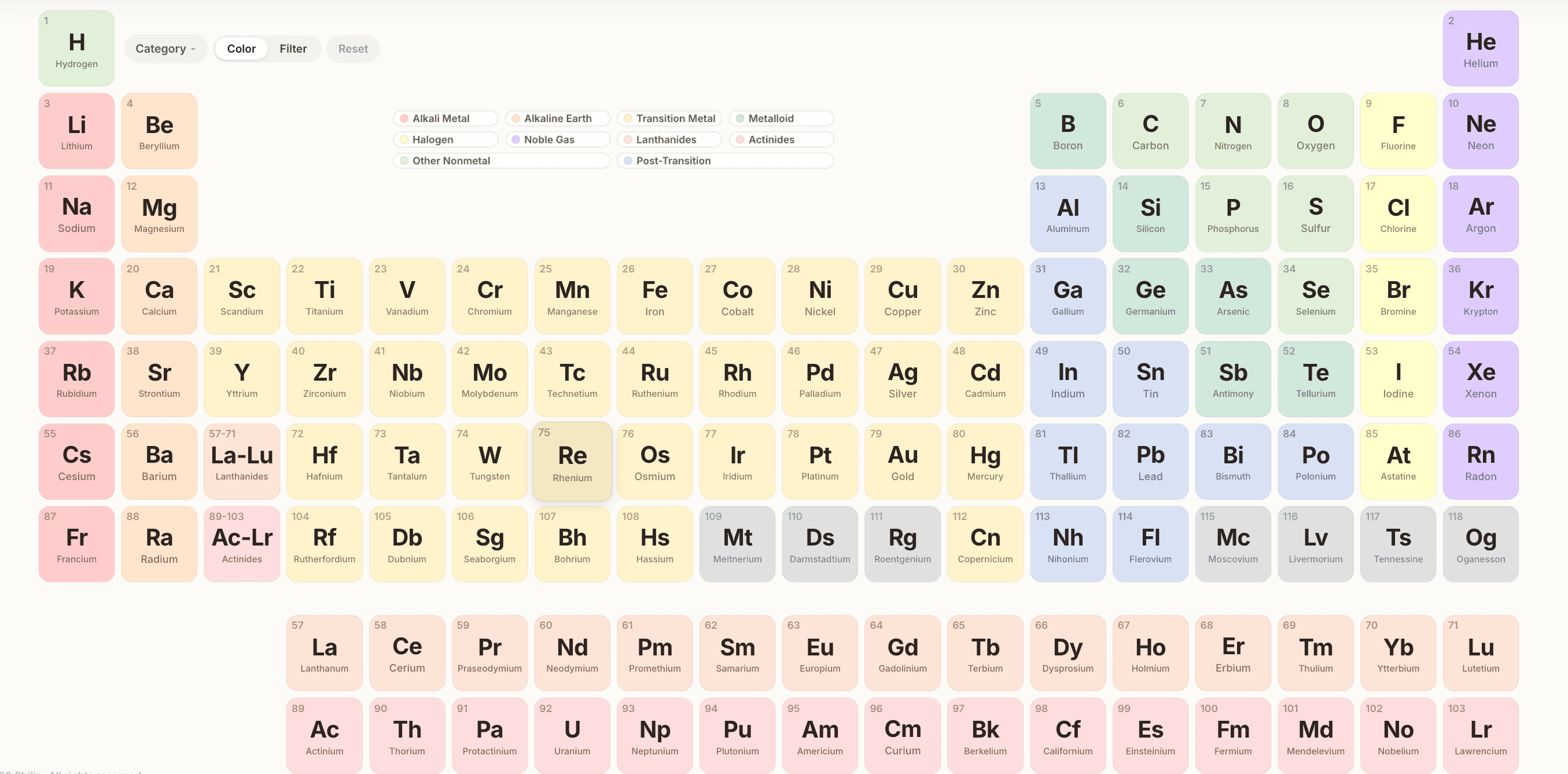
If you've ever stared at the periodic table and felt completely lost — don't worry. You're not alone. Most students see it for the first time and think it looks like a giant, confusing grid with random letters and numbers scattered everywhere. But here's the truth: once you understand the logic behind it, the periodic table practically does your homework for you.
This guide will walk you through everything you need to know — from reading a single element box to using the table confidently in your O-Level Chemistry exam.
What Exactly Is the Periodic Table?
The periodic table is a well-organised chart of all 118 known chemical elements, arranged in order of increasing atomic number. It's not random at all — every element has a fixed position, and elements that behave similarly are grouped together.
The word "periodic" refers to a repeating pattern. As you move across the table, elements with similar properties appear at regular intervals. This pattern is called periodicity, and it's the whole reason the table is so useful.
The first widely accepted version was created by Russian chemist Dmitri Mendeleev in 1869. He arranged 63 known elements by atomic mass, spotted the repeating pattern, and even left deliberate gaps for elements that hadn't been discovered yet. Many of those gaps were filled accurately in the decades that followed — which says a lot about how powerful the table really is.
For you as a student, the practical value is straightforward. Instead of memorising individual facts about every single element, you can use its position in the table to figure out its properties, predict how it will react, and write correct ionic formulae — all from one sheet of paper provided in every exam.
How to Read an Element Box
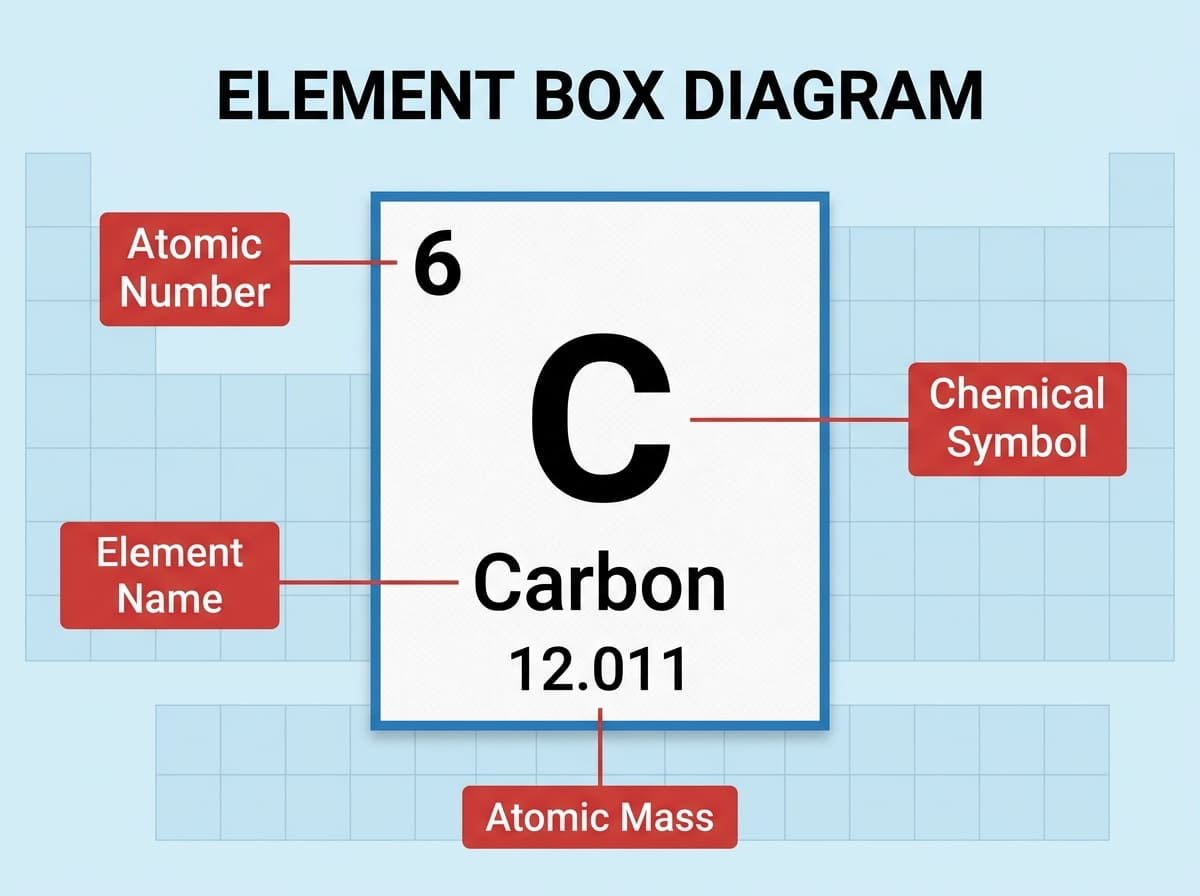
Each element has its own little cell on the periodic table. This cell — called an element box — contains four key pieces of information.
 ### 1. Atomic Number (Top)
The atomic number sits at the top of the box. It tells you the number of protons in the nucleus of that atom. In a neutral atom, the number of electrons always equals the number of protons — so the atomic number gives you both at once.
No two elements share the same atomic number. It's the single value that uniquely identifies every element on the table.
2. Chemical Symbol (Centre)
The chemical symbol is the one or two letter abbreviation in the middle of the box. Many symbols match the English name directly — C for Carbon, O for Oxygen, N for Nitrogen. Others come from Latin names that were used before English became the standard language of science:
- Na for Sodium (from Natrium)
- K for Potassium (from Kalium)
- Fe for Iron (from Ferrum)
It's worth memorising the symbols for the most common elements — they come up constantly in equations.
3. Element Name (Below the Symbol)
The full English name of the element, written below the symbol.
4. Relative Atomic Mass (Bottom)
The number at the bottom represents the relative atomic mass — the average mass of the element's atoms, weighted across all naturally occurring isotopes. Because most elements exist as a mix of slightly different isotopes, this number is usually a decimal rather than a whole number.
Worked Example: Carbon (C)
ComponentValueWhat it meansAtomic number66 protons, and 6 electrons in a neutral atomSymbolC—NameCarbon—Relative atomic mass12.01Weighted average across Carbon-12 and Carbon-13 isotopes
Understanding the Rows (Periods)
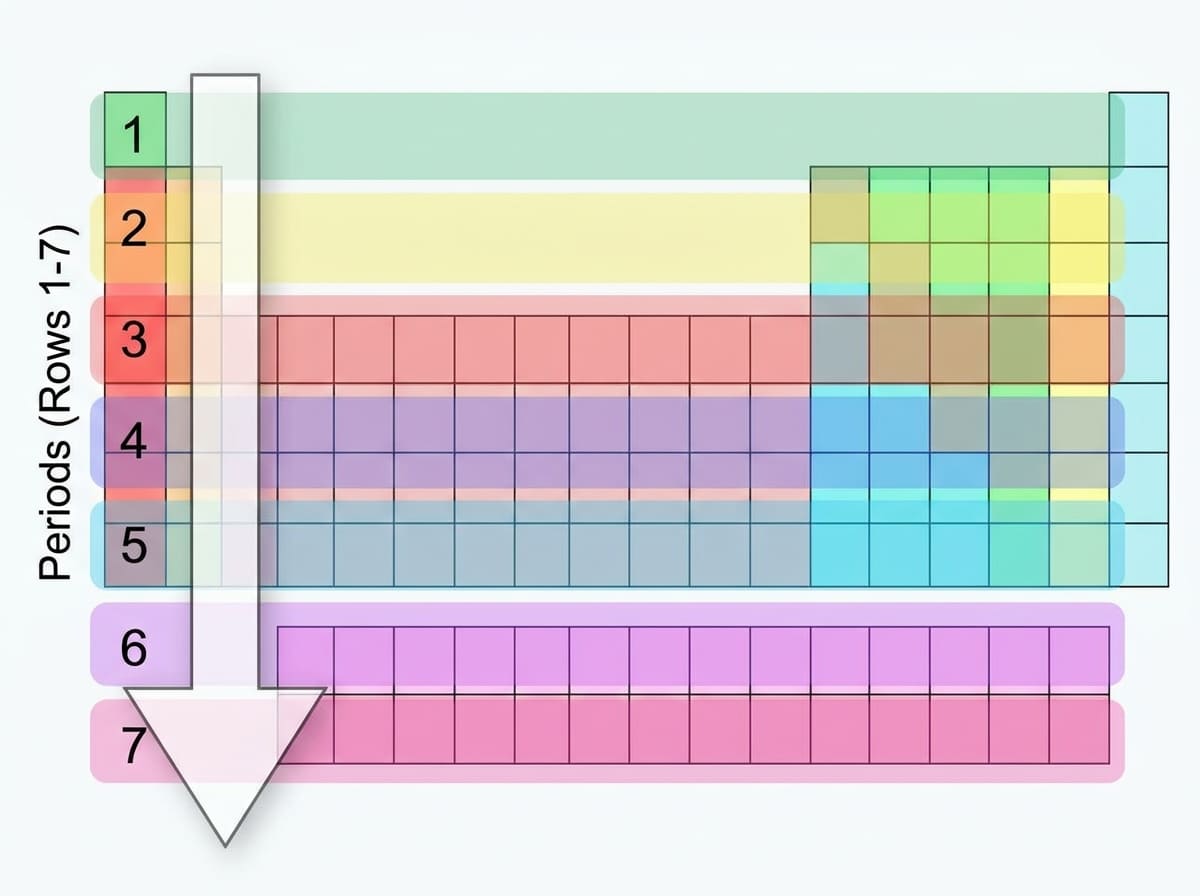
The horizontal rows of the periodic table are called periods. There are 7 periods in total, and they're numbered 1 through 7 from top to bottom.
 ### How Many Elements Per Period?
- Period 1: 2 elements (Hydrogen and Helium)
- Periods 2 and 3: 8 elements each
- Periods 4 and 5: 18 elements each
- Periods 6 and 7: The longest rows, each including one of the inner transition metal series — displayed separately beneath the main table to keep the layout from becoming too wide
The Lanthanide and Actinide Series
Those two rows you see sitting below the main table? Those are the lanthanide series (atomic numbers 57–71) and the actinide series (atomic numbers 89–103). They're moved below simply to save space.
The lanthanide series includes elements like Lanthanum (La), Europium (Eu), and Ytterbium (Yb). The actinide series includes Uranium (U), Plutonium (Pu), and even Einsteinium (Es) — named after Albert Einstein.
The Key Rule for Periods
Here's the one rule you need to remember: period number = number of electron shells.
-
Sodium (Na) is in Period 3 → it has 3 electron shells
-
Carbon (C) is in Period 2 → it has 2 electron shells
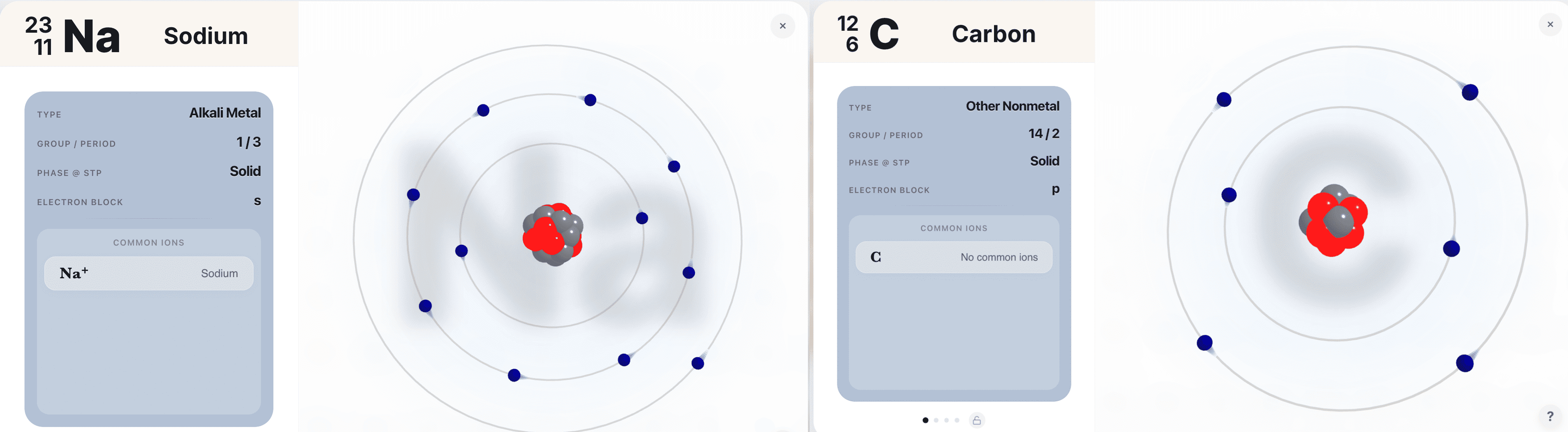
Moving left to right across any period, the number of protons increases by one at each step. The elements also shift in character — metals appear on the left, and non-metals appear on the right.
Understanding the Columns (Groups)
The vertical columns are called groups. There are 18 groups, numbered 1 through 18 from left to right.
Elements in the same group share similar chemical properties because they have the same number of electrons in their outer shell (valence electrons).
Group Number = Valence Electrons
For Groups 1 to 7, the group number tells you directly how many valence electrons an element has. This is one of the most useful shortcuts in all of O-Level Chemistry:
- Group 1 elements have 1 valence electron
- Group 7 elements have 7 valence electrons
- Group 18 (noble gases) have a full outer shell — which is why they're so unreactive
Predicting Ion Charge from Group Number
GroupTypeElectrons lost/gainedIon charge1MetalLoses 1+12MetalLoses 2+23MetalLoses 3+35Non-metalGains 3-36Non-metalGains 2-27Non-metalGains 1-1
Metals, Non-Metals, and Metalloids
Elements on the left and centre of the table are metals. Elements on the right are non-metals. Between them runs a diagonal zigzag line — elements along this boundary are called metalloids (Boron, Silicon, Antimony). They display properties of both metals and non-metals depending on conditions.
Important Patterns to Spot
The periodic table is built around patterns. Once you see them, you can answer a huge range of exam questions without memorising individual facts.
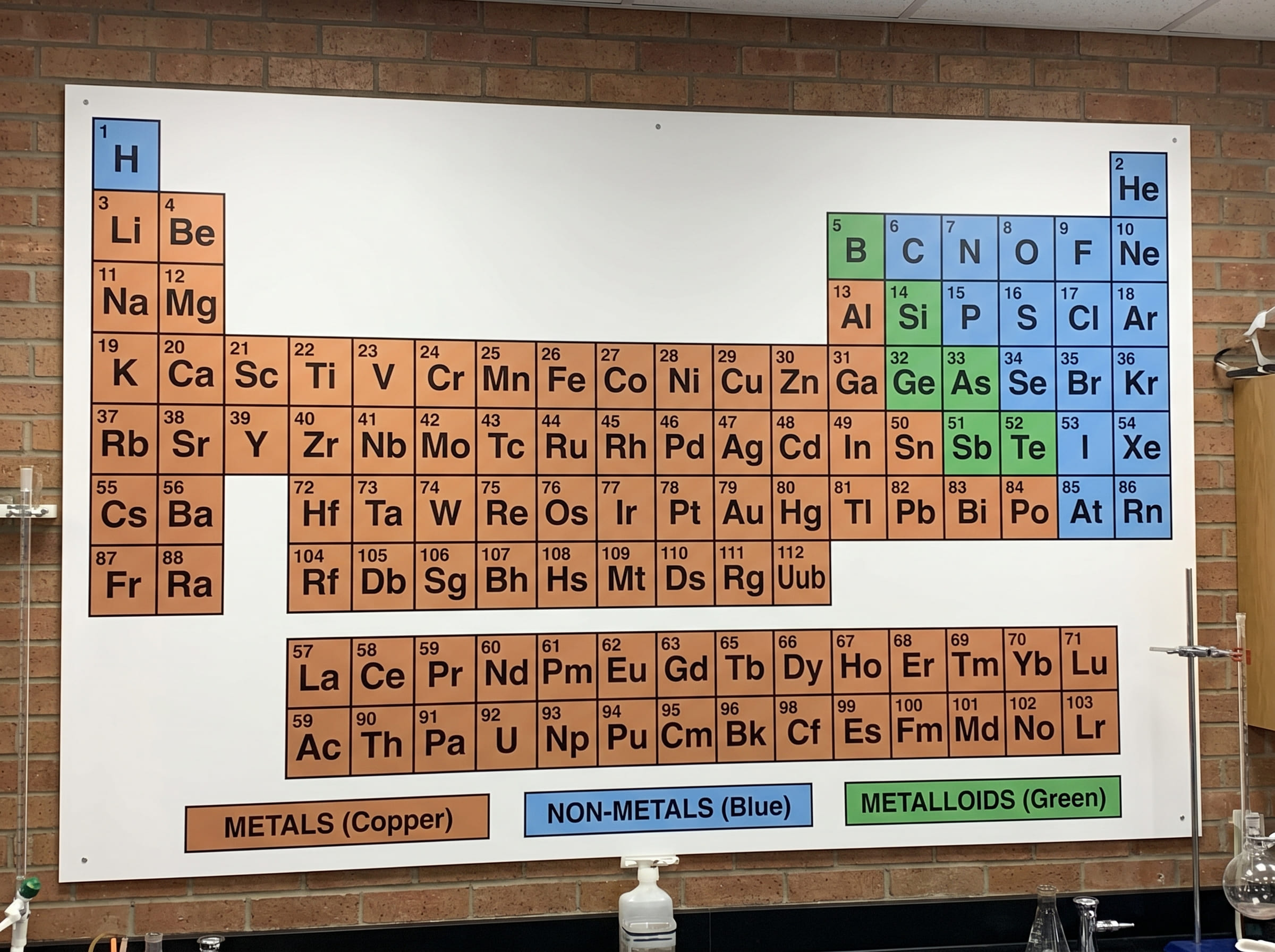
Reactivity Trends
- Group 1 metals: reactivity increases going down the group (Lithium → Caesium)
- Group 17 halogens: reactivity decreases going down the group (Fluorine → Astatine)
Natural vs. Synthetic Elements
Elements with atomic numbers 1 to 94 occur naturally. Elements 95 to 118 were produced in laboratories, nuclear reactors, or nuclear explosions — they don't exist in nature. For the O-Level Chemistry syllabus, only naturally occurring elements are assessed.
The Four Groups You Must Know for O-Level
The Singapore O-Level Chemistry syllabus (6092) tests periodic trends and group properties in detail. These four groups come up again and again.
Group 1 — Alkali Metals
Includes: Lithium (Li), Sodium (Na), Potassium (K)
Physical properties:
- Soft solids that can be cut with a knife
- Low density — lithium, sodium and potassium all float on water
- Shiny when freshly cut, but tarnish quickly on exposure to air
- Low melting and boiling points compared to most metals
Chemical properties:
- One valence electron, easily lost to form a +1 ion
- Highly reactive with water and oxygen
- Stored under oil to prevent unwanted reactions
Key reactions to know:
2Na(s) + 2H₂O(l) → 2NaOH(aq) + H₂(g)
Trend: Reactivity increases from Lithium to Caesium. Melting and boiling points decrease going down the group.
Group 17 — Halogens
Includes: Fluorine (F), Chlorine (Cl), Bromine (Br), Iodine (I), Astatine (At)
[Image placeholder: halogens in test tubes showing colour changes]
Physical properties:
- Each halogen has a distinct colour: Fluorine is pale yellow, Chlorine is yellow-green, Bromine is red-brown, Iodine is grey-black
- Poor conductors of electricity
- State changes going down the group: Fluorine and Chlorine are gases, Bromine is a liquid, Iodine is a solid at room temperature
Chemical properties:
- Seven valence electrons; gain one electron to form a -1 ion
- Exist as diatomic molecules (Cl₂, Br₂, I₂)
- React with metals to form salts
- Reactivity decreases going down the group: F > Cl > Br > I
Halogen displacement reactions come up frequently in exams. A more reactive halogen will displace a less reactive one from a salt solution. For example, Chlorine displaces Bromine from potassium bromide solution, turning the solution orange-brown. Know this reaction type — it's a favourite with examiners.
Group 18 — Noble Gases
Includes: Helium (He), Neon (Ne), Argon (Ar), Krypton (Kr), Xenon (Xe), Radon (Rn)
Physical properties:
- Colourless gases at room temperature
- Very low melting and boiling points
- Exist as single atoms (monoatomic), not bonded pairs
Chemical properties:
- Fully filled outer electron shell
- Extremely low reactivity — they essentially don't form bonds or ions
- Treated as inert for all O-Level Chemistry purposes
Practical uses:
- Helium in balloons and airships — low density and non-flammable
- Neon in advertising signs — glows when electrically excited
- Argon in incandescent light bulbs — prevents the tungsten filament from oxidising
Transition Elements
Common examples: Iron (Fe), Copper (Cu), Zinc (Zn)
Physical properties:
- High melting and boiling points
- High density
- Hard, malleable and ductile
- Excellent conductors of heat and electricity
Chemical properties:
- Variable oxidation states — Iron can be Fe²⁺ or Fe³⁺ depending on conditions
- Form coloured compounds in solution (copper sulphate solution is blue; iron(III) chloride solution is yellow-brown)
- Act as catalysts: Iron in the Haber Process, Manganese(IV) oxide in the decomposition of hydrogen peroxide
How to Use the Periodic Table in Your Exam
The periodic table is provided in every O-Level Chemistry exam paper. You don't need to memorise individual element data — but you do need to know how to use what's in front of you quickly and accurately. Here's exactly how:
1. Find the electron shell countPeriod number = number of electron shells. An element in Period 3 has three shells; Period 4 has four.
2. Determine valence electronsFor Groups 1–7, the group number equals the number of outer electrons. This tells you how an element will behave when bonding or forming ions.
3. Predict ion charge
- Groups 1, 2, 3 → metals lose valence electrons → positive ions (+1, +2, +3)
- Groups 5, 6, 7 → non-metals gain electrons → negative ions (-3, -2, -1)
4. Write ionic formulaeOnce you know two ions' charges, balance them. For example:
- Na⁺ and Cl⁻ → 1:1 ratio → NaCl
- Mg²⁺ and Cl⁻ → 1:2 ratio → MgCl₂
5. Compare reactivityGroup 1 metals become more reactive going down. Group 17 halogens become less reactive. Use position to rank or compare without needing extra data.
Frequently Asked Questions
How do you read the periodic table?Start with the element box. The top number is the atomic number, the central letters are the chemical symbol, and the bottom number is the relative atomic mass. The row (period) tells you how many electron shells the element has. The column (group) tells you how many valence electrons it has.
How many groups and periods are there?The periodic table has 18 groups (columns) and 7 periods (rows), containing 118 elements in total.
What is the difference between atomic number and relative atomic mass?The atomic number is the number of protons — always a whole number, and unique to each element. The relative atomic mass is the average mass of the element's atoms across all isotopes — usually a decimal.
What are the most important groups for O-Level Chemistry?Group 1 (Alkali Metals), Group 17 (Halogens), Group 18 (Noble Gases), and the Transition Elements. These four account for the majority of group-related exam questions in the 6092 syllabus.
Why do elements in the same group have similar properties?Because they have the same number of valence electrons. Electron configuration drives chemical behaviour — same outer electrons, same tendencies in reactions.
Get Personalized Help
Match with an expert tutor for your exact curriculum and goals.
Final Thoughts
The periodic table can look intimidating at first, but it's one of the most logical tools in science. Every piece of information is there for a reason, and once you understand the structure, you can use it to answer questions you've never seen before.
If you're preparing for O-Level Chemistry, start by getting comfortable with just the element box — atomic number, symbol, and mass. Then build up to reading periods and groups. By the time you're revising Group 1 and Group 17, the whole table will start to feel familiar.
Need more support with Chemistry? At StudyHours, our tutors work 1-on-1 with students across IB, IGCSE, and O-Level syllabuses — helping you build real understanding, not just memorise facts.
Published by StudyHours Global Editorial Board