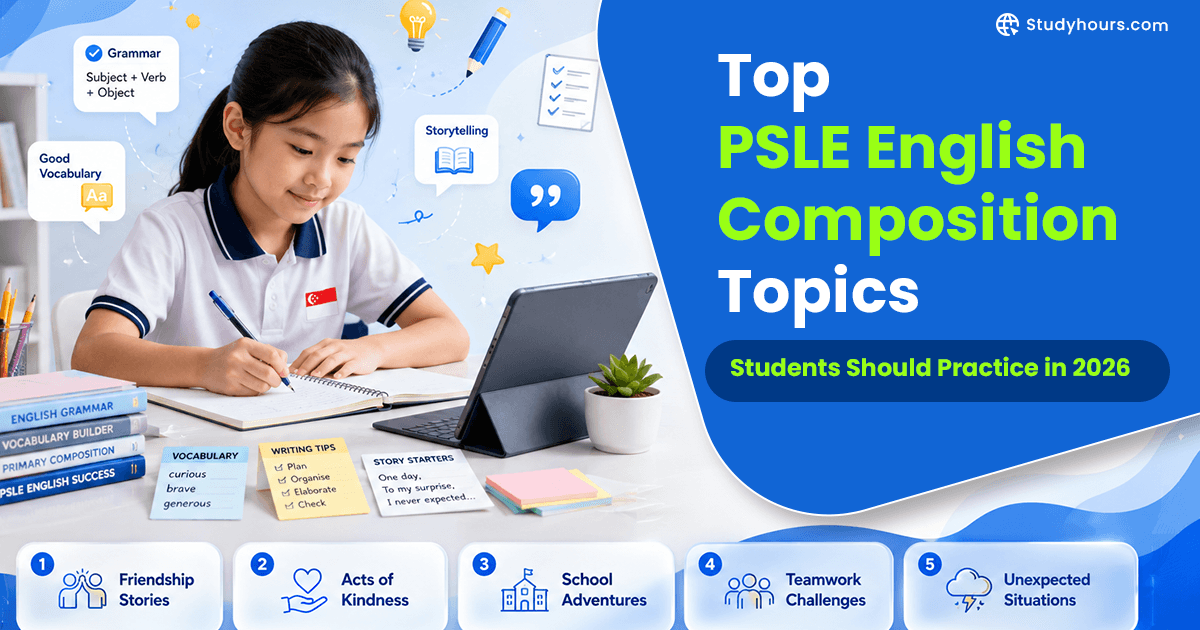
Top PSLE English Composition Topics Students Should Practice in 2026
The PSLE English Composition is a key component of the Primary School Leaving Examination in Singapore. It really assesses how well a student can craft a very clear and quite meaningful story in English itself. For this assignment, students are given a subject matter and have to construct a composition within a set timeframe. The aim here is to demonstrate very clear expression, accurate grammar, and perfect organisation of ideas. This aspect of the test doesn't just evaluate one's language proficiency. It truly evaluates how students think and even plan out things. A commendable composition will exhibit a very discernible structure - having a beginning, a middle section, and an ending. It should also show just how well a student can link up events in a rather logical sequence and express their emotions in a straightforward and clear manner. In Singapore primary schools, the art of composition writing is taught stepwise. Students start off with brief paragraphs in the lower primary levels and progress to entire stories in the upper primary ones. By Primary 6, they're expected to create full compositions all under timed conditions. That's why regular practice with PSLE English Composition topics for 2026 is essential indeed for thorough preparation.
What is PSLE English Composition?
The PSLE English Composition - it's a writing assignment within the English Paper of the Primary School Leaving Examination itself. Students receive a topic occasionally accompanied by a set of pictures or a few hints. They really have to compose a story centred on the provided theme. Examiners look out for many aspects. These comprise grammar, sentence formation, vocabulary, and just how well-organised the story actually is. Nonetheless, the most crucial point is all about clarity itself. The reader really should be able to grasp your story quite clearly from start to finish. A top-notch composition also displays thoughts in a very logical sequence indeed. Events should flow naturally - and the story shouldn't ever seem puzzling or hurriedly written. Students are expected to demonstrate lots of imagination, yet the language really has to be quite straightforward and precise.
PSLE English Composition Topics Students Should Practise in 2026
PSLE composition topics often follow familiar life-based themes. These themes repeat because they test real thinking skills and everyday situations.
A Memorable Journey
This topic focuses on a travel experience. It may start as a normal journey but becomes special due to an event or surprise. Students should describe places, actions, and feelings in a clear order.
An Unexpected Friendship
This topic shows how a friendship can begin in an unusual situation. It may happen in school, during travel, or in the neighbourhood. The focus is on how strangers become friends.
Overcoming a Challenge
This is a common PSLE theme. It may involve a difficult task, a fear, or a problem. The story should show effort, struggle, and success in the end.
A Lesson Learned
This topic focuses on reflection. The student may make a mistake and later understand what went wrong. The story should clearly show personal growth.
A Time I Helped Someone
This topic highlights kindness and responsibility. The student helps someone in need and improves the situation through action.
A Surprise Discovery
This is a creative topic. The discovery may be an object, a place, or a hidden truth. The story should build curiosity and interest.
A Day Without Technology
This modern topic shows life without phones or computers. It tests how students adapt to simple living and real interaction.
An Act of Courage
This topic focuses on bravery. The character may stand up for someone, face fear, or make a brave decision.
A Family Tradition
This topic is related to home life. It may include celebrations, customs, or regular family activities.
An Unforgettable Celebration
This may include birthdays, festivals, or school events. The focus is on strong emotions and memorable moments.
Changing for the Better
This topic focuses on personal improvement. The student may correct their behaviour or develop better habits.
The Long Wait
This topic builds tension. It may involve waiting for results or an important event. The focus is on emotions during waiting.
Trying Something New
This topic explores new experiences, such as hobbies or activities. It often shows growth from fear to confidence.
Finding the Right Direction
This topic may involve being lost or making an important choice. It tests problem-solving and clear thinking.
Tips for Tackling PSLE Composition Topics
Understand the Topic Clearly Before Writing
Read over the composition question several times. Discover your main idea and what the topic really wants from you. Many students lose points because they compose a narrative which looks somewhat related, yet doesn't perfectly fit the theme. Concentrate on the key words in the question and determine what kind of story matches best - before starting out.
Plan Your Story in a Simple Way
Don't jump right into writing. Take a few minutes to think out your story mentally - or even rough it out on some paper. Determine your characters, environment, key occurrence, and final result. Having an easy plan will help you stay concentrated and will really prevent confusion whilst composing.
Use a Clear Beginning, Middle, and Ending
Every PSLE composition really needs to have a very straightforward structure. The start gives us the setting and the characters. The middle constructs the central challenge or event itself. The end sorts out the situation altogether, showing us what occurs next time. An obvious structure makes your narrative quite easy to follow.
Keep Your Language Simple and Correct
Use simple language you're really familiar with. Avoid using very difficult words if you aren't quite sure what they mean. Correct grammar and clear sentences are a lot more important than lots of complicated vocabulary. Simple writing often delivers your message much stronger and clearer indeed.
Stay Focused on One Main Idea
Don't throw a lot of ideas into one story. Focus on one key event and construct your narrative around it. Extra or unconnected information can confound your reader - and decrease clarity. A tightly focused story is far simpler to read - and scores significantly higher.
Show Feelings and Actions Clearly
Good compositions really show what the character feels and does. Rather than just telling us the story, describe actions and emotions in simple terms. This makes the story much more natural and interesting to read.
End Your Story Properly
Always end your composition with a clear conclusion. The ending should either solve the problem or display the outcome of the event. You could also include some simple reflection on what the character learned from that experience.
More PSLE Composition Topic and Title Examples
Unexpected Events Topics
Unexpected events are based on situations where something suddenly changes a normal day. These stories test students' reactions when something unusual happens - and how they bring the situation under control. The focus is on clear events, logical flow, and a simple explanation of cause and effect.
A Sudden Power Failure at Home
This subject matter really begins with an ordinary evening routine. Then, suddenly, the lights switch off - and everything falls into darkness. Your story will show how the student and their family react, what problems they experience without power, and how the predicament is resolved. It requires sharp observation and calm thinking processes.
The Day the School Gate Would Not Open
In this topic, students may find the school gate locked or stuck when they arrive. This really causes confusion and delays getting them to class on time. The story can show how both students and teachers act and what steps are taken to get things fixed. It puts problem-solving skills to the test - especially in a school environment.
A Strange Noise in the Classroom
Building curiosity and a hint of tension is key to this topic. An odd sound interrupts an otherwise normal lesson plan. Students will either feel afraid or curious. The story should then reveal the source of the noise and show how the class reacts. It concentrates on suspense and making everything crystal clear.
Moral and Decision-Making Topics
These topics put a student's ability to make the right choice in a difficult situation to the test. The story should clearly show the problem, the decision made, and the outcome of that decision itself.
A Choice Between Right and Easy
In this topic, the student encounters two alternatives. One path is simpler yet incorrect, and the other much harder yet correct. The narrative will depict how the student thinks and which option they ultimately choose. It will showcase values such as honesty and accountability.
A Time I Had to Tell the Truth
This topic really involves a situation where telling the truth will probably cause you some problems - yet hiding it won't be quite right either. The story really shows your fear, lots of pressure, and ultimately, complete honesty. It actually teaches us why telling the truth is so important - even when it's super hard.
A Promise I Was Tempted to Break
Here, the student makes a promise - but later faces a situation that really makes it hard to keep. The story should show inner conflict, decision-making, and finally, what happens. It focuses on responsibility and commitment.
Helping and Community Topics
These themes really focus on being kind and assisting others. Your narrative really should very clearly present the situation itself, the action you take, and the resultant positive impact.
A Time I Helped a Stranger at the Bus Stop
This subject involves noticing someone really struggling - maybe dazed or hurt. The learner actually assists quite simply, perhaps by calling out for help or giving some directions. It really shows empathy and an understanding of one's environment very well indeed.
A Community Clean-Up That Taught Me Something
In this topic, the student is involved in cleaning their neighbourhood or school surroundings. The story can deal with teamwork, hard work, and what was learned from the experience itself. It really focuses on one's sense of responsibility toward the environment itself.
A Neighbour Who Needed Help
This topic surrounds a neighbour dealing with problems, like illness or doing daily tasks. Students will help directly or not so directly. It really shows kindness and how communities look out for one another.
School and Competition Topics
These topics centre around school life, pressure situations, and group activities. They really test how students handle stress and take responsibility.
The Day of an Important Exam
This topic really explores feelings before and during an exam. The student might be very nervous - but will try their best to concentrate. The story could cover all that preparation, the actual exam itself, and just how it all finishes.
A Competition I Was Nervous About
This topic may involve a speech, sports, or academic contest. The story shows fear at the beginning and confidence during participation. It tests courage and preparation itself.
A Group Project That Went Wrong
Here, teamwork problems might arise. Members may disagree or fail to complete tasks. Your story should display conflict, communication, and how the group resolves its issue.
Personal Growth and Self-Improvement Topics
These topics focus on learning, change, and improvement over time itself. The story should show a clear difference between the beginning and the end.
A Habit I Tried to Change
This topic may be something of a bad habit - like procrastination or carelessness. The student will struggle but gradually gets better. The story really shows effort and self-control.
The Day I Realised My Mistake
In this subject, students understand that an action from their past was wrong. The story really focuses on self-reflection and learning.
A Time I Became More Responsible
This topic demonstrates how a student is given responsibility and learns to manage it effectively. It really focuses on maturity and trust.
Mystery and Curiosity Topics
These subjects really involve unusual or very interesting situations which necessitate an explanation. Your story ought to really build curiosity - and then provide a very clear resolution.
A Locked Box in My Classroom
The pupil sees a locked box and ponders just what's held within it. The narrative really displays curiosity, investigation, and eventually discovery.
The Secret Behind the Old Door
It involves an old or unneeded door at school or at home. The student explores the mystery surrounding it.
A Missing Notebook Mystery
In this story, a notebook vanishes - and the pupil tries to track it down. The focus lies with clues - and solving the problem one step at a time.
How to Start Writing a Good PSLE Composition in 5 Steps
First, you have to grasp the subject itself. Pupils really need to understand what your question asks before they begin composing their response. It will really help them remain quite focused. Secondly, construct your characters and setting. A clear story actually needs both characters and a location - this is where all your story's occurrences take place. Thirdly, work out your main event or problem. Every narrative actually requires one significant concept that pushes the plot along throughout all of its parts. Fourthly, arrange how your story progresses. Your story ought to unfold quite logically from the beginning, through to the middle, and finally to the very end, without any sort of confusion. Lastly, think over how your narrative ends itself. Your ending really should solve your problem and display what your character either learns or emotionally responds to.
Get Personalized Help
Match with an expert tutor for your exact curriculum and goals.
FAQ
Is spelling important in PSLE composition?
Yes. Correct spelling is important. Many spelling mistakes can affect the final score, even if the story is good.
What is tested in PSLE composition writing?
The exam tests several areas at the same time. These include grammar, sentence structure, spelling, vocabulary, and how well the story is planned. It also checks whether the ideas stay relevant to the topic and whether the story is easy to follow.
What types of topics come up in PSLE composition?
Most topics are based on everyday life. They often include situations like helping someone, facing a challenge, learning a lesson, friendship, courage, school life, and memorable experiences. These themes are used because they are familiar to students and test real thinking.
How much time should be spent planning before writing?
Students should spend about 5 to 10 minutes planning. This helps them organise ideas, avoid going off-topic, and write a smoother story.
How should students prepare for PSLE composition?
Students should practise writing regularly and focus on planning their stories before writing. Reading storybooks and paying attention to how stories are structured also helps. It is better to write simple and clear English instead of trying to use difficult words.
Is using difficult vocabulary important for PSLE composition?
No, difficult vocabulary is not required. What matters more is clarity and accuracy. Simple words used correctly are better than complex words used wrongly. The examiner values clear communication over fancy language.
Can students memorise model essays for the exam?
Memorising full essays is not a good approach. The exam tests original thinking based on the given topic. Students should learn how to build stories instead of copying fixed essays.
How long should a PSLE composition be?
There is no strict word limit. However, most compositions are usually between 150 and 300 words. The focus should always be on clear ideas, not length.
How can students improve their writing speed during exams?
Students can improve speed through regular practice under timed conditions. Planning quickly and writing simple sentences helps them complete their composition within the given time.
What makes a PSLE composition score high marks?
A high-scoring composition has a clear structure, relevant content, correct grammar, smooth flow of events, and proper use of language. The story should also stay on topic.
Conclusion
PSLE English composition skills are vital for students in Singapore. It assesses both language proficiency and thinking abilities quite keenly. Common themes like friendships, courage, obstacles, and personal growth appear frequently in exams. Students who regularly practice these topics improve their writing skills greatly - and their self-confidence too. Through clear structure, easy vocabulary, and plenty of practice, students can handle any PSLE composition subject in 2026 - and do well in their exams.
Published by StudyHours Global Editorial Board